
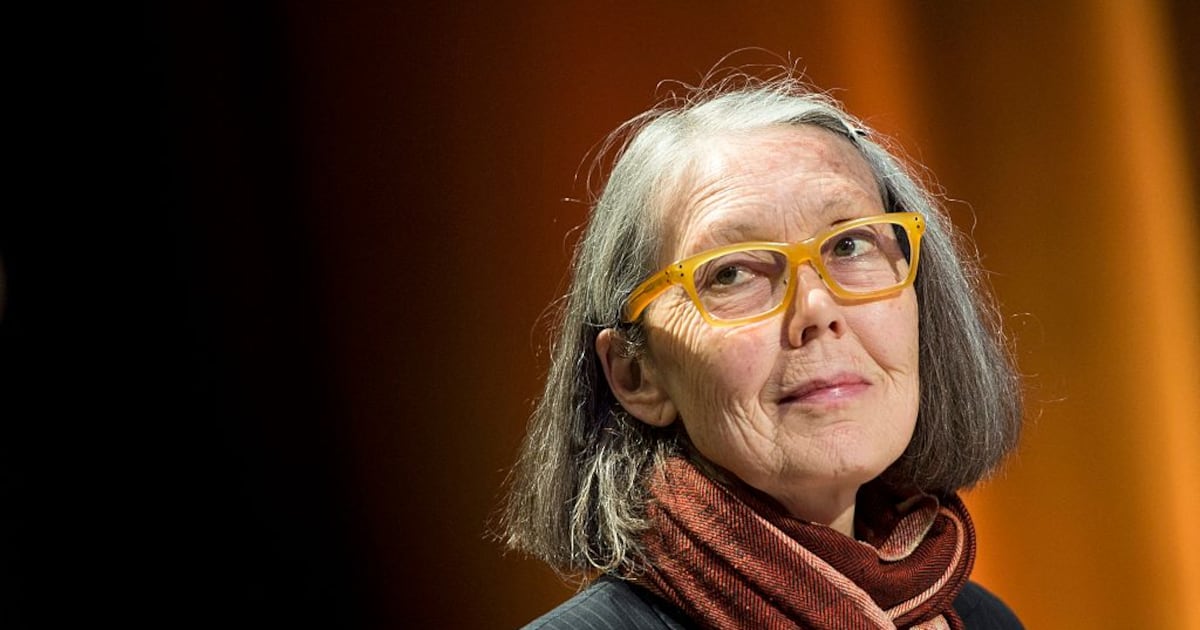
Canadian writer Anne Carson has been awarded the 2026 Nobel Prize in Literature.
According to the Swedish Academy in Stockholm, which awards the prize, Carson won “for her bold and inventive oeuvre that, in playful dialogue with the classical tradition, has created new forms for contemporary literature”.
Carson, who was born in Toronto in 1950, has, throughout her career, combined poetry writing with translation work and teaching classics at various universities in North America.
The 76-year-old writer revealed in a London Review of Books essay in 2024 that she has Parkinson’s disease. “A symptom particularly mortifying to me was that my handwriting disintegrated,” she wrote. “I scrub out whole paragraphs in shame.”
Carson is married to the artist Robert Currie. The couple were granted Icelandic citizenship in 2022.
Former Irish Times poetry critic John McAuliffe, choosing Carson’s Float as his book of the year in 2016, wrote: “Float is the best new ‘book’ I’ve read this year, funny, bleak and urgent, as might be gathered from Carson’s definition of her art: ‘If prose is a house, poetry is a man on fire running quite fast through it.’
“Float collects 22 pamphlets in a clear slipcase, including poems about the death of her older brother, which she so memorably wrote about in Nox (2010), brilliant litanies which draw on ancient Greek poets and 20th-century visual art (and, in one case, the instruction manual for her microwave), funny, theatrical poems for Laurie Anderson and Lou Reed, and cross-genre essays, including the reflection on Francis Bacon, Variations on the Right to Remain Silent, which was initially commissioned by Belinda McKeon and first performed at the Poetry Now festival in Dún Laoghaire.”
A highly-regarded translator of classical writers such as Sappho and Euripides, including her triptych rendering of An Oresteia (2009), Carson has published poems, essays, libretti, prose criticism, and verse novels. Her subjects include love, desire, sexual longing and despair.
Almost all her literary production has centred upon the intersection between the philologist’s obsession with words and the poet’s desire for new meaning, Anders Olsson, chair of the Nobel committee, said, “She has identified the etymology of words as the starting point for all her work.” Her translations from classical Greek include her interpretation of Sappho’s poem fragments, If Not, Winter (2002), along with tragedies such as Sophocles’s Electra (2001) and Antigone (2015) and Euripides’s Bakkhai (2015).
In her long essay Eros the Bittersweet (1986), Carson laid the foundation for her work, Olsson said. She speaks of a “stereoscopic vision” that allows her to “hold in equipoise two perspectives at once”. Her method of writing leads to playful and ironic works that move not only between classical and modern poetry but also between different genres and artforms.
In the 1990s, Carson published a series of notable works such as The Glass Essay in Glass, Irony, and God (1995), which demonstrates the potential of the long poem where genre boundaries are seen to blur. While the work is written in verse form, it is also a long story about grief and unrequited love, in which the first-person narrator, a woman who has been left by her husband, visits her lonely mother in the desolate moorlands. On the journey there, she takes with her the works of her favourite author Emily Brontë, whose own moorlands and inner world are intricately woven into the text. Constructed around three lonely women sitting at a kitchen table, the long poem, which is also a reading of Brontë, is thus transformed into an essay about abandonment.
The same decade saw the publication of another work, often heralded as Carson’s greatest, Autobiography of Red: A Novel in Verse (1998). This demonstrates her eminent ability to actualise the classical literary tradition with a precise feel for contemporary idioms and experiences.
“Carson once described boredom as her arch-enemy, and it is a state she confronts with drastic humour and wit,” Olsson said. The Beauty of the Husband: A Fictional Essay in 29 Tangos, published in 2001, tells of a cutting and sardonic row with a deceitful husband, its 29 episodes each opening with lines of verse by the romantic poet John Keats.
“Carson often crosses over into various artistic and academic fields. Her collaborations with visual artists and choreographers and with opera and theatre directors demonstrate the freedom with which she relates to literary expectations and rule systems. It is this that lies behind the outstanding importance her work since the 1990s has had for the international art and literature scene.”
The Nobel Prize in Literature is worth 12 million Swedish crowns (€1.07 million). The prize was won last year by Hungarian author László Krasznahorkai. There have been 123 literature laureates to date. Carson is only the 19th woman to be awarded the prize.