
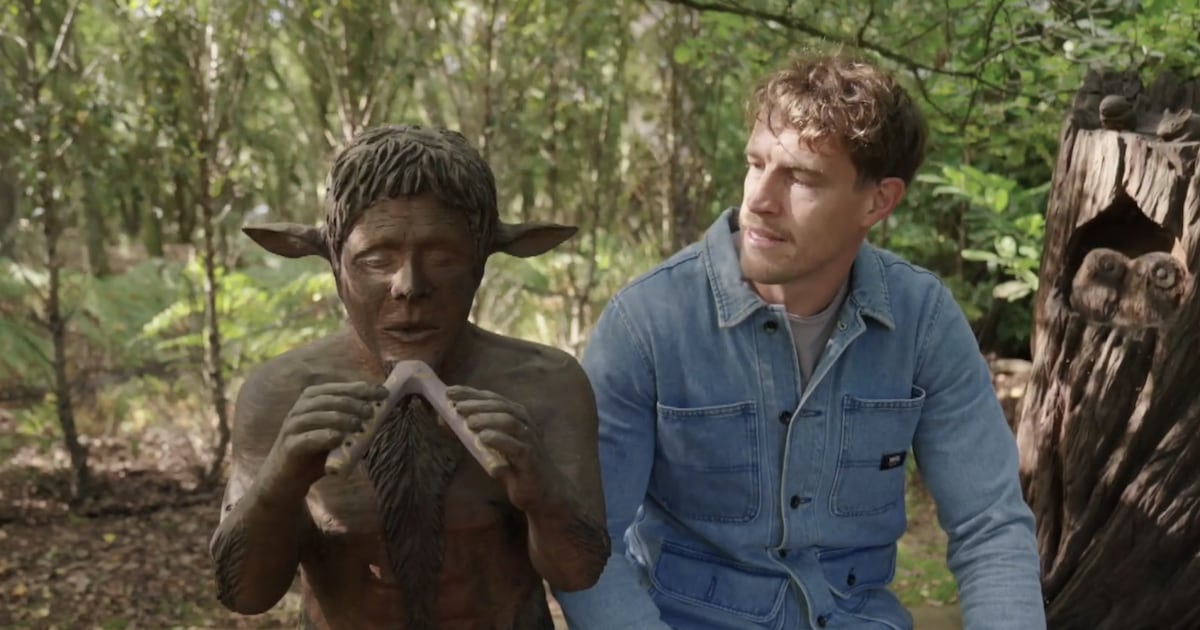
CS Lewis was an author born in Ireland – but can he be considered an Irish author? That is the question posed by ex-rugby international Andrew Trimble in The Lion, the Witch and the Ulsterman (RTÉ One, Thursday, 10.15pm), an engaging documentary in which Trimble, a former Christian theology student from Coleraine, considers Lewis’s complex connection to the island of his birth through the prism of his own multifaceted relationship with Irishness.
Lewis’s Narnia novels have sold in the hundreds of millions and are a key fantasy text, alongside Tolkien’s The Lord of the Rings. Yet despite his stature, he is rarely thought of as an Irish writer, despite growing up in Belfast to a family from Cork.
One reason, Trimble discovers, is that Lewis did not sound Irish. He learns this in Oxford, where Lewis worked as a “fellow” and tutor for 29 years, and where Trimble listens to a recording of the writer from the 1950s. His Britishness is striking. He pronounces “prayer” as “pray-ah” and “idea” as “idea-r” – betraying a thorny relationship with the letter “r” that many Irish people would regard as bordering on the obscene.
“That’s a caricature of an Oxford accent,” Trimble observes to Prof Suzannah Lipscomb. She suspects that Lewis’s Irish accent would have been the first thing to go when he was packed off to an English boarding school aged nine, following the death of his mother. “He went to schools that were brutal to him,” she says. “The Irish accent was probably beaten out of him.”
Yet if he sounded thoroughly British, he retained an abiding fondness for Belfast and its rolling hinterlands, as the amiable Trimble discovers. In a Lewis-themed coffee shop in East Belfast, Prof Margaret O’Callaghan says Lewis would have known growing up that the city was rived with divisions between unionists and nationalists, and suggests he may have taken refuge in flights of fantasy. She says the “escapism into ideal rurality” is a “reaction to a polarised city”.
Lewis is a beloved but controversial figure due to his Christian beliefs – and his enthusiastic use of his fiction as an ideological Trojan horse (in the Narnia books, the wise lion Aslan is a stand-in for Jesus). British fantasy author Philip Pullman was so annoyed by Lewis that he wrote an entire trilogy, His Dark Materials, simply to scold Lewis over his cruel and chilling final Narnia novel, The Last Battle – in which Susan Pevensie is condemned for growing up and developing an interest in lipstick and nylon.
Trimble doesn’t get into the weeds of Lewis’s divisiveness. And he does not quite identify the reason why Lewis is excluded from the pantheon of significant Irish literary figures – which surely has more to do with the lack of any tradition in Ireland of celebrating “regional” authors. It could be argued Frank O’Connor, the Cork Chekhov, receives short shrift for similar reasons – he doesn’t fit in the Dublin bubble and is thus snubbed.
But Trimble never pretends to have the answer and, across a documentary that is as shaggy as a lion’s mane, he proves agreeable company. The best thing that can be said about The Lion, the Witch and the Ulsterman is that – and apologies in advance to Philip Pullman – it makes you want to reach for one of your faded Narnia paperbacks and read it end to end.