
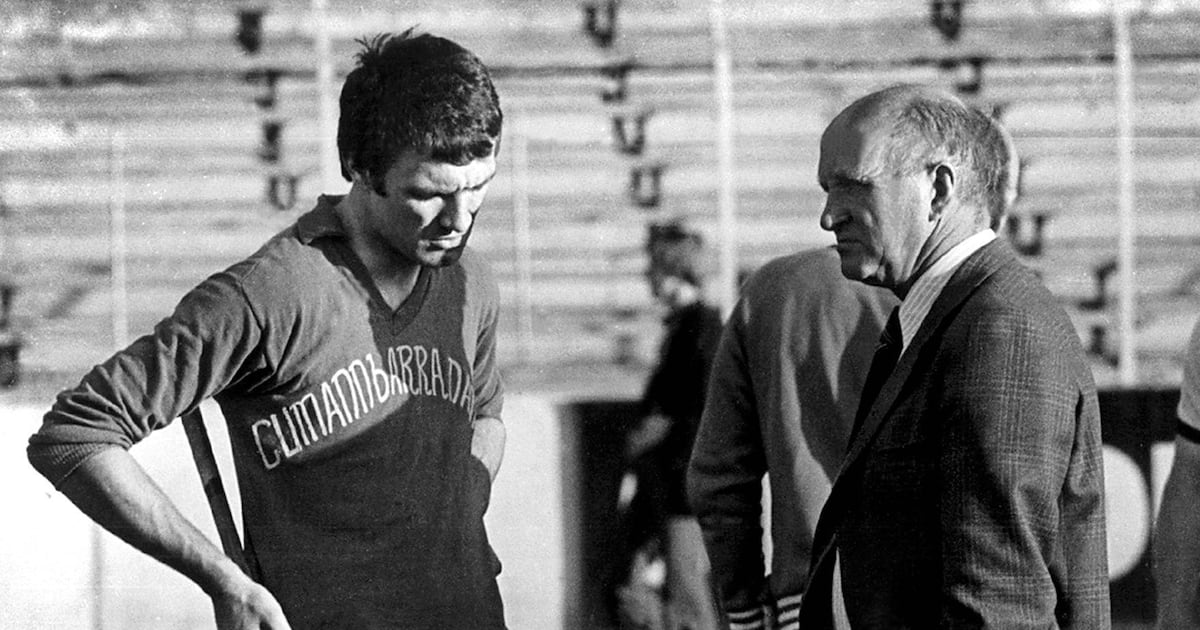
There is a photograph of Jimmy Barry-Murphy and Christy Ring from the summer of 1978 that is evocative and magnetic still. It was taken at a Cork training session in Páirc Uí Chaoimh before the Munster hurling final and published in the Cork Examiner on July 26th, four days before the match.
In the black-and-white shot, Ring is dressed in a suit and tie and JBM is wearing the jersey of his club St Finbarr’s. Neither man is looking at the other. JBM is staring at the ground, with his hands on his hips, which was his default posture when the ball was nowhere near. Ring is looking up at the City End.
“Dual star Jimmy Barry-Murphy and maestro Christy Ring ponder a point of tactics during a Cork training session,” ran the caption in the paper.
The body-language detectives would have copped that the reality was not so banal. JBM has been answering questions about this photograph for nearly 50 years. In an interview with Off The Ball on stage at the Cork Opera House three years ago, he said, playfully, that he had given “50 different versions of the story over the years, but this is the truth”.
“He was giving me a proper dressing down, in a nice way,” said JBM. “He said I wasn’t playing to my potential. I was playing football and hurling, and I was cruising through matches. If we were to win another All-Ireland, I literally needed to pull my socks up.”
JBM says that he has signed more copies of that photograph than any other piece of memorabilia from his career. It hangs in pubs all over Cork and in other pubs around the world where Cork people have left a trace. If you were never curious about the words that passed between them, it is an image of two of the most cherished sportspeople in Cork’s history, frozen in another time.
Photographs that live independently of digital devices still have that power: not just as a public portal into a dreamy past, but as safe houses for nostalgia.
It comes to mind now because JBM’s club St Finbarr’s and Ring’s club Glen Rovers will meet in the Cork county final on Sunday. Around the time the photograph was taken, the Glen and the Barr’s captured four club All-Irelands between them in five years. It was a staggering period of Cork dominance during which the three big city clubs – including Blackrock – reigned supreme.
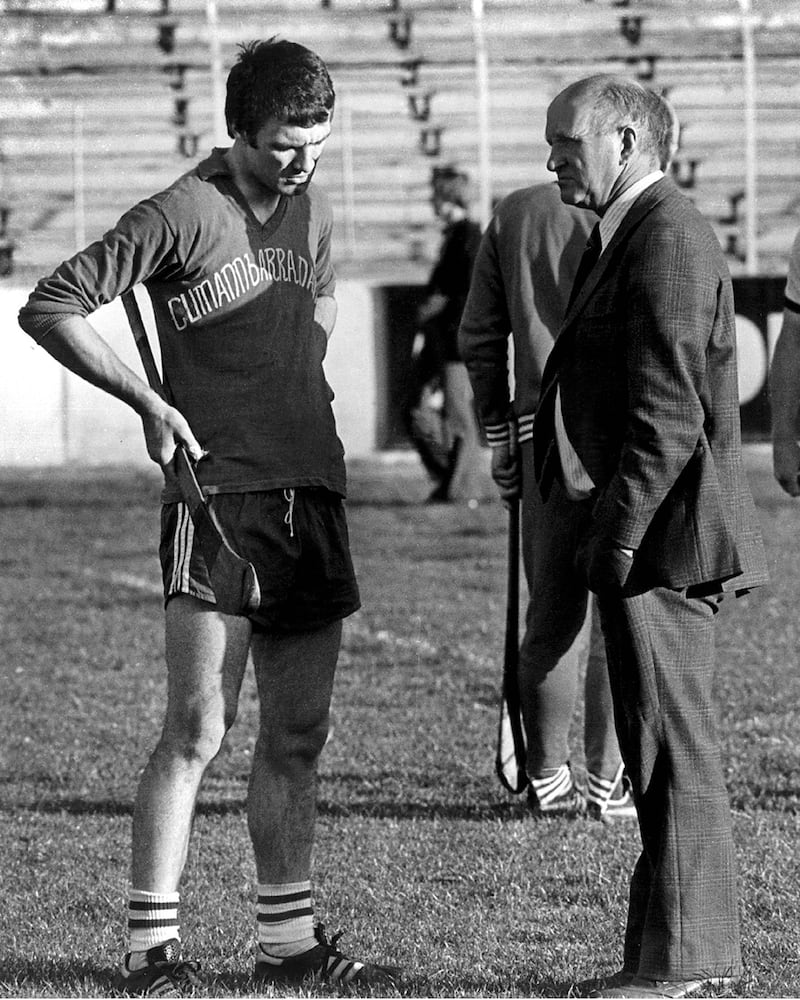 Jimmy Barry-Murphy says he has given countless versions of what is being said in this photo with Christy Ring from 1978. Photograph: Irish Examiner
When the Glen and the Barr’s met in the 1977 county final, the Glen were reigning All-Ireland champions. Just a fortnight earlier, Cork had completed the middle leg of what would become three-in-a-row and the old Páirc Uí Chaoimh was only a year old, a model of modernity. All of it reeked of what is now a lost empire.
Parts of it are vivid in my memory still because it was the first county final I was brought to and first impressions on a child are often visceral. The official attendance in the Páirc that day was 34,151, which remains a record for a county final anywhere in the country, but the real figure must have been closer to 40,000.
So many people arrived late that a gate was forced open at one end of the ground and it was estimated that 2,000 people flooded in. The official figure also didn’t include schoolchildren, who were admitted for free, and 1,200 five-year ticket holders, who had put their hands in their pockets to help service the debt on the new stadium.
The gate receipts were £23,193, and according to the Examiner, it took six hours to count the money, “under top security”.
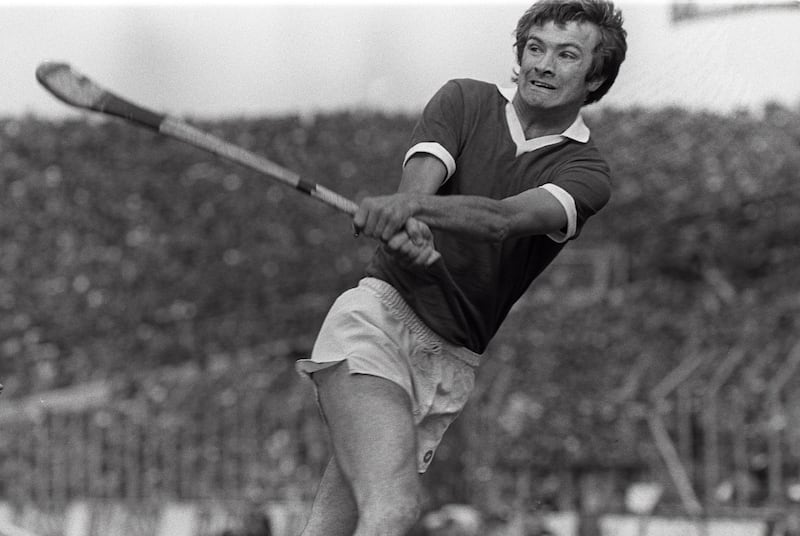 Jimmy Barry-Murphy shoots for a point while playing for Cork in 1983. Photograph: Inpho/Billy Stickland
The match programme was a thin pamphlet by modern standards, but its centre piece was an article written by Jack Lynch, the taoiseach of the day and a former Glen player. It must be the only time that a sitting head of government has contributed a piece of personal reminiscence to a county final programme, but Lynch was so embedded in Cork GAA that it probably didn’t seem at all remarkable.
The Barr’s routed the Glen that day, holding them scoreless in the second half, and six months later the Barr’s succeeded them as All-Ireland champions.
The landscape of Cork hurling, and its place in the wider scheme of things, is much different now. The Barr’s and the Glen have won just five Cork titles between them since 1989, and they haven’t met each other in a final since 1988. In the last 38 years, only two Cork clubs have won the club All-Ireland, a staggeringly miserable record.
But none of that will matter on Sunday. County final season is in full swing now and every county final, at every level, everywhere, has a self-contained importance. It doesn’t matter how many people are there, or how many people care; it doesn’t need a context other than itself.
In the GAA calendar, the All-Ireland hurling and football finals are the big feast days, and those occasions have a uniquely national appeal. All-Ireland final day, though, has never been inclusive. County finals have a different nature. Clubs find their level and the prospect of glory has a sustainable existence. Year in, year out, that’s enough.
Anyway, the photograph. By 1978 Ring had made a personal investment in JBM’s Cork career. A couple of years earlier, when the Cork footballers seemed more interested in JBM than the hurlers, Ring championed his case.
There is a famous story from the 1976 All-Ireland final. With 10 minutes left, and the game in the balance, Cork switched JBM on to Mick Jacob, who had been cleaning up at centre back for Wexford. The legend is that Ring made a unilateral decision to move JBM and in the time that remained he scored four points, precisely the difference between the teams.
When Barry-Murphy took off on one of his solo runs, Ring paced him in a parallel run down the Cusack Stand sideline and when the final whistle blew, the RTÉ cameras captured Ring making a dash for JBM and wrapping him in a bearhug. “I knew you’d do it boy,” he said. “I knew you’d do it.”
Five weeks after the photograph was taken at Cork training, Cork beat Kilkenny in the All-Ireland final and JBM scored the goal that broke the game open, 13 minutes from the end.
He may have been looking at the ground, but he was listening.