

Among the small crowd in Santry on Thursday evening for a third-level league game trialling new experimental rules was a Trinity College masters student attending their first ever Gaelic football match.
The fact the fixture ended up as a cricket score (UCD 9-19 Trinity College 1-9) might have been puzzling enough, but how do you explain that UCD’s nine goals were worth 36 points in new money but only 27 in old money?
Either way, the GAA newcomer did get to experience a game of Gaelic football in which foot-passing was a dominant skill, present in pretty much every phase of play. The limit of three consecutive handpasses certainly had the desired impact of showcasing a sport with more kicking.
The players were visibly and audibly more aware, and anxious, of that rule than any of the others put forward for experimentation by the Gaelic football Expert Advisory Group (EAG).
They counted handpasses aloud mid-play and, on receiving one, their immediate impulse was to look to make a kick-pass.
So conscious of the rule were both teams that over the course of the entire match there was only one violation – by UCD in the opening play of the second half.
A handpass violation during a Gaelic football match, played under new rules, between UCD and Trinity in Santry, Dublin. Video: Gordon Manning
Several early, long kick-passes inside led to scores at either end and players were certainly taking on passes they wouldn’t have under the traditional rules.
However, the increase in kick-passing didn’t massively change the pattern of the game from what would be the norm under the old rules. There was still plenty of lateral build-up play, only, rather than hand-passing across the arc, players were instead moving the ball from side to side by kicking.
On a couple of occasions players were caught on the third handpass and delivered the next offload with an unnatural, popped kick-pass to a team-mate in close proximity.
Aside from the handpass experiment, the other main takeaways were:
Kick-outs nearly all went long. Providing goalkeepers with the option of only needing to get their kick-out beyond 13 metres rather than the 40-metre arc actually appeared to stretch the pitch with opposition players tending to loiter inside the arc, prompting the keeper to go long.
Trinity went short with three restarts, UCD didn’t go short once.
There were two backcourt violations – one from each team. No scenario occurred where the ban on a fisted point was tested and yet there were two fisted/palmed goals during the game – when balls were centred across the face of the goal and slapped mid-air by a player into the net. Under the trial rules, those goals are still permitted.
Charlie O’Connor was superb in the middle of the field for UCD while Ben Hanafin, Conor Broderick and Donal Daly were among their goalscorers. James McBreen netted Trinity’s goal.
Overall, it was a generally positive night for the experimental rules but the one-sided nature of the match must frame any analysis. It is impossible to argue the rules received a rigorous road-test over the course of the hour in Santry.
And if the Kevin McStay-chaired EAG hoped momentum would organically grow behind various rules, Thursday night proved how tricky it might prove to gain a consensus.
Because the general feeling of those on the small terrace was that the limit on handpasses had a positive impact on the spectacle – we were treated to some superb long foot-passing and both teams constantly looked to move the ball forward early.
However, after the game several players suggested the game felt stunted and less natural because of the limit on handpasses.
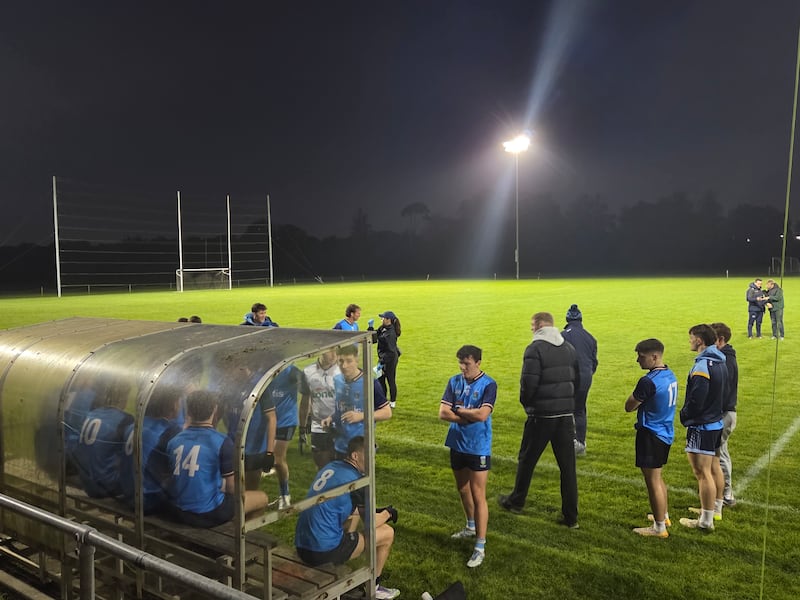 UCD players at half-time. Photograph: Gordon Manning
“To be honest I’m not a fan of it,” said Trinity midfielder Tom McCarroll.
“The new rules are encouraging you to try kick forward, but if there’s nothing on you can’t give it. I think there are too many things for the ref to look for, there are too many things going on.
“Even in training, we were working on only doing one handpass at times and just trying to kick it forward, but there is a practical reality to it as well – if it’s not on, you can’t kick it.
“In fairness there was quite a lot more kicking (in the game) than we would normally be used to, but I must say I’m not the biggest fan of it (limited handpass).”
Despite the absence of manager John Divilly, UCD still had a stacked sideline on Thursday night. Current Dublin boss Ger Brennan (who is GAA Executive at Belfield) was in the dugout while former Dublin player Johnny Magee was coaching the team.
“We’ve probably just tried to simplify it as much as we can. We haven’t overly emphasised the new rules because when it comes to the Sigerson it will be back to normal,” said Magee.
“But I suppose the big thing is probably the three handpass rule and being conscious of that.
“It’s about having the lads talking to each other, you could hear them shouting ‘two, two, two’ and letting team-mates know when the kick-pass was on. So, it’s just kind of being conscious of that.”
Experienced intercounty referee Barry Tiernan was the man in the middle and policed the game confidently.
David Coldrick was in attendance as a member of the EAG. Johnny Bradley, head of the GAA’s Games Intellegience Unit (GIU), was also present.
Of all the trial rules, Down native McCarroll feels the four-point goal is one of the most positive – despite it counting against his side on Thursday.
“I’m a big fan of it because it definitely encourages you to go for a goal,” he said.
Magee echoed that sentiment.
“The one thing I do like is probably the four points for a goal, it’s more of an incentive now.
“The two-pointers were obviously a big thing this year and it is great to see the long-range shooting in the game now. But I also think it’s a positive that the reward for a goal has gone to four, it encourages players to go for it more often.”
The data from the round-one games this week in the third-level football league – Ryan Cup – will not be central to the review of the experimentation window.
The GIU has identified 15 fixtures in particular to record and analyse – the eight round-two matches, the four quarter-finals, two semi-finals and the final. The round-one matches are being viewed more as an opportunity for players to familiarise themselves with the rules in a match scenario.
“I think you have to let the old new rules settle a wee bit before you start introducing more,” added McCarroll. “But in fairness I did enjoy it there tonight.”