
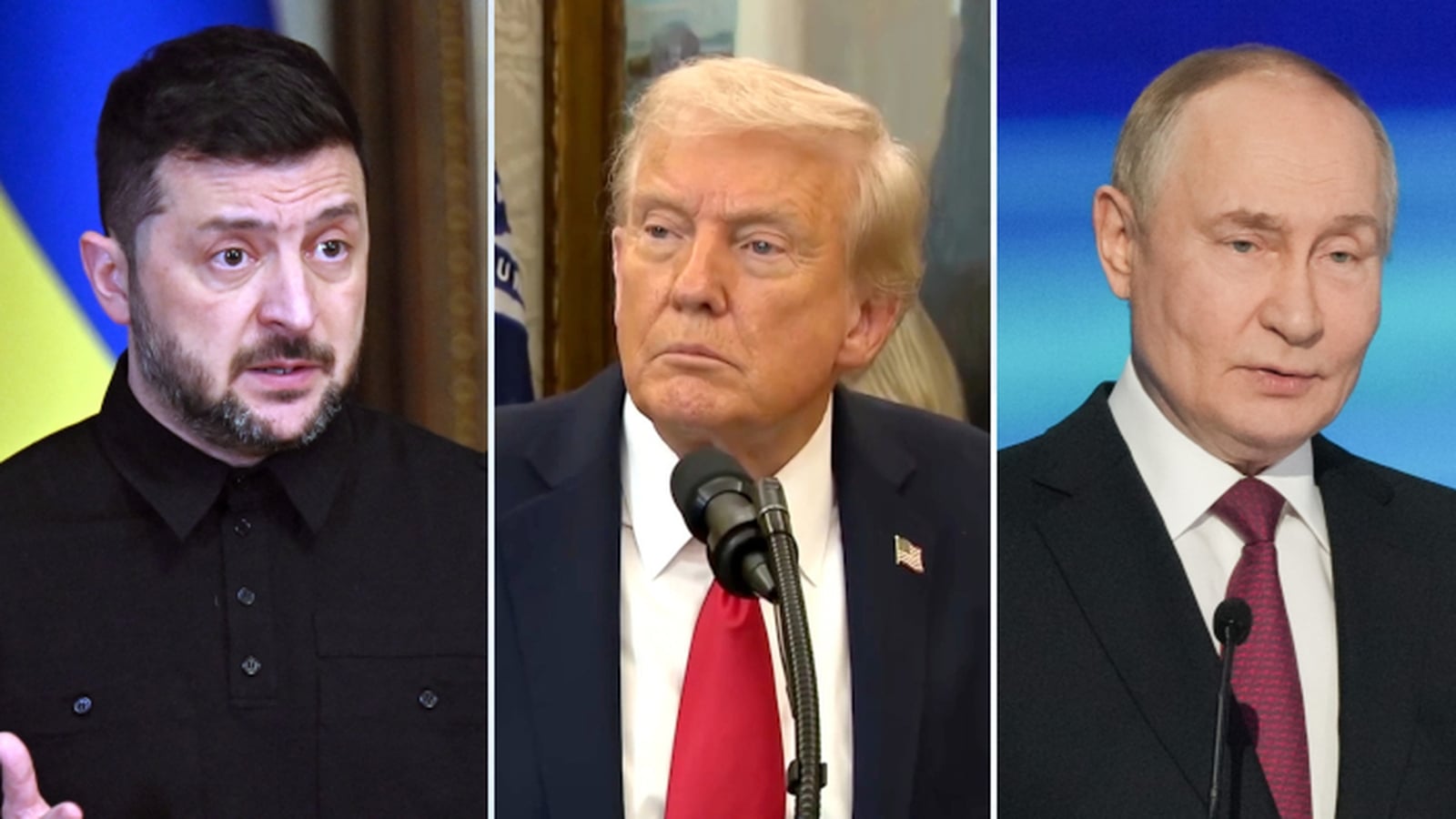
In the week when Volodymyr Zelensky had the worst falling out with Donald Trump since the notorious Oval Office ambush 18 months ago, Ukraine’s president is also facing a grave financing problem for next year.
Both issues dominated his presence at this week’s EU summit in Brussels.
The Oval Office encounter was a straightforward humiliation by the US president and JD Vance; this time around, Donald Trump’s displeasure that Ukraine baulked at stopping attacks on Russian oil refineries had a deadly real-world consequence.
The White House both withheld intelligence about imminent Russian ballistic missile attacks and impeded Ukraine’s access to the Starshield satellite system, meaning that Ukraine’s defence interceptor drones could only fly at 70kmh and were thus no match for Russia’s jet-powered Shahed drones which travel at 400kmh.
Because Russia has been sending waves of such drones since the summer, the death toll is climbing, with over 150 civilians killed in the past 10 days.
While President Zelensky was meeting leaders in Brussels, a Russian drone hit a flea market in Kharkiv, killing two people.
Russia’s escalation is impacting Ukraine’s financial situation.
In September, there were 3,900 Russian air attacks across the country, 65% more than one year ago. Seventy percent were aiming at residential blocks, while there were 145 attacks on energy infrastructure.
They are destroying our logistics first
Russia is broadening its targets with more civilian areas and civilian infrastructure being hit, but also mobile phone networks, passenger trains, petrol stations, grain silos, storage depots, substations and shipping.
Grain and oilseed exports, a mainstay of Ukraine’s economy, have fallen by 30% in the past year, with grain having to be transported by truck; a much more expensive option which has further dented the country’s revenues.
Ukraine had 12 metallurgical and steel-making plants before Russia’s intervention in 2014; today only one is operating, and even that one may close soon. These are important employers and revenue generators.
“They are destroying our logistics first,” finance minister Sergii Marchenko recently told a European Policy Centre (EPC) seminar in Brussels. “Second, they destroy our retail storage. Then they destroy our fuel stations. Now they are specifically targeting our data centers, mobile operators.”
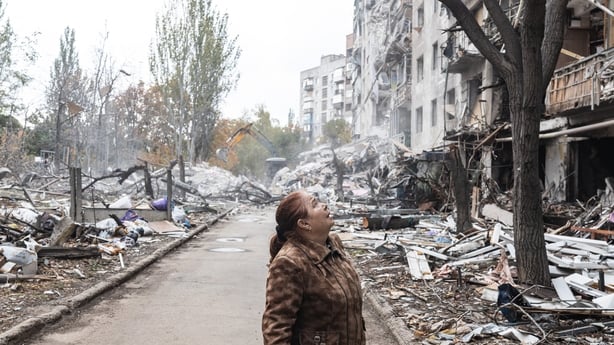
A resident surveys the damage after a Russian air strike in Kramatorsk
Ukraine is running out of money in trying to defend itself against increased attacks; at the same time the Russian stranglehold on the economy is limiting the country’s ability to generate its own income.
“It’s the first time since 2022 that we have had an underperformance in tax and customs administrations,” said Marchenko.
“In September, we expected to have around an underperformance of €400 million, and if we make a projection to the end of the year, it could be several billions.”
Ukrainian officials prided themselves in being able to collect taxes and customs despite nearly five years of a brutal war, one way of showing resilience. But that is now showing real strain – just what the Kremlin’s bombing onslaught is designed to achieve.
Vladimir Putin is also waging war on Europe’s psychological staying power, knowing that in countries where the cost of living is high, shelling out for Ukraine’s survival will become politically ever more toxic.
The greater the economic cost of mass bombing, the more Europe will have to come to the rescue, and the more far right leaders like Marine Le Pen in France and the AfD’s Alice Weidel in Germany will clamour for Ukraine to be abandoned.
This is now a real test of will for EU leaders, knowing that a wave of elections in 2027 could return more eurosceptic, Russian-sympathetic parties to power.
Last December, those leaders agreed a €90 billion loan for Ukraine’s budgetary and military needs for two years.
That is now insufficient.
Ukraine’s finance ministry has said the country needs €70bn to meet its defence needs in 2027, €40bn of which is so far unfunded.
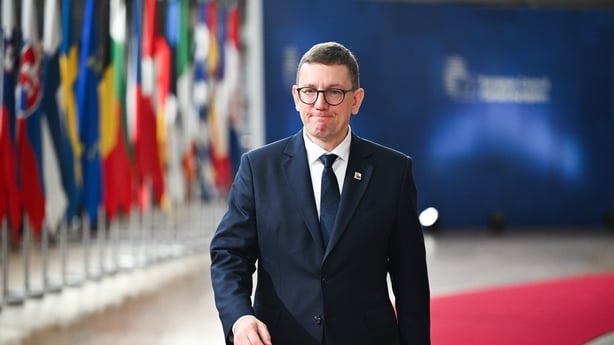
Kristen Michal, Estonia’s prime minister said Europe had to continue to provide financial support to Ukraine
Estonia’s prime minister Kristen Michal told Reuters on Friday: “European financial assistance has to be there. Financial assistance in the war of attrition is the alpha and omega. You have to keep it up… That has to come from the European Union.”
The European Commission is currently assessing Ukraine’s financial needs. As well as the €90bn loan agreed last December, the EU has committed to a further €100bn in support via the long-term budget (2028-2034).
G7 finance ministers and central bank governors also pledged further support on the margins of the IMF and World Bank Annual Meetings in Bangkok, an amount which could rise to $25bn by the end of 2026.
Given the hole in Ukraine’s finances next year, those immobilised Russian assets have come back into the frame.
Some €210bn in Russian central bank assets were immobilised just days after the invasion in February 2022. Around €185bn of those assets have been held in the Belgian securities depository, Euroclear.
Last Autumn, the European Commission proposed using the assets to underwrite a loan to Ukraine that would be repaid by Russia by way of war reparations in the event of a peace agreement.
Belgium argued that using the assets in this way would leave the country at risk of hostile legal action by Russia which, if successful, could mean liability worth tens of billions of euro.
In December, EU leaders tried to convince Belgium to agree, but the financial guarantees prime minister Bart de Wever sought were too prohibitive. Instead, the EU went for a straightforward loan, underwritten by headroom in the EU budget.
By this summer, as Russia’s attacks escalated and Ukraine’s financial situation worsened, senior European Commission figures were talking privately about revisiting the frozen Russian Central Bank Assets.
There was no point in trying to repeat last year’s gambit. However, other options were not immediately apparent.
Last month, an initiative called The Russian Transfer was launched by a group of economists, a French MEP and a former German defence minister.
The group was proposing to move the Russian assets out of Euroclear and into a European Union vehicle in a way that would absolve Belgium of any legal exposure.
The work-around was inspired by the Belgian prime minister’s remark last year that he would be happy for somebody to “take the entire Euroclear balance…. and…sign for all the risks”.
Hugo Dixon, a columnist and campaigner, explained that the proposal was simply to get the immobilised Russian assets out of Euroclear (and any other securities depositories on European soil) as a first step, without explicitly getting the money to Ukraine.
It would be done by moving the Euroclear Russian accounts (not just the assets, but also the liabilities, including its obligation to the Central Bank of Russia) to a new “European Union instrument”.
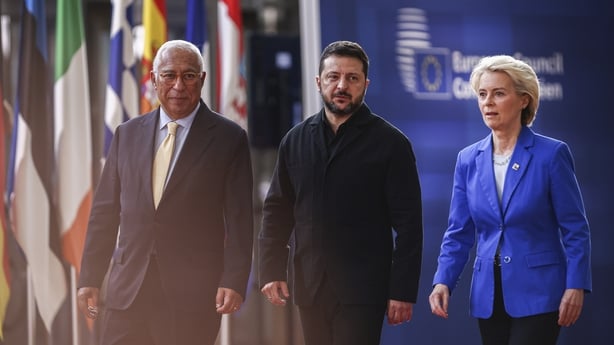
Volodymyr Zelensky (C) attended the European Council summit in Brussels this week
Under this manoeuvre, the European Union would provide protection to Euroclear and Belgium (and any other institution holding Russian assets) through a legal regulation.
That meant that if there was any financial liability thanks to a successful Russian legal bid, then the EU – not Belgium or Euroclear – would be liable.
Dixon said there was a precedent: the decision by the Iraqi government to transfer its central bank assets to an external vehicle after the fall of Saddam Hussein so that it could be used in the country’s reconstruction.
“We’re not trying to pretend that this is an exact parallel to the situation that we face here,” Dixon said, “and we’re certainly not trying to suggest that it can be used to justify a second step, which would involve using the Russian accounts to help Ukraine.
“But we do think it’s very relevant for the first step, which is the transfer itself.”
The idea was given short shrift by Wim Schoutens, a financial engineering expert at KU Leuven University.
He argued that whatever about the technical wizardry involved, it would be perceived by international markets as straightforward confiscation that would pose a risk to the euro in terms of investor confidence.
“Under the proposal, it will be conceived that a high-value, unconditional claim of the Central Bank of Russia against Euroclear is replaced by a conditional claim on Russia paying an equivalent amount in reparations to Ukraine,” he told the EPC seminar, “and this is actually replacing the high-value claim by something conditional, almost worthless”.
He argued that the Iraqi precedent was dubious given that Iraq was then under a UN mandate and that the United States and Iraq had been at war, whereas the EU is not officially at war with Russia.
Dixon responded that the EU, while not at war either with Iraq, had also implemented the mandatory transfer of Iraqi accounts, and that a greater risk to the euro was not investor scepticism but a Russian victory in Ukraine.
It is not clear if the European Commission has examined the option in detail, but it has garnered the support of 122 MEPs and a number of member states.
Ukraine needs this money right now
Senior officials believe it is only a matter of time before the Russian assets are once again part of the debate.
Denmark, Finland and Sweden all raised the issue during the summit. “We have agreed that we will not return the frozen assets unless Russia pays reparations for Ukraine,” the EU’s foreign policy chief Kaja Kallas told reporters on Friday.
“Ukraine needs this money right now.”
Nathalie Loiseau, a French MEP from President Emmanuel Macron’s party and part of the Russian Transfer initiative, said Europe was supporting Ukraine not just for moral reasons, but in the interests of its own security.
She said the freezing of the Russian assets in the immediate aftermath of Russia’s invasion in 2022 were met with threats that “it was illegal, that it was financially unsound, and that the seven plagues of Egypt would fall on Europe. And it didn’t happen”.
She added: “Putin threatened to sue. He did, and he lost. He threatened to sue the decision to use windfall profits. He did it and he lost again. So, threats are one thing; legal reality is another.”
Intriguingly, President Zelensky held a bilateral meeting with Belgium’s Bart de Wever in Brussels on Thursday evening.
The conversation mostly focused on Belgium providing ten F16 fighter jets, which are highly effective at shooting down jet-powered drones. But it is clear the frozen assets were mentioned.
The following day, President Zelensky chose his words carefully. “The main thing,” he said, “is that Russia does not have the opportunity to influence these assets. We know very clearly that they want to bring these assets back – it’s one of Russia’s aims.”
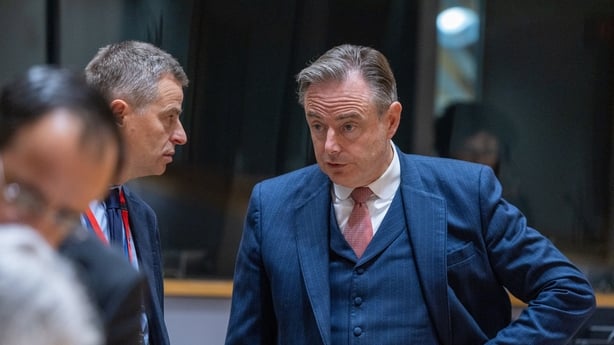
Belgian Prime Minister Bart De Wever (R) held a bilateral meeting with President Zelensky in Brussels
Zelensky’s objective, he said, was that Ukraine would get its hands on the assets before Russia did.
For his part, Bart de Wever would only say that the unanimous decision of EU leaders last December was that the Russian assets would remain immobilised indefinitely.
“My personal view,” he told reporters, “is that if you have immobilised assets, in every war – even in the Second World War they were never touched – at the end of the conflict there’s always a peace deal. Part of this peace deal will be the use of immobilized assets.”
However, there is no sign of a peace deal, certainly not with Putin adhering to his calculus of a weary and financially strapped west gradually abandoning Ukraine.
The stakes for Putin abandoning the war amount to the probable demise of his long dictatorship; the stakes for Ukraine in giving up are immeasurably higher – the destruction of its culture, language and economy.
The stakes for Europe, potentially a mass exodus of refugees abandoning either a militarised Russian vassal state – or a failed state – right on Europe’s borders.