
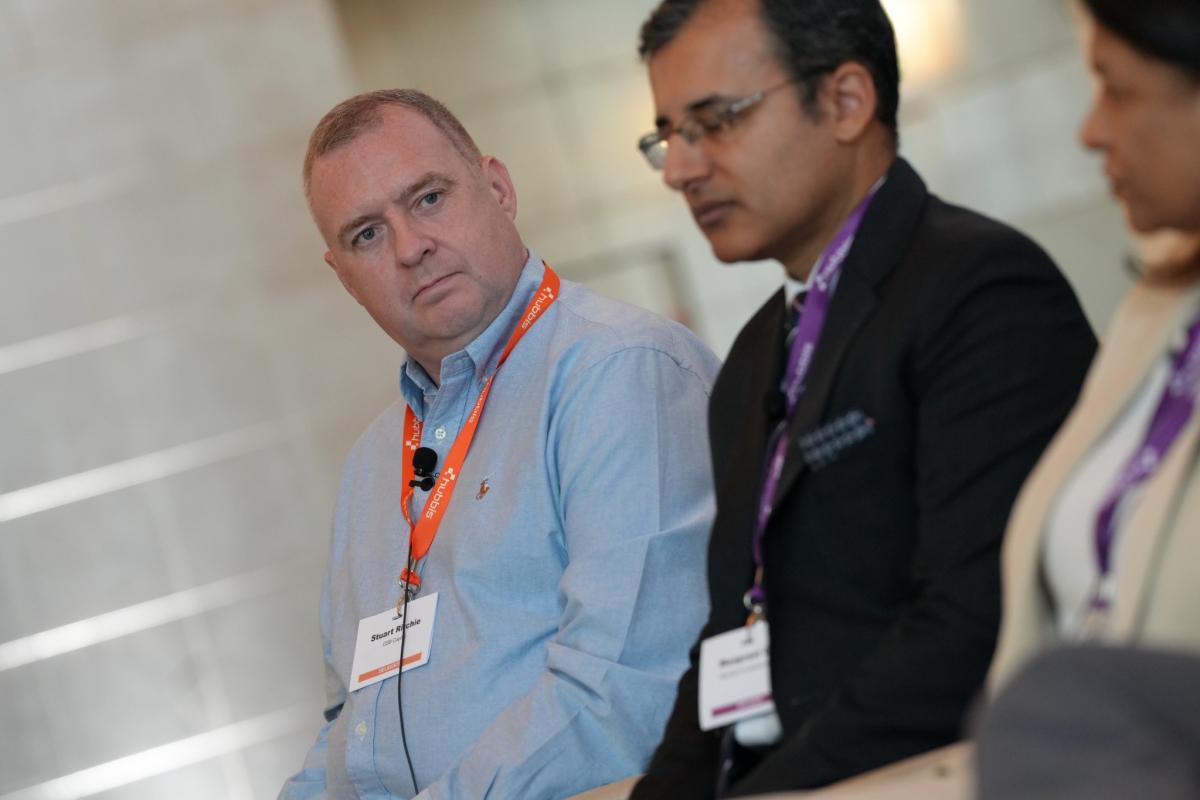
For independent wealth managers in the Gulf, the proliferation of AI tools and the growing sophistication of client knowledge present both a challenge and an opportunity. Stuart Ritchie, Group Head of Wealth at GSB Capital, described at the recent Middle East Private Capital Forum 2026 how his firm is navigating that shift, from the changing nature of client conversations to the practical adoption of technology in day-to-day advisory operations.
The panel, hosted by Hubbis at the Shangri-La Dubai and chaired by Damian Hitchen, Chief Executive Officer for MENA at Saxo, explored how private wealth platforms across the region are adapting to converging product access, rising client expectations and the rapid evolution of AI-driven tools. Ritchie’s contribution offered a ground-level perspective on what independence looks like in practice, how client data might become a more central part of the advisory proposition, and why the firm remains in the early stages of its technology journey.
Key Takeaways
Clients are increasingly using AI to cross-check the advice they receive, with Ritchie reporting that double-checking of recommendations has become common across generations.
Beneficiaries of trusts and foundations are becoming more active participants in advisory meetings, asking more informed questions about portfolio rationale and personal impact.
Independence and the absence of product ties remain central to GSB Capital’s value proposition, according to Ritchie, allowing the firm to select solutions based on client’s needs and suitability.
Client data represents an underleveraged asset that Ritchie believes could be used more effectively to build tailored solutions, with AI as a potential driver of that capability.
The firm is in the early stages of AI adoption, using tools for meeting transcription, workflow automation and report writing, while remaining conscious of hallucination risks and the impact on junior staff development.
A More Informed Client
Ritchie opened by describing a shift in client behaviour that he said has become widespread. Clients are no longer passive recipients of advice. They are actively verifying what they are told, using AI tools that are now accessible across age groups and levels of financial sophistication.
“It’s definitely become very common. We see a lot more double-checking of advice, and people can access a lot more information.” Ritchie said. He noted that the reach of these tools extends well beyond professional investors. “Even my mum is using ChatGPT,” he said.
The effect, Ritchie observed, is that different generations of investors are now able to get up to speed on financial concepts and market dynamics more quickly than in the past. From a client-facing perspective, he said, this is producing “much more insight, much more knowledge,” particularly among the beneficiaries of trusts and foundations.
Ritchie said that GSB Capital actively encourages beneficiaries to attend advisory meetings, and that those participants are engaging at a higher level than before. “They’re asking really good questions,” he said. “They want to understand more about the conversation, what it’s there for, how that will impact them.”
The Case for Independence
On the question of value proposition, Ritchie was direct. GSB Capital’s model, he said, is built on independence and the absence of ties to any particular product provider. “We’ve always worked for the client, sitting on their side of the table, being completely independent,” he said. “We don’t have any ties to any particular providers. We really can look at what’s the most suitable for their requirements.”
That independence, Ritchie argued, is the foundation of the firm’s relevance. “The value add is always that independence: working with the client to select the best products for their needs,” he said.
He also stressed that, despite the sophistication of the tools now available, clients continue to place weight on human engagement. “People just want to be secure,” he said. “The reason they want to speak to a CIO is to understand the proposition…” and “I don’t think that human connection is going to go away anytime soon.”
Ritchie pointed to the track record of robo-advisory platforms as evidence of that preference. Automated advice models have been available for some time, he noted, but have not displaced human-led advisory relationships. “I think that people still do value that human expertise,” he said.
Data as an Underleveraged Asset
One of Ritchie’s more forward-looking observations concerned the potential value of client data. He drew an analogy with large technology platforms, noting how companies such as Facebook and Instagram have built their businesses around the data they collect and the ability to tailor their offerings accordingly.
“I think about how much information we receive from clients. They share everything with us,” Ritchie said. “And I feel like there’s something in that that we should be able to really drive forward and create better solutions for clients that really do match their needs.”
He identified AI as a likely enabler of that ambition, suggesting that the technology could help firms extract more value from the information clients already share in the course of the advisory relationship, with appropriate safeguards for client confidentiality and data protection. “I think AI will be a huge driver of that,” he said.
Early Stages of Adoption
On the practical question of how GSB Capital is deploying technology today, Ritchie was candid about the firm’s position. “We are still very much at start, so it’s about exploring and seeing what’s out there,” he said.
He described several tools currently in use. The firm uses Microsoft Copilot for office productivity and an AI-enabled adviser support platform called Marloo. Before client meetings, the team takes notes, and Microsoft Teams now generates transcripts that are organised into key details and action items. Ritchie also envisaged further automation, including the preparation of follow-up emails and coordination with other parts of the organisation.
“We then see the next evolution from that,” he said. The firm is also exploring AI assistance with drafting suitability reports and other written materials, with adviser oversight and human review remaining essential. Ritchie noted that hallucination remains a live concern. “Making sure that we don’t have too many hallucinations,” he said. The process, he added, “still involves human contact.”
Ritchie raised a concern that is less commonly discussed: the impact of AI adoption on the development of junior staff. As AI tools take over tasks such as note-taking and meeting preparation, he said, there is a risk that less experienced team members miss out on the learning that those tasks traditionally provided. “We’re also very careful about the development then, the junior members of the team who perhaps aren’t as involved in the client meetings because AI is taking care of it,” he said.
His overall assessment was measured. The tools have the potential to improve accuracy and efficiency, he said, but the firm is still in the early stages of understanding how to deploy them effectively. “It will get better over time, still very, very early stage,” he said.