
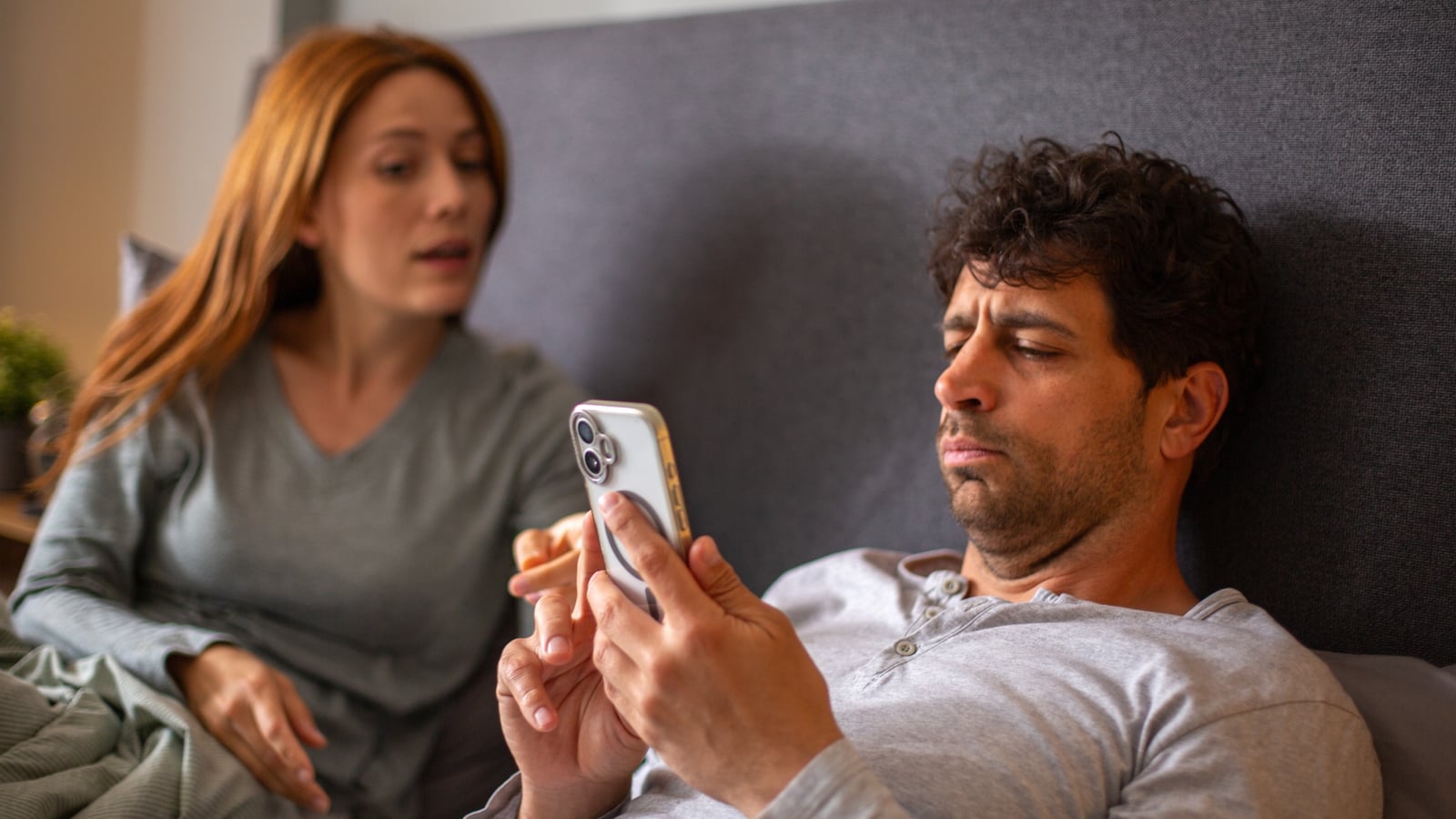
Are you suffering from ‘attention infidelity’? American author Daniel Cox coined the term to explain how screen habits intrude on face-to-face connection and emotional presence. Helen Vaughan, Director at Maynooth Counselling and Psychotherapy, explains. Listen back above.
To paraphrase Princess Diana: there are now three players in most relationships. And one of them isn’t even a person.
Phones have infiltrated the majority of our relationships, whether it’s a mindless scroll in bed, liking posts throughout that film you promised you’d watch together, or missing out on sharing special moments in favour of consuming yet more online content.

We now have a term for this thoroughly modern relationship hurdle: ‘attention infidelity’. But what’s behind its rise, and what can we do to curb it?
Accredited psychotherapist Vaughan says it boils down to “lack of connection” and the fact that we all have a device that is engineered to pull our focus, which doesn’t help.
“It’s designed to be addictive, it is, and if you don’t consciously uncouple with your phone, it can take over, and it can interrupt those small opportunities couples have to connect with each other in the morning, in the evening and at the weekend, whenever it is that you have a bit of downtime”, she says.

Vaughan adds that she would get caught in endless scrolling too, but limited it by deleting her social media every time she went on her summer holidays.
“This summer I tried to stay with a more distant relationship with it, where if you’re going to look at something on your phone, consciously go in, have a look at whatever it is you’re going to look at and then log off again.
“Sometimes you just end up scrolling; you’re not really looking at anything. I was like, what was I wanting from this experience? And I just wanted a break, I wanted a bit of nothingness.”

She adds that there could be someone in the room with you actively trying to talk to you, ask you something or share something with you and looking at your phone is like “a huge barrier, basically saying ‘this is more interesting than you are’, which is not good for your partner”.
Vaughan points to the research of American psychologist John Gottman, who studied couples and how they interacted. Based on this, he would try to predict whether they would stay together or not.
“What he said was that the biggest predictor of success in any couple was when one tries to talk to the other; he calls them ‘attention bids’, so when you try to say something to the other partner. And it’s whether that person responds and connects back with you or not”, Vaughan explains.
A healthy couple that stays together responds 86% of the time, while a couple more likely to go on and separate from each other responds just 33% of the time.
“Surely a phone has made that even worse”, she notes.

But is attention infidelity the same as traditional infidelity? Vaughan says it’s hard to know.
“For different couples and different people, [attention infidelity] can mean different things. For some people it might be looking at explicit content online. I think for a lot of us it’s just looking at nothing, and it’s kind of wanting a bit of nothing, a bit of a break, a bit of not having to think, not having to worry about whatever it is.”
As always, it comes down to talking to your partner about what is okay and acceptable for them, and what isn’t, Vaughan says.