
SOUTHWEST FLORIDA (WINK) — A Southwest Florida mother is speaking out after watching her son struggle with severe mental illness that has led to hospitalizations and jail.
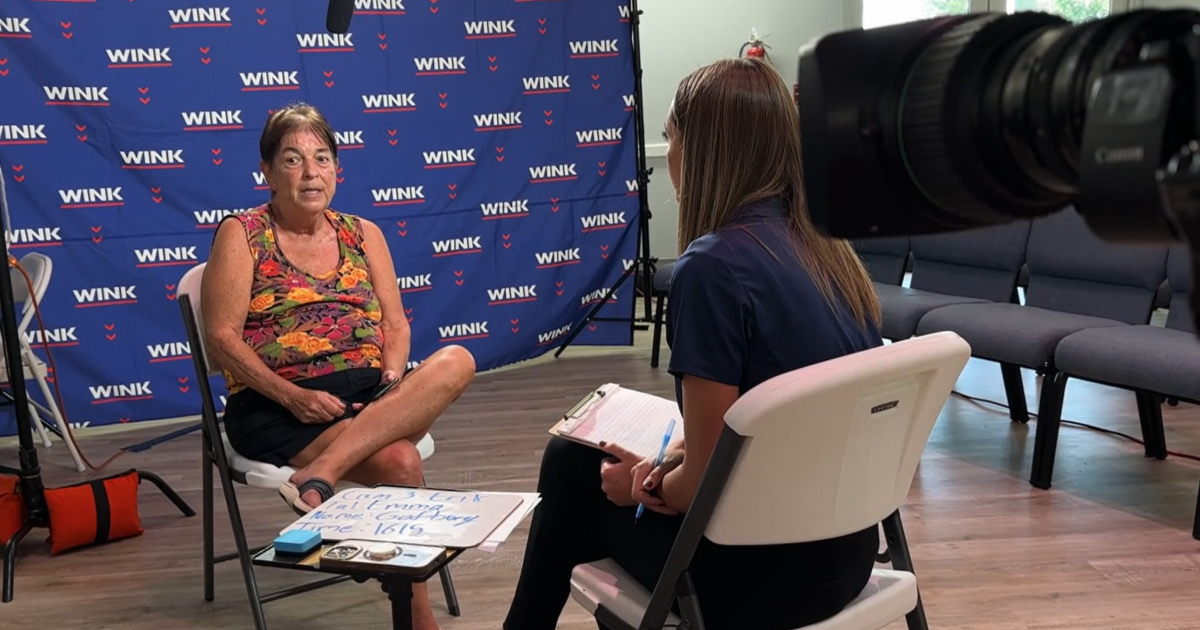
Dr. Robin Gofberg of Punta Gorda sat down with WINK News anchor Emma Heaton to share her family’s story. Her son, Colin Chapman, appears in Lee County mugshots. Once for battery on a person 65 years or older, then for failure to appear.

“I’ll try not to cry. This concerns my son,” Gofberg said. “I am a doctor. I’m a forensic psychologist and a neuropsychologist. But more than anything else, I’m a mom.”
Years ago, photos show Chapman as a smiling kid who loved his sister and his pets. Gofberg never could have imagined the role mental illness would eventually play in his life.
“He has a severe mental illness, but he’s a Harvard Law School graduate and a Fulbright scholar,” Gofberg said. “He’s published extensively. He’s very bright. He was interviewed by NPR and BBC, but in recent years his mental illness has taken over, and he has not been doing well.”
That struggle eventually led to a cycle of hospitalizations and jail. During one mental health crisis, Gofberg says Chapman was psychotic and punched someone, leading to the battery charge.
Gofberg bailed him out. But within a week, she says he needed to be hospitalized again.
Eventually, she says Chapman spent six months in a state hospital. Then he was taken back into custody.
Colin Chapman is now out of jail on probation
“I’m hiring an attorney,” Gofberg said. “I live on Social Security, but I will hire an attorney to defend my son.”
For Gofberg, her son’s story is personal. But it also raises a bigger question. What happens when someone with serious mental illness ends up in the criminal justice system?
Charlotte County Sheriff Bill Prummell says law enforcement is often the first point of contact, and deputies have to know how to recognize when someone is in crisis. His deputies are trained in crisis intervention training, or CIT.
“It gives the deputies an extra tool on their tool belt, so when they respond to a situation, if it’s safe to do so, because you know the situation dictates our response,” Prummell said. “But if it’s safe to do so, the deputy can take that step back and say, ‘Okay, what do I have here?'”
Deputies ask themselves questions like: Is this person dealing with a mental health crisis? Are they struggling with a loss? Is there something else they’re having a hard time with?
“We try and take that step back, and it teaches them how to better communicate with the individual and how to kind of talk the situation down,” Prummell said. “We’re also trying to divert people away from the criminal justice system because many of these individuals they commit nuisance crimes, and actually, it’s a misnomer.”
The goal, the sheriff says, is to keep people who don’t need to be in jail out of the criminal justice system. In Charlotte County, that includes a mental health unit pairing a trained deputy with a clinician.
“They respond to mental health calls and substance use calls,” Prummell said. “We also use them for follow-ups.”
The team also checks on medications, connects individuals with their families and helps get them connected to services.
“This year we’ve diverted 156 people away from the criminal justice system, and in 2025, we diverted 203 people away from the criminal justice system and into services,” Prummell said.
But even with those efforts, Prummell says there aren’t enough mental health professionals to meet the need.
“The problem we’re running into right now is that Charlotte Behavioral doesn’t have the staffing to be able to maintain all that, so they are working on trying to get their staffing up,” Prummell said. “We’re looking at grants. But also, like we’re finding with many professions, there’s not a whole big rush of people getting into the mental health business.”
That shortage extends beyond Charlotte County. The Florida Center for Behavioral Health Workforce website says 24% of the state’s current behavioral health workforce needs are unmet.
“You got state agencies that just need to do some rule changes, which we were working on,” Prummell said. “We have some legislation that needs to be tweaked or introduced, so that’s being looked at. Cost is everything too.”
For Gofberg, her focus is on what happens next. She wants her son to get the help he needs.
“Ultimately, I hope it gets resolved and he gets treatment and gets out of a jail,” Gofberg said.
She says she’s speaking up not just for her son, but for other families who may find themselves in the same position.
“My hope is that someone out there will say this isn’t right,” Gofberg said. “Mentally ill people deserve a voice.”
Prummell’s message: Don’t give up.
“Don’t give up hope. Keep looking for help,” Prummell said. “A lot of your communities do have mental health and substance use—it’s usually your fiscally constrained that are less likely to. So look to your neighbor and counties. Reach out to your sheriff’s office or your police department. See what resources they might have or where they may be able to point you in the direction.”
LOCAL RESOURCES
WINK News reached out to every local city, county, sheriff’s office and police department about available mental health resources, particularly those that can help someone experiencing a mental health or substance-use crisis before they become involved in the criminal justice system.
Cape Coral:
Melissa Mickey, communications manager for the city of Cape Coral, responded in an email.
“Melissa Mickey, Communications Manager for the city of Cape Coral responded in an email, “While the City is not a mental-health treatment provider, Cape Coral’s public-safety personnel work with regional behavioral-health partners to help connect residents in crisis to appropriate services. Residents should call 911 for an immediate safety emergency; for non-immediate behavioral-health crises, call or text 988 or contact the Mobile Crisis Response Team at 844-395-4432.
Here’s some additional information, but you will want to confirm with the appropriate agencies:
For a mental-health, substance-use or emotional crisis that does not present an immediate danger, residents can call or text 988 at any time. Florida’s 988 Lifeline is free and available 24/7, connecting callers with trained Florida-based crisis counselors.
Residents in Lee County may also contact the Mobile Crisis Response Team at 844-395-4432, available 24/7 at no cost. The team serves Lee County and can provide on-site crisis intervention.
For individuals who need urgent psychiatric stabilization, SalusCare operates a Crisis Stabilization Unit in Fort Myers at 10140 Deer Run Farms Road and can be reached at 239-275-4242.”
Andrea Jones with the Collier County Sheriff’s Office responded in an email:
“What mental health crisis resources are available to residents?
The Collier County Sheriff’s Office Behavioral Health Bureau (BHB) assists residents experiencing mental health or substance-use crises and provides follow-up, community support, and connections to treatment resources. Residents can also access the Crisis Call Diversion program, Behavioral Health Intervention Team, and community partners such as the David Lawrence Center and NAMI Collier County.
Does your agency have a crisis intervention team (CIT), co-responder program, or mental health unit?
Yes. CCSO operates a Behavioral Health Bureau, provides Crisis Intervention Team (CIT) training, and has a Behavioral Health Intervention Team (BHIT) that can pair law enforcement with mental health professionals for co-response when appropriate.
What should someone do, or who should they contact if they or a loved one is experiencing a mental health crisis?
For an immediate emergency or danger, residents should call 911. For a non-emergency behavioral health concern, they can contact the CCSO Behavioral Health Bureau hotline at 239-252-0949; Crisis Call Diversion counselors can also help route appropriate calls to mental health professionals.
Are there any local programs that help divert people from jail and connect them with treatment or other services?
Yes. CCSO’s co-response program works to divert individuals from the justice system when possible and connect them with appropriate resources, while the Law Enforcement Assisted Diversion (LEAD) Program redirects certain substance-related cases toward treatment instead of jail and prosecution. CCSO also participates in Collier County Treatment Court teams.
Are there any current staffing, funding, or other challenges affecting access to these resources?
This question is probably better directed toward one of the partner agencies as we are not primarily a mental health agency.”
Collier County:
Andrea Jones with the Collier County Sheriff’s Office responded in an email detailing the agency’s Behavioral Health Bureau, which assists residents experiencing mental health or substance-use crises and provides follow-up, community support and connections to treatment resources.
CCSO operates a Behavioral Health Bureau, provides Crisis Intervention Team training and has a Behavioral Health Intervention Team that can pair law enforcement with mental health professionals for co-response when appropriate.
For an immediate emergency or danger, residents should call 911.
For a non-emergency behavioral health concern, they can contact the CCSO Behavioral Health Bureau hotline at 239-252-0949. Crisis Call Diversion counselors can also help route appropriate calls to mental health professionals.
CCSO’s co-response program works to divert individuals from the justice system when possible and connect them with appropriate resources. The Law Enforcement Assisted Diversion Program redirects certain substance-related cases toward treatment instead of jail and prosecution.
Lee County Sheriff’s Office:
Julie Sin, public information officer for the Lee County Sheriff’s Office, wrote in an email, “
What mental health crisis resources are available to residents?
Crisis Intervention Team (CIT) Training: LCSO deputies undergo specialized training to safely de-escalate crisis calls and connect individuals to various resources in the community. All Cadets going through the LCSO in-house academy also receive a three-day in-house CIT training and can elect to attend the 40-hour FDLE/NAMI CIT training. CIT training provided by the LCSO Training Division is on-going and continuous throughout a deputy’s career.
Crisis Care K9’s: Two specially trained Golden Retrievers from Golden PAWS Assistance Dogs, that will deploy with handlers to provide emotional comfort, reduce trauma, and assist individuals during high-stress calls or mental health events.
Family Initiative Partnership: LCSO collaborates with Family Initiative to coordinate specialized support and clinical consultations for deputies interacting with individuals with developmental disabilities.
Threat Assessment Coordinators (TACs): Embedded in the School Threat Enforcement Team, TACs role is to evaluate at-risk students, identify underlying mental health or behavioral challenges, and connect families with resources before situations escalate to violence or arrests.
Community Outreach: Our Community Response Unit coordinates general community outreach, but also serves on the County HOT (Housing, Outreach, and Treatment) Team. The HOT Team goes into the community and provides vulnerable population with resources to get the help they need.
Does your agency have a crisis intervention team (CIT), co-responder program, or mental health unit?
Nearly all LCSO Deputies have completed 40-hours of crisis response and intervention training through NAMI Southwest FL or FDLE. This training helps recognize the signs and symptoms of mental illness, substance abuse, and cognitive disabilities. When deputies can recognize these signs, they are able to connect individuals to local resources and programs. Recruits going through the LCSO in-house LE/CO academy, complete a three-day CIT course, providing them with hands-on training in recognizing and responding to individuals experiencing a mental health or behavioral health crisis. Crisis intervention training is also an ongoing part of LCSO’s Training Division. The Training Division regularly provides refresher and advanced courses to help deputies maintain and build upon these skills and stay current on best practices for safely responding to individuals in crisis.
What should someone do, or who should they contact if they or a loved one is experiencing a mental health crisis?
Are there any local programs that help divert people from jail and connect them with treatment or other services?
Yes, there are many programs’ people can be referred to by a Judge and pretrial services such as mental health treatment, substance treatments, etc. Juveniles can also be referred to diversion programs that provide counseling, community service or even the LCSO Youth Boxing Program.
Are there any current staffing, funding, or other challenges affecting access to these resources?
Fort Myers Beach:
Abigail Eberhart with Fort Myers Beach responded by email, “As a municipal government, the Town of Fort Myers Beach has a limited scope when it comes to providing health and behavioral health services directly. We typically take our lead from Lee County, which has dedicated resources and partnerships in place to support these important needs.
At the Town level, our role is primarily to help educate residents and connect them with the appropriate resources. We regularly share information about where individuals can turn for assistance, including Lee Health’s Behavioral Health Center and several important nonprofit partners throughout the community.
We feel very fortunate to be part of Lee County and have confidence in the network of services and resources available to our residents. Betsy Clayton, the County’s Communications Director, may also be able to provide you with additional insight into the County’s role and the resources available.
Thank you again for reaching out, and best of luck with the story.”
Lee County
Lee County provided information about several resources available to residents.
“Are there any current staffing, funding, or other challenges affecting access to mental health crisis resources?
As demonstrated below, services are provided in partnership with a number of community organizations, agencies and resources.
What mental health crisis resources are available to residents?988 Suicide and Crisis LifelineCenter for Progress and Excellence (Mobile Crisis Response Team)SalusCare (Crisis Stabilization Unit)Park Royal (Crisis Stabilization Unit)Centerstone (Certified Community Behavioral Health Clinic)
Does your agency have a crisis intervention team (CIT), co-responder program, or mental health unit?Crisis intervention team (CIT) – NAMI Southwest Florida teaches these classes.Co-responder programThe Mobile Crisis Response Team (MCRT), operated by Crisis Prevention and Empowerment, formerly known as the Center for Progress and Excellence, provides no-cost mental health mobile crisis services to residents of Lee County. The program’s mission is to reduce the use of involuntary Baker Act admissions by providing 24/7 access to proactive interventions in community settings.Centerstone – Homeless Outreach Team provides specialized services to individuals who are experiencing homelessness or at imminent risk of homelessness. Services focus on individuals with mental health and substance use needs providing comprehensive behavioral health assessments, crisis intervention, facilitating direct connection to treatment services, housing resources and long-term supportive care.Community Health Program, launched in 2023 as an innovative extension of Lee County Public Safety, was created to address the growing intersection of behavioral health, substance use, chronic illness and social vulnerability. Operating three ALS-equipped Mobile Integrated Health (MIH) units from the Emergency Dispatch Center in Fort Myers, the program brings medical and behavioral health care directly to individuals who may not otherwise engage with the traditional healthcare system.What should someone do, or who should they contact if they or a loved one is experiencing a mental health crisis?988 Suicide and Crisis LifelineCPE’s Mobile Crisis – 844-395-4432The 988 Suicide and Crisis Lifeline is a telephone, text, and chat line. When someone calls, texts, or chats 988, they are connected to a trained crisis counselor who provides emotional support, safety screening and connection to local resources over the phone. If the counselor determines that in-person intervention is needed, they work with local partners to dispatch a mobile crisis team to the individual’s location. Locally, that in-person response is provided by CPE’s Mobile Crisis team, which can be reached directly at 844-395-4432.Are there any local programs that help divert people from jail and connect them with treatment or other services?
Charlotte County:
Charlotte Behavioral Health Center provided information about its Crisis Stabilization Unit/Central Receiving Facility.
What mental health crisis resources are available to residents?
For an immediate life-threatening emergency, call 911. Other crisis resources available are:
988 Suicide & Crisis Lifeline: Available 24/7, anyone experiencing suicidal thoughts or having a mental health or substance use crisis can call this free & confidential hotline. This national hotline is not just for those considering suicide, but for anyone in severe distress or experiencing a mental health or substance use crisis. Callers speak with trained crisis counselors, who can also help connect callers with local services, if appropriate. Call or text the hotline at: 988.Charlotte Behavioral Health Care’s Crisis Stabilization Unit/Central Receiving Facility: Located at 1700 Education Avenue in Punta Gorda, the Unit provides 24/4 assessment, intervention, and short-term stabilization for adults and children experiencing a mental health or substance use crisis. The Crisis Unit accepts both voluntary and involuntary (Baker Act/Marchman Act) admissions. To reach the Unit, call (941) 575-0222.Integrated Response for Intervention & Support (IRIS): The IRIS Team is a collaboration between Charlotte County Sheriff’s Office (law enforcement) and Charlotte Behavioral Health Care (mental health professionals). The IRIS Team consists of one deputy and one mental health clinician who have received specialized training for mental health, crisis intervention, and medical-related calls for service. IRIS members will meet the person or family in crisis where they are in the community and attempt to restore the person to a pre-crisis level. IRIS will provide follow up until the crisis is diverted or resolved. To reach the IRIS team, call the Charlotte County Sheriff’s Office non-emergency line at (941) 639-0013.Does your agency have a crisis intervention team (CIT), co-responder program, or mental health unit?
Yes, we have both a co-responder program and a mental health unit (see question 1 above).
For more info: Integrated Response for Intervention & Support (IRIS)
For more info: CBHC’s Crisis Stabilization Unit/Central Receiving Facility
What should someone do, or who should they contact if they or a loved one is experiencing a mental health crisis?
See question 1 above.
Are there any local programs that help divert people from jail and connect them with treatment or other services?
Yes. Sometimes people with serious mental illnesses or addiction issues use poor judgment and find themselves facing legal charges. These offenders often spend unnecessary time in jail, lack access to treatment services, and become repeat offenders – cycling through the justice system yet again.
Our Court Services programs involve close collaboration between criminal justice, mental health, and substance use disorder treatment systems — all of who truly want everyone to succeed. The goal is to divert individuals from the jail system and into treatment. Programs involve identifying and addressing the unique needs of the offender and require intensive treatment and community supervision. People who participate are held accountable for their behavior in an immediate, practical and supportive way.
These programs achieve the following results for the benefit of the offenders: Faster case processing time, improved access to treatment services, improved well-being, and reduced recidivism. Other than saving taxpayer dollars, an important outcome achieved by the program for the larger community is improved public safety.
Each of these intensive programs are for individuals with non-violent criminal charges. For more information, click here.
Are there any current staffing, funding, or other challenges affecting access to these resources?
At this time, we are still awaiting final state and local funding allocations, so the impact on available resources is not yet known. As the need for behavioral health services continues to grow, there is always a need to expand and enhance services. Additional funding allows us to increase access, strengthen existing programs, and better meet the evolving mental health and substance use needs of our community.
North Port:
“What mental health crisis resources are available to residents?
The North Port Police Department does not provide mental health treatment directly, but we work closely with community partners and encourage residents to utilize available behavioral health resources before a situation reaches a crisis point. We lean heavily on local providers, including North Port Behavioral Health, to connect individuals and families with appropriate services and support.
For someone experiencing a mental health or substance-use crisis, 988 is also an important resource. The 988 Suicide & Crisis Lifeline provides free, confidential support 24/7 and can connect individuals with crisis services and resources in their community.
Does your agency have a Crisis Intervention Team (CIT), co-responder program, or mental health unit?
NPPD does not currently have a dedicated Crisis Intervention Team, co-responder program or mental health unit. Our officers respond to calls involving individuals experiencing mental health or behavioral health crises and work with available community resources when appropriate.
What should someone do if they or a loved one is experiencing a mental health crisis?
If someone is experiencing a mental health or substance-use crisis, we encourage them to seek help as early as possible rather than waiting until the situation becomes an emergency. Calling 988 is one option for immediate crisis support and guidance.
If there is an immediate threat to someone’s safety or a life-threatening emergency, call 911 so emergency responders can be dispatched.
Family members and loved ones can also reach out to behavioral health providers for assistance in identifying appropriate treatment and support services.
Are there local programs that help divert people from jail and connect them with treatment or other services?
Our goal is always to connect people with the appropriate resources when circumstances allow. Officers evaluate each situation individually and, when appropriate and legally permissible, can utilize available community resources rather than relying solely on the criminal justice system.
Our officers frequently work with behavioral health providers and other community partners to help connect individuals with services.
Are there current staffing, funding or other challenges affecting access to these resources?
Like many communities, access to behavioral health and substance-use treatment can be affected by availability, capacity, and the resources available in the community. From a law enforcement perspective, having accessible behavioral health services and crisis resources is important because it gives officers additional options when responding to people who are experiencing a crisis.
We believe the strongest approach is a community-based one, where law enforcement, behavioral health providers, families, and other community partners work together to connect people with the appropriate help before a situation escalates into a criminal justice matter whenever possible.”
Hendry County:
What mental health crisis resources are available to residents? See attached flyer.
Does your agency have a crisis intervention team (CIT), co-responder program, or mental health unit? Hendry County BOCC has a mental health coordinator who can assist with connecting residents to the proper mental health services for their needs 863-675-5338. Are there any local programs that help divert people from jail and connect them with treatment or other services? Dawn Oliver, DOliver@ca.cjis20.org
Glades County:
What mental health crisis resources are available to residents? Center for Progress and Excellence (CPE) Mobile Response Team: (844) 395-4432.Does your agency have a crisis intervention team (CIT), co-responder program, or mental health unit? Glades County Sheriff’s Office has Deputies and SRO’s with CIT training. We do not have a dedicated mental health unit.What should someone do, or who should they contact if they or a loved one is experiencing a mental health crisis? Call 911 (immediate, life-threatening crisis), Call or Text 988 (Suicide & Crisis Lifeline), Call (844) 395-4432 (Center for Progress and Excellence (CPE) Mobile Response Team)Are there any local programs that help divert people from jail and connect them with treatment or other services? The Hanley Foundation, Adult Pre-Trial Intervention (Diversion Program)Are there any current staffing, funding, or other challenges affecting access to these resources? As a small, rural, and fiscally constrained county, this causes the inability to have dedicated staff for mental health and substance abuse crisis’s.