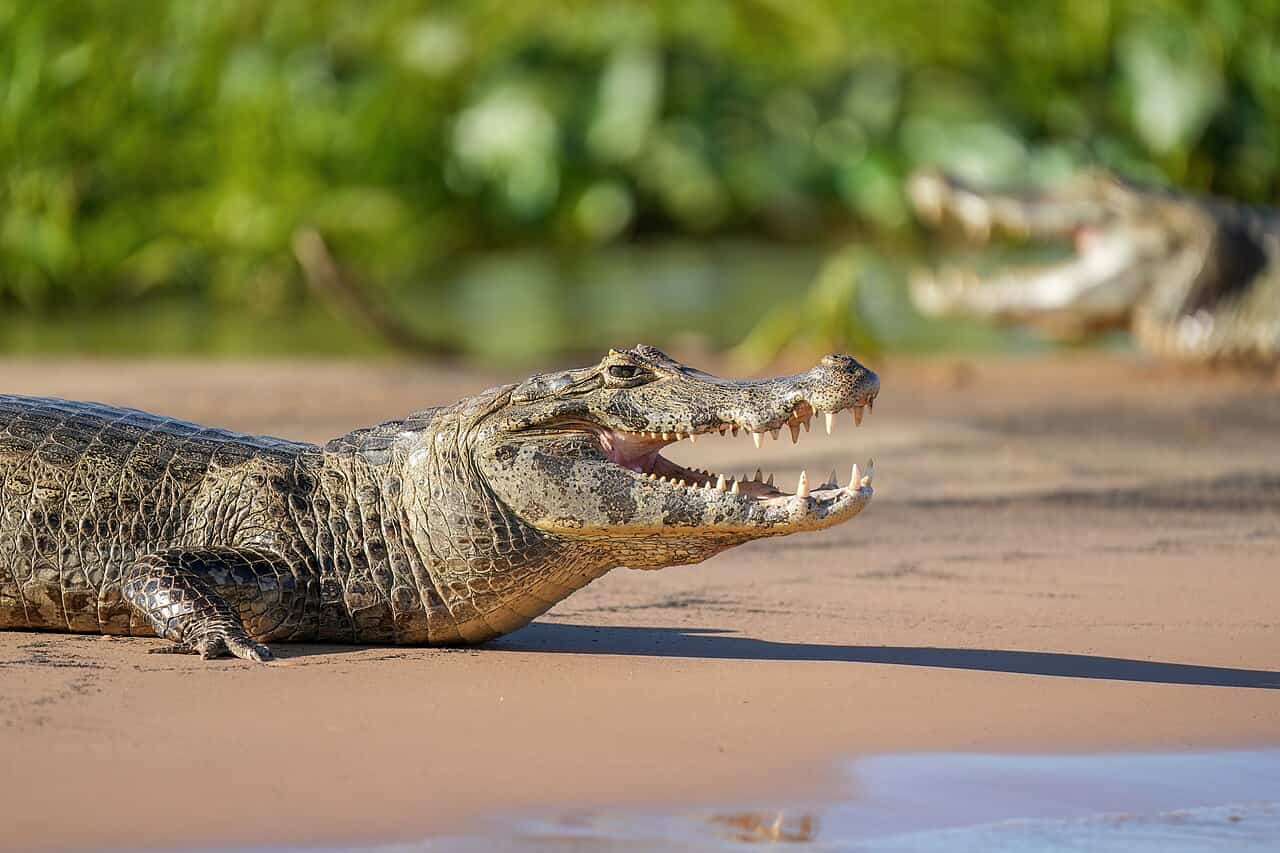
 Crocodylus acutus—the American crocodile. The word “crocodile” comes from the Greek kroko (gravel) dilos (worm), traditionally interpreted as “gravel worm,” possibly referring to these reptiles basking on stony riverbanks. Credit: Wikimedia Commons
Some 66 million years ago, an asteroid slammed into Earth, bringing the age of giants to a catastrophic end. T. rex, Triceratops, and all other non-avian dinosaurs vanished. Only one branch of the dinosaur family tree survived—birds.
But what about another great prehistoric lineage? How on Earth did crocodiles survive?
After all, the broader crocodile lineage had already existed for roughly 180 million years when the asteroid struck. Its evolutionary family tree included colossal predators that could attack dinosaurs, armored plant eaters, and strange creatures that looked nothing like the crocodiles we know today.
A new study offers a surprising explanation. Despite their extraordinary diversity, crocodiles and their ancient relatives spent roughly 250 million years following a remarkably consistent rule: follow the warmth.
That seemingly simple preference may have put some of them in exactly the right places when disaster struck.
The crocodiles that looked nothing like crocodiles
Today’s crocodilians are variations on an exceptionally effective ambush-predator design. Their armored bodies lurk unseen beneath the waterline, while eyes and nostrils perched high on their skulls remain exposed. Powerful tails propel them forward, exploding into action with muscular jaws seizing unsuspecting prey.
It’s a successful design, but for most of their evolutionary history, crocodile relatives were anything but predictable.
 Protome batalaria—a phytosaur. Same body plan, nostrils near the eyes. Credit: Wikimedia Commons
More than 200 million years ago, phytosaurs patrolled Triassic rivers looking uncannily like modern crocodiles, complete with long snouts and armored bodies. Their nostrils, however, sat much farther back, near their eyes. Whether phytosaurs belonged to the crocodile evolutionary branch or were more distant relatives remains debated. Either way, they were an extraordinary example of evolution producing similar solutions to similar problems.
×
Thank you! One more thing…
Please check your inbox and confirm your subscription.
But the crocodile family tree was never limited to this aquatic ambush-predator blueprint.
Some crocodile relatives were powerful land hunters, evolving body plans that looked more like dinosaurs than modern crocodiles. Poposaurus stalked prey on two legs, with feet remarkably similar to those of bipedal dinosaurs. Meanwhile, Fasolasuchus was a colossal four-legged predator that may have reached 9 meters (30 feet) in length, potentially ranking among the largest land predators outside the dinosaurs.

Artist’s rendition of Poposaurus gracilis. Credit: Wikimedia Commons
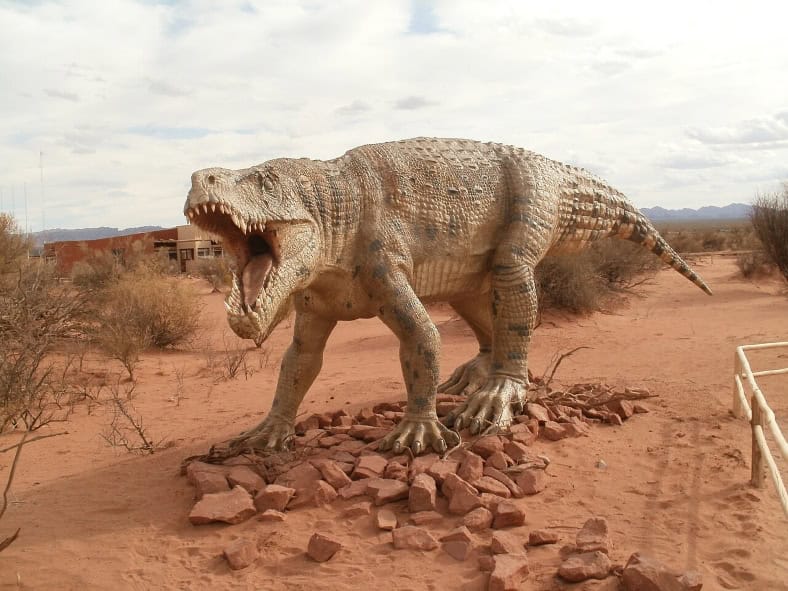 Life-sized model of Fasolasuchus at Talampaya National Park. Credit: Wikimedia Commons
Other branches took an entirely different evolutionary path and became herbivores. Simosuchus, a small crocodile relative from Madagascar, had a short, pug-like snout and unusual leaf-shearing teeth adapted for eating vegetation.
And in the Triassic, aetosaurs like Desmatosuchus roamed the landscape covered in bony armor, with enormous spikes protruding from their shoulders. They looked more like miniature tanks than crocodiles.
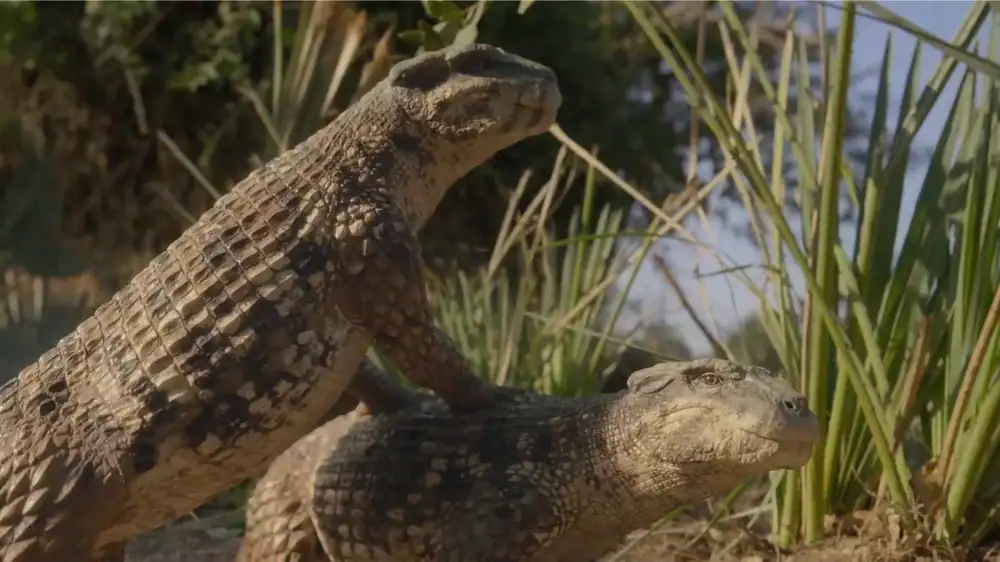 CGI rendition of Simosuchus clarki. Credit: Prehistoric Planet

Artist’s rendition of Desmatosuchus spurensis with human size comparison. Credit: Wikimedia Commons
Still others took to the water.
Metriorhynchus evolved into an ocean-going predator, complete with flippers and a powerful tail adapted for swimming. Meanwhile, enormous semiaquatic creatures such as Deinosuchus stalked Cretaceous waterways, with some estimates putting the largest individuals at around 10 to 12 meters long. These giants were capable of preying on dinosaurs that ventured too close to the water.
 Artist’s rendition of Metriorhynchus brevirostris (this thing was about 5 meters long). Credit: Wikimedia Commons

Artist’s rendition of Deinosuchus schwimmeri (this thing was about 10 meters long). Credit: Wikimedia Commons
“They have occupied almost every conceivable ecological role,” Alessandro Chiarenza, a paleontologist at University College London and the study’s lead author, told Reuters.
Today, only a fraction of that diversity remains. Almost everything about crocodile relatives changed over the centuries, from what they ate to how they moved.
But something else barely changed at all.
The one constant
 Alligator mississippiensis sunbathing (I don’t think there’s any need in translating that name). Credit: Wikimedia Commons
To investigate, Chiarenza and his colleagues assembled an evolutionary tree containing more than 400 living and extinct species, drawing on over 7,000 fossil records and extensive modern observations.
They compared these records with 52 reconstructions of Earth’s ancient climates, stretching back 245 million years. Their habitat models focused on nonmarine crocodile-line animals, rather than every ocean-going offshoot.
The results revealed that despite evolving radically different bodies, diets, and lifestyles, crocodile-line animals largely retained their ancestral preference for warmth.
This wasn’t simply a matter of crocodiles living in the tropics. For much of their history, the tropics weren’t their only option.
Around 50 million years ago, when Earth was approximately 10° Celsius warmer than today, crocodile relatives inhabited high-latitude regions of North America, Europe, and even Antarctica.
As the planet cooled, suitable habitats shifted toward the equator, and crocodile populations largely followed. In other words, rather than evolving to withstand increasingly cold conditions, they generally moved to places that still offered the warmth they needed.
 Caiman yacare—the piranha caiman—sunbathing as well. Credit: Wikimedia Commons
Their climatic preferences weren’t completely fixed. The researchers identified changes in temperature preferences around 94 million years ago and a shift toward drier conditions among certain Australian crocodile relatives around 34 million years ago.
But the broader pattern remained remarkably consistent. Rather than continually evolving new tolerances, crocodiles generally followed the climates they already preferred.
Scientists call this climatic niche conservatism: the tendency of a lineage to retain its inherited environmental preferences over evolutionary time.
It’s a strategy that sounds almost stubborn. But 66 million years ago, it became a lifeline.
When the asteroid struck, warmth was a refuge
The Chicxulub impact didn’t just kill animals in the immediate vicinity of the collision. It sent enormous quantities of dust and other particles into the atmosphere, reducing the sunlight reaching Earth’s surface.
Temperatures plummeted, photosynthesis was disrupted, and food webs began to collapse. For animals dependent on stable temperatures and abundant food, the consequences could be devastating.
With sunlight reduced by 5% or 10%, tropical and subtropical regions retained climates suitable for crocodile relatives. Only the most extreme scenario, involving a 15% reduction, eliminated suitable habitats globally. The researchers noted that this particular scenario is considered unlikely.
The results contrast with an earlier 2020 study involving several of the same researchers, which found that an asteroid-induced impact winter drastically reduced suitable habitats for non-avian dinosaurs. The new findings suggest that the same global catastrophe could have affected two ancient lineages very differently, partly because of where suitable habitats remained.
 Gavialis gangeticus—the gharial or fish eating croc. Credit: Wikimedia Commons
Cold-blooded survivors
Climate wasn’t the whole story, however.
Living crocodilians are cold-blooded, requiring far less energy than comparably sized warm-blooded animals. They can endure long periods without food, and some enter dormant states when conditions deteriorate. These characteristics would have been especially useful after the impact, when the collapse of plant productivity disrupted food supplies.
Smaller body sizes, semiaquatic lifestyles, and flexible diets probably helped some surviving crocodile relatives, too.
The simulations don’t prove that tropical refuges saved crocodiles, nor do they explain why particular species survived while others disappeared. But they reveal how geography and inherited climatic preferences could have tipped the odds.
There’s also a sobering lesson for modern crocodilians. Their ancestors often survived changing climates by moving to places that remained suitable. But today’s crocodilians face a world increasingly fragmented by roads, farmland, cities, and other human barriers. The habitats they need aren’t always connected, and moving to a better location may no longer be so simple.
And therein lies the evolutionary irony.
Crocodile relatives spent 250 million years experimenting with extraordinary ways to live, becoming giants, herbivores, land hunters, and marine predators. Yet one of the traits that may have helped their lineage endure was something they changed surprisingly little: their preference for a warm place to live.
The study was published in the journal Science Advances.