
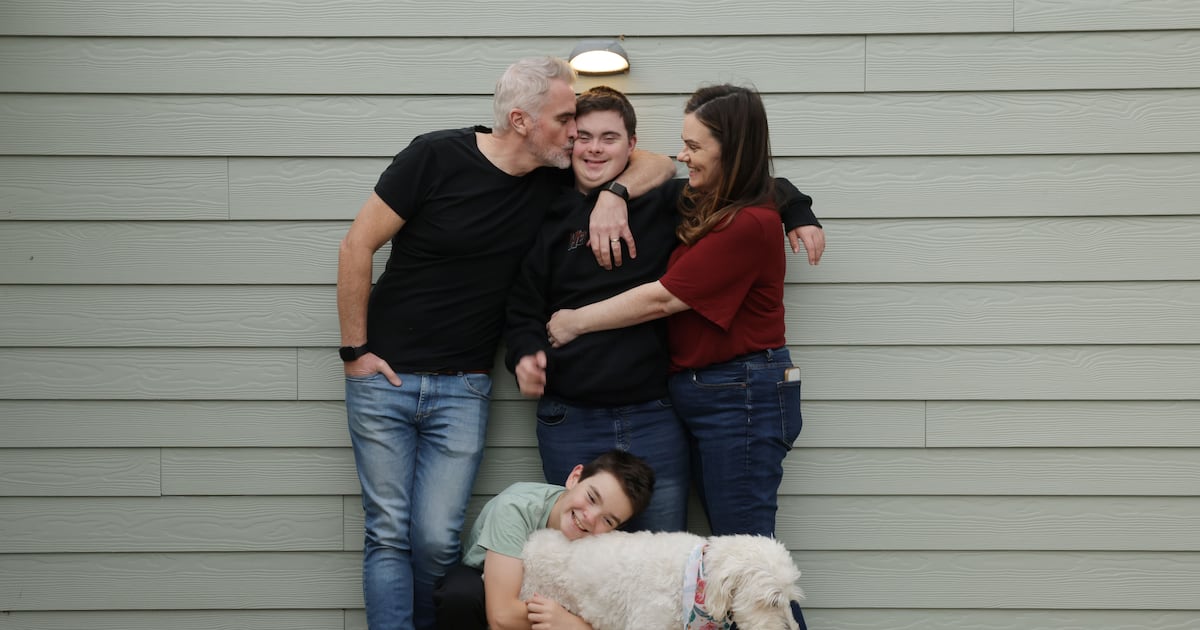
After the birth of Christopher with Down syndrome 16 years ago, Joseph Birchall realised this boy would be relying on him, not just to 18 but way beyond. Joseph immediately gave up smoking and, based on longevity research, switched to a plant-based diet. He runs, goes to the gym and manages stress and sleep as well as he can.
“It is about health span as opposed to lifespan,” says Joseph, a business owner and author. “It’s about remaining healthy.”
Joseph, who is 56, believes that if he and his 49-year-old wife, Eileen, a psychotherapist, had not, through “sheer bloody-mindedness and love for our son”, poured time and money into him, he would not have developed into the “unique, funny, beautiful personality” he is today.
When Christopher was diagnosed with autism around age five, they paid a child behavioural therapist to come to their home in Tallaght, Dublin, every week. She helped them manage their son better.
“Christopher is an amazing kid,” he says. “He’s extremely verbal and he has a great vocabulary. A lot of that comes from talking to ChatGPT. His communication skills are incredible.”
An unspoken implication of Joseph’s dedication to longevity is the prospect that a parent might outlive a child. He and Eileen cannot envisage the State providing the care and understanding their son would need without his parents. They say the current lack of support and services makes the future appear “bleak”. But as to any thoughts that the generational order of death might be reversed, Joseph says, “it’s too early to even go there”.
For older parents of adults with a disability that leaves them unable to live independently, the future wellbeing of their sons or daughters is an urgent concern. Gerry and Geraldine Conroy have cared for their eldest son, Donal, who has Down syndrome, for 40 years and say “we will continue to do so for as long as we are able”. But they are both in their 70s and know the time will come when, due to failing health or death, they will not be able to manage his onerous, full-time care.
“It is then that our family will be thrown into a crisis situation. What we are looking for now is a very clear plan for Donal, as to what would happen.” He is one of an estimated 2,300 adults with an intellectual disability being cared for at home in Ireland by parents aged over 70. Donal needs help with all his personal care, including toileting, and is nonverbal. But, worse than that, says Gerry, “he doesn’t understand anything we’re saying to him. He can’t watch a programme on television. He can’t look forward to something that’s happening tomorrow. He’s living absolutely and totally in the present.”
[ ‘Community care’ is exposed as an empty concept when a carer diesOpens in new window ]
Donal attends day services during the week, leaving home in rural Co Meath just before 9am and returning at 3.30pm. He has a younger brother and sister, Brendan and Áine, and Gerry believes the siblings are often forgotten about in these situations.
“Over the years they have been absolutely selfless in regards to Donal and have been a tremendous help to him and to us. Now we are very worried about the pressure they may come under when the crisis occurs in relation to the lack of housing – and even a plan to have housing.”
Gerry is alarmed to hear other parents say they hope their disabled adult child will die before them. “This is because of the very genuine fear they have as to what would happen when they are gone.”
It is a fear shared by the Conroys, who have asked services about that eventuality. Donal would be seen as an emergency case, put into respite care and “advertised out to private providers”, says Gerry. “Seemingly, then, family would have no say in where he goes or what kind of people he’s with or what situation he’s in.”
Donal is familiar with his locality, although he cannot go out alone. The couple hate to think of him being taken to another part of the country for residential care. Their ideal for Donal would be step-up accommodation nearby right now, for two nights a week. It would help to prepare him for living elsewhere, as well as giving the couple much-needed rest.
“The amount of sleep we get is very much determined by how he sleeps. There are times he sleeps through the full night, there are times he’ll sleep for a couple of hours and there are times he won’t close an eye.
“We could retire from our own jobs,” adds Gerry, a former national schoolteacher, “but we can’t retire from this job.”
‘My daughter will end up as a commodity being exploited by the profit sector’
Another set of parents of an adult with Down syndrome, Paul and his ex-wife, Hazel, are already struggling with unexpected, serious illness in their late 60s. Foremost in their minds is what will happen to their daughter Susan, who is in her late 20s. (All names in this family have been changed at their request.) Soon after Hazel was diagnosed with stage-four cancer, Paul, who is Susan’s primary carer, was told he had stage-four chronic kidney disease and would require dialysis within one or two years.
[ Ageing parents of adults with disabilities say: ‘I hope they go before me’Opens in new window ]
The theoretical question of their daughter’s care after they die, which he had raised with his ex-wife a few years ago, is now an all-too-real issue. Paul has always maintained, “I don’t want Susan to become a multigenerational burden”. He would ask her siblings to be “the best advocates for her” but not take over her care.
While Paul uses the term “burden”, he quickly stresses, “I love her to death”, glancing at the large black-and-white photograph of Susan that he has placed on the table we are sitting at in their Dublin home. “Having a child with a disability changes your whole perspective on life.”
Paul chokes back emotion as he talks about how he is beginning to prepare his daughter for a possible deterioration in his and his ex-wife’s health. All she has been told is that her mother has a “sore back”, which is why she has seen very little of her over the past year.
He poses, and proceeds to answer, the question: if he and his ex-wife die, what happens to Susan?
“She’s classified as an emergency by the HSE. That means they put her care package out to the private, for-profit sector, which is exactly what it says on the tin.
“In one fell swoop, Susan loses her dad, her carer, her home, her community. She loses her choice because she’s placed in there. She loses her buddies, which is the big thing for her, and she loses her voice because I’m no longer there to represent her.”
He sees parallels between the plight of adults with intellectual disabilities and women who were placed in Magdalene laundries where they were exploited for profit. “Institutions look at cost. My daughter will end up as a commodity being exploited by the profit sector.”
Paul is associated with Before We Die (BWD), a parents’ group lobbying the Government to fund and deliver residential places for adults with intellectual disability. It says the Budget 2027 provision of funding for 212 residential places for people with disabilities is a continuing “crisis-first policy”, as 112 of those places are ring-fenced for emergency cases.
“Ageing parents need residential homes arranged while they are still alive to support their sons and daughters through the transition – not emergency beds sourced in the days following a parent’s funeral,” a statement from BWD adds.
Ireland signed up to the United Nations Convention on the Rights of People with Disabilities in 2018. “That gives voice to every person’s right to live in their local community,” says Derval McDonagh, chief executive of Inclusion Ireland, the national association for people with an intellectual disability.
“Unfortunately, a lot of the narrative around people with intellectual disabilities is not about people’s rights. It’s about grouping people together or putting people into large settings.” Inclusion Ireland argues that there needs to be a three-choice test for every individual: do I have choice about where I live, who I live with and how I spend my time?
“If we’re answering no to any of those, then unfortunately we’re perpetuating institutional-type models.” Almost 200 people have been accommodated more than 100km away from their family and community, says BWD. For people with intellectual disabilities, “the consequences of that are utterly devastating”, says McDonagh. “Things can’t be fixed overnight but at least there should be a plan.”
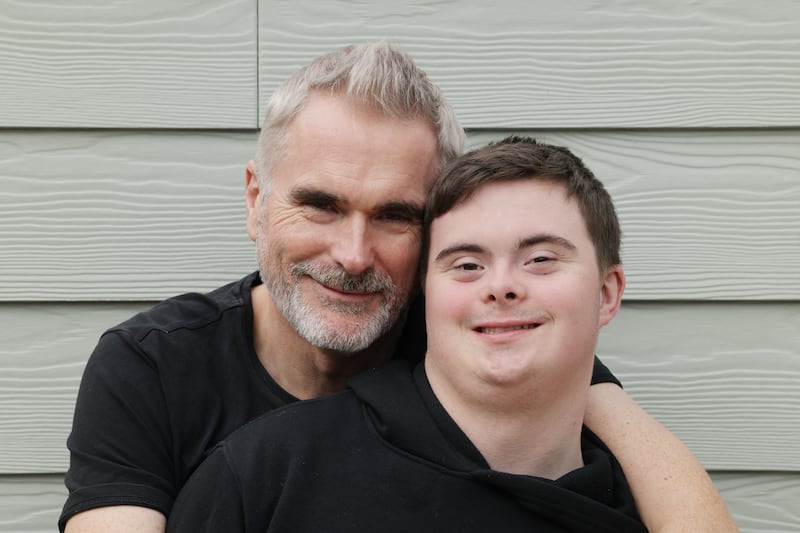 Joseph and Christopher Birchall. Photograph: Alan Betson
In response to queries from The Irish Times, the Department of Children, Disability and Equality says a key focus of the Government and the HSE is increased emphasis on longer-term planning for residential placements. As of last August, 142 new residential placements had been created and provided to people with disabilities out of 152 funded in Budget 2026, bringing the total number of residential places to over 9,000.
Budget 2027 brings the entire disability services budget to over €4 billion for the first time, it points out and, contrary to the BWD assertion, “it is not the case that just 100 places are available for individuals to transition out of their family home”, because funding “will also support a number of new placements into existing vacant places with necessary enhancements”. Government departments are, it adds, working with local authorities to set targets for housing people with disabilities for the first time.
Meanwhile Joseph, whose latest book is a crime thriller, Reported Missing (Poolbeg), will step back within two years from an online business he runs with his brother. He wants and will need to spend more time with Christopher, who currently attends St Michael’s Grosvenor School in Leopardstown but that will stop at age 18.
“There are adult services but nothing is guaranteed,” says Joseph, who has an older daughter from a previous relationship. He and his wife have always regarded Christopher as their responsibility and never want their younger son, Jamie (13), to have to take that on. They hope Christopher will have the chance of further education, a part-time job, and, ideally, could move into residential care nearby, returning home at weekends.
“Christopher has surprised us his whole life and, if anything, we’ve learned not to put limitations on him,” says Joseph, who has no doubt his own retirement will be enhanced by his eldest son.
“I like being who I am when I’m with him. He brings an energy and a youth to me – and a purpose.”