
Analysis: The psychological motivations behind this popular phenomenon include mating, community, online connections, wellness and nature
This article is now available as a Brainstorm podcast and can be heard above. You can also subscribe to the Brainstorm podcast through Apple Podcasts, Stitcher, Spotify or wherever you get your podcasts.
By Isobel Walsh, Adam Daly and Alex Neuroth, DCU
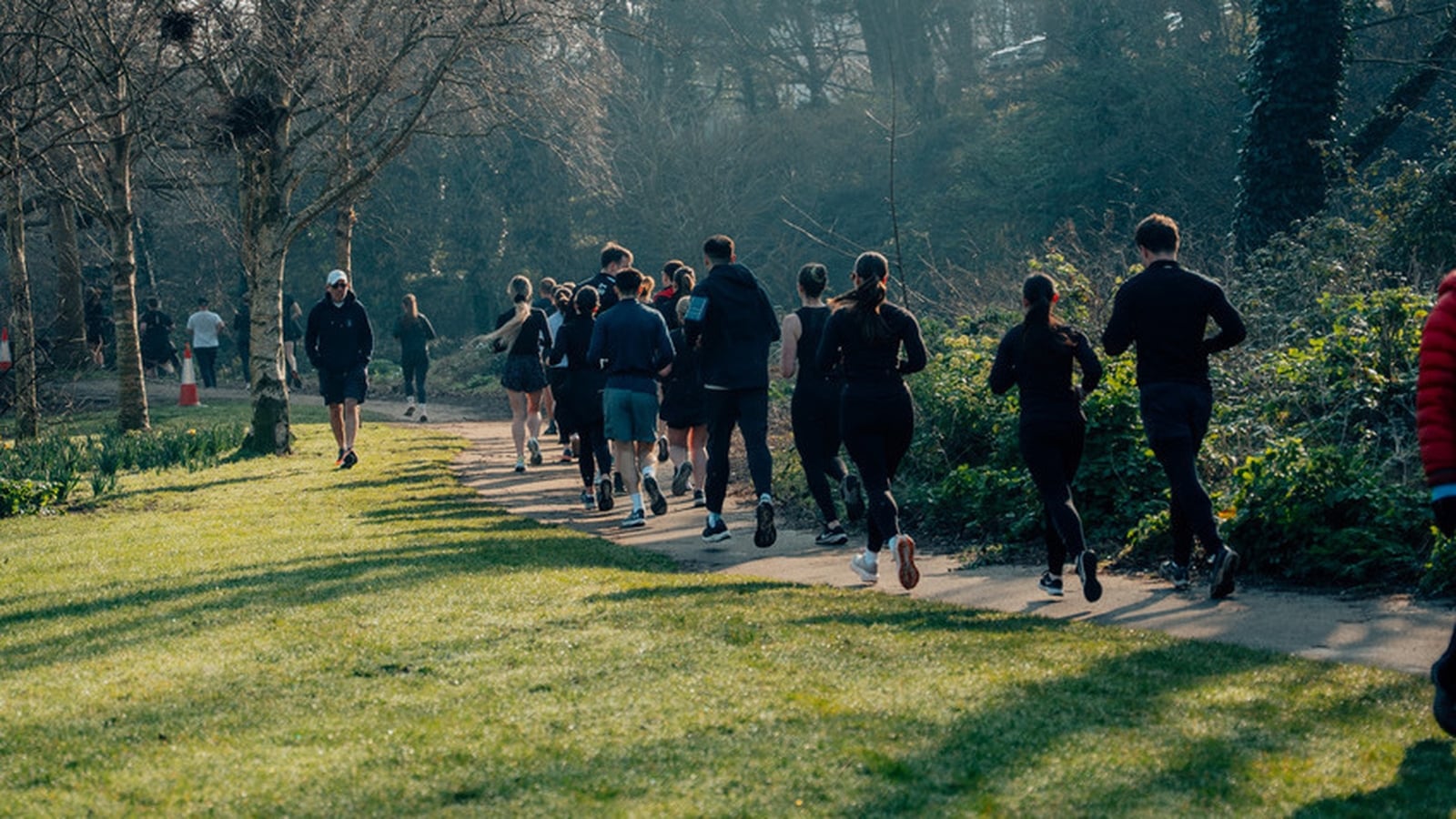
Red-faced, hot, sweaty and tired: why would anyone want to run in public, let alone join a club to do it? We all know regular exercise is good for us, but that doesn’t fully explain the recent popularity of run clubs. Psychologically, run clubs can be understood as a modern-day ritual: a repeated practice performed in a specific way, imbued with symbolic meaning. Consider the sweet treat-themed run clubs popping up all over Dublin, where folks force themselves out to the local bakery at the crack of dawn on specific weekdays, run distinct routes and identify themselves as part of a particular group.
Humans have evolved to engage with ritual behaviours (in this case, putting ourselves through a 5k before 10am) so that we might enjoy the associated benefits of connecting with each other. If we think of run clubs as rituals, it allows us to start considering the psychological motivation behind this popular phenomenon.
We need your consent to load this rte-player contentWe use rte-player to manage extra content that can set cookies on your device and collect data about your activity. Please review their details and accept them to load the content.Manage Preferences
From RTE Radio 1’s Today with Claire Byrne, can running clubs improve your speed?
Running to attract a mate
One potential motivation concerns an age-old animal behaviour: attracting a mate. Singles run-club events, personal accounts, and survey data all suggest that run clubs have become a feature of the modern dating scene.
This behaviour could be explained using signalling theory. For example, peacocks are viewed more favourably by potential mates if they are in possession of large and colourful tail feathers (the larger and more colourful, the better). In theory, this is because the feathers act as a costly and honest ‘signal of fitness’.
A ‘costly’ signal shows potential mates that an animal can bear the survival risks of living with, for example, flamboyant but cumbersome tail-feathers which make escape from predators more challenging. A peacock’s tail-feathers are also ‘honest’ signals of their fitness, since the peacock cannot ‘fake’ survival with their extravagant plumage – they either live with their luscious looks, or become prey in the food chain.
We need your consent to load this rte-player contentWe use rte-player to manage extra content that can set cookies on your device and collect data about your activity. Please review their details and accept them to load the content.Manage Preferences
From RTÉ Radio 1’s News at One, reporter Florence Okojie speaks to people who have ditched the dating apps to try and find a partner through a singles running club
Comparatively, runners may be ‘peacocking’ their fitness and friendliness through participating in run clubs. These signals are honest because it’s fairly difficult to fake running a 10km, and it’s also hard to maintain relationships within a club without displaying, at the very least, platonic commitment. These signals are also costly because of the energy and time expended in regularly running with a club. All this contributes to sending out attractive and trustworthy signals to potential mates. However, not all costs are made equal – if you think affording the increasing price of post-run flat whites is enough to show off to your crush… some re-evaluation may be needed.
Building a community
Mating isn’t the only possible motivation for engaging in the run club ritual. Would-be runners may be motivated by a related human need: community-building. In a society which is increasingly concerned with promoting social health and tackling loneliness, run clubs offer a low-cost, relatively accessible, mobile ‘third space’ in which we can meet and connect with like-minded others.
Unlike traditional third spaces (essentially, social settings outside of our homes and workplaces), run clubs are defined less by location and more by routines and relationships. Doing behaviours in the same place at the same time as other group members promotes a sense of cooperation, connectivity, and collective identity. Run clubs are, quite simply, hubs for bonding experiences.
From RTÉ News, how the Runners High Dublin run club for women is gathering pace
In her article, Saoirse Hanley highlights the central role of community-building in modern run clubs. Run club organisers here describe supporting local businesses through their bakery-centred routes, and supporting connection between runners through their relaxed, conversation-friendly running pace. In the midst of a cost-of-living crisis, run clubs provide a flexible third space that you can access for, at most, the price of a coffee.
The social media factor
Fitness signalling and community-building are no longer constrained to the physical world. Although social media continues to be a double-edged sword in conversations around technology and wellbeing, social networking apps do serve to enhance the community-building of run clubs. By posting and commenting online, we can hold each other accountable to the necessary behaviours of the run club ritual from a distance.
Social media provides opportunities for conducting new ritual practices on previously unheard of scales and timelines. With rallying cries delivered through WhatsApp group chats and personal bests flaunted on Strava, one could argue that the modern run club could not have evolved without social media – individuals may feel the need to participate or risk missing out on the advertised healthy exercise, communal fun, and tasty pastries.
Connecting with nature
A longing to reconnect with nature may also partially explain the rise of run clubs. Fischer and colleagues describe an intricate evolutionary relationship between ritual behaviour in humans and the natural environment. Connecting with nature fills us with positive emotions, reduces stress, and restores resources to our tired and wired brains.
Simply existing in green and blue spaces (natural outdoor environments) also encourages us to be physically active. It may be that a longing for nature connectedness leads people to join run clubs, and the exposure to blue-green spaces keeps them coming back for more.
Wellness culture
However, run clubs aren’t all sunshine and lattes. Run clubs are gaining popularity within a modern wellness culture which can sometimes take physical fitness to extremes. Rachel White argues that within this culture, we consider our bodies to be ‘projects’, something that requires curation, optimisation, and surveillance. Being healthy is not only a medical concern, but a social currency, where a visibly ‘fit’ body garners significant social wealth.
Whether it’s for fitness, finding friends, or fanciful pastries, run clubs provide a fascinating case study for modern human behaviour
In some cases, run club membership requires you to have the ‘right’ gear, pace, and body size, otherwise you run the risk of being isolated from the group. These kinds of ‘aesthetic hierarchies’ are by no means unique to run clubs, but this phenomenon nonetheless demands some further reflection and research.
Assuming that their members are not simply indulging in masochism, we must conclude that run clubs are meeting some pressing need for people all over the country. Whether it’s for fitness, finding friends, or fanciful pastries, run clubs provide a fascinating case study for modern human behaviour.
Follow RTÉ Brainstorm on WhatsApp and Instagram for more stories and updates
Isobel Walsh and Adam Daly are PhD researchers in the School of Psychology at Dublin City University. Alex Neuroth is a Research Assistant at the School of Psychology at Dublin City University
The views expressed here are those of the author and do not represent or reflect the views of RTÉ