
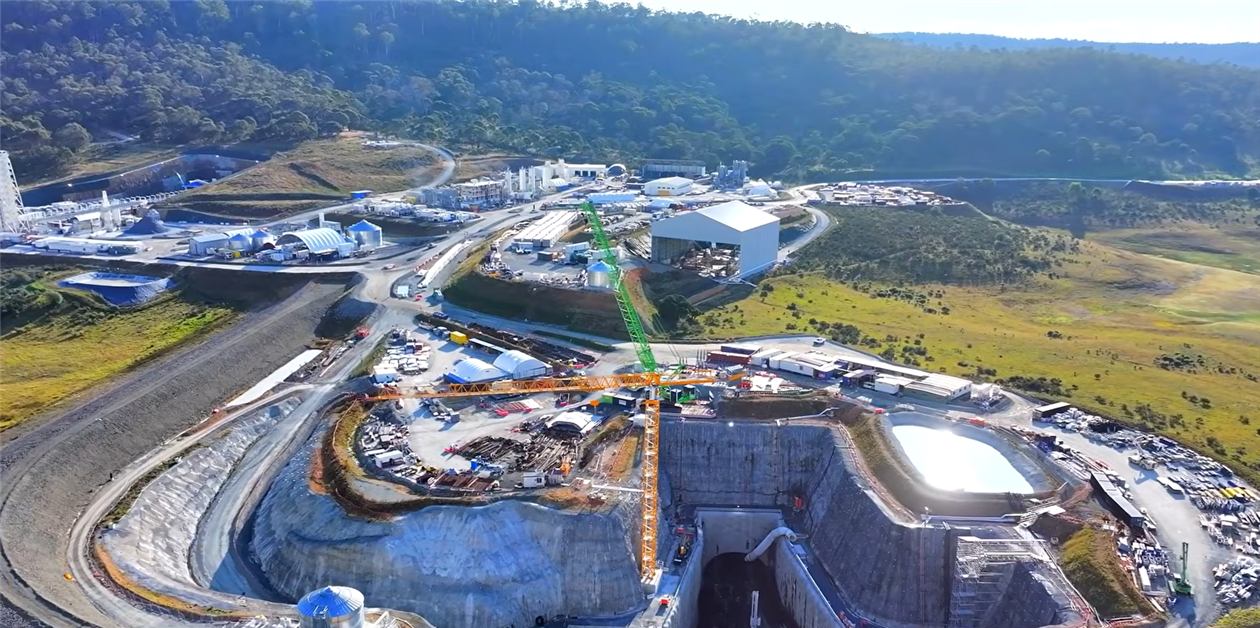
 Snowy 2.0 (Image: Snowy Hydro)
The bill for the Snowy Hydro 2.0 megaproject in New South Wales, Australia, is now set to cost more than ten times its original budget and could reach A$25 billion (US$17.6 billion).
That’s according to the latest reassessment of the pumped storage project, as it moves towards commissioning in 2029.
The 2,200 MW Snowy Hydro 2.0 was first announced by Australia’s then-Prime Minister Malcolm Turnbull in 2017, when it was expected to cost A$2 billion and take four years to complete.
The Future Generation Joint Venture (FGJV), which comprises Webuild, Clough and Lane, is responsible for linking two existing Scheme reservoirs, Tantangara and Talbingo, through 27km (16.8 miles) of tunnels and a new hydroelectric power station located approximately 800 metres underground at Lobs Hole.
The power station will feature six reversible turbines to allow for water to be released for energy generation during times of peak electricity demand and then pumped back up to the top reservoir at times of excess wind and solar.
But the project, in the remote Snowy Mountains of Australia has proven much more complex than originally envisaged.
Costs spiralled and delays stretched out until a project reset in 2023 put the revised cost of construction at A$12 billion and expected completion in 2027.
While the project has hit more of its milestones since that reset, the latest reassessment puts machine tunnelling at 65% complete and cavern excavation 90% complete. Work to build the underground power station is now underway. Drill and blast tunnels are 95% complete, having only been 20% complete at the time of the reset.
The reassessment puts the cost of Snowy 2.0 at A$22.2 billion (US$15.6 billion), with an allowance for that to rise to A$25 billion (US$17.6 billion) in the event of a “higher cost scenario”.
Snowy Hydro chief executive Dennis Barnes, who was appointed in 2023, said, “I have no doubt that moving from a fixed price contract, which was never suitable for such scale, uniqueness and complexity, has protected the project from an even greater cost increase.
“It’s also likely that under a fixed price contract, the project would again be stopped under the weight of billions of dollars of claims from the contractor, as it was prior to the reset.”
He added that more than half the total energy storage the gride needs by 2050 will come from Snowy 2.0 alone.
Snowy Hydro also set out the main reasons why the megaproject’s budget has blown out to the extent that it has.
The four primary reasons were:
The design of the project was immature when the final investment for the project was made and did not reflect the full complexity of the project. Snowy Hydro said detailed technical analysis is continuing to identify the scale and nature of the design immaturity.
Contractor FGJV failed to meet productivity targets as a result of the construction complexities.
Snowy Hydro accused FGJV of underestimating the delivery scope as a result of cost and planning underperformance.
Meanwhile, the last several years have seen significant inflation on equipment, services, and people, which exceeded the allowances made at the 2023 contract reset.
In a bid to get control of the project’s costs and delivery, Snowy Hydro has driven changes in FGJV’s leadership, including a new project director responsible for daily cost and schedule performance on the ground and a “broad uplift” with more senior and globally experienced megaproject leaders drafted in.
It has also directed FGJV to establish a project control office with “enhanced data and analytics” to drive productivity and identify emerging risks earlier, as well as embedding independent infrastructure delivery and cost experts into the project. And it has established a new board oversight committee including external megaproject advisors.
“We’re now much further through the project than at the 2023 reset, meaning we’ve learned more and more risk is behind us,” Barnes said.
“At the reset, only 44% of the construction design had been completed, now it’s 96%. While there are still risks to manage, the project is in its strongest position yet.”
Around 5,000 people continue to work on the project and are expected to remain for some time to come, which is one of the significant drivers of the cost overrun.