
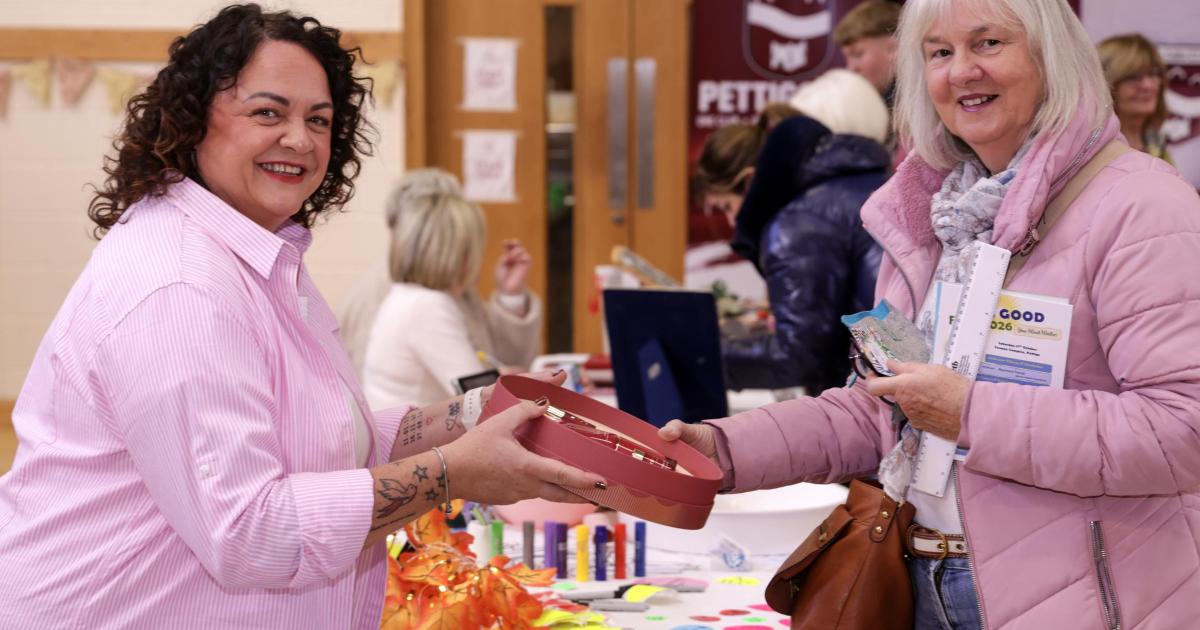
For the ‘Feel Good Fair 2026’ had something for everyone in the audience as three eminent speakers lifted the veil on the ‘hidden illness” with some practical tips on how to cope with the dark dogs of anxiety and depression.
But it was not just about better mental health as there were over 26 exhibitors with local produce and wares for the around 150 attendees to peruse.
And there were timely breaks for some chair Pilates, social interaction and lots of tea and treats which made this a pretty unique event.
The three speakers, Raymond Farrell, Annes Gallagher and Anna Marie Brosi outlined the coping mechanisms to live fuller richer lives in concise easily understood language stressing, connection, self- appreciation and the dangers of isolation in an increasingly impersonal world.
One of the organisers, Maureen Boyle said they had a similar event ten years ago in the same location.
“But lots of things changed in those ten years, but there are constants and there is a continuing need for people to just take time for themselves to be aware of how their environment and what they do can affect their mental health an general well- being.
“So, we wanted to bring together what’s available locally and nationally, what support services are there, what’s on offer to people in their own community to help them in their general well- being and their mental health.
“We also have over 26 exhibitors with different businesses and the different support services to showcase what is out there and encourage people to connect with other like- minded people.”
Ballinamallard based Raymond Farrell stressed the need for “positive social connections.
The mental health practitioner said “low levels of social connection are linked to depression, anxiety and in some cases violence and aggression.
“It is also acknowledged to be as bad for your health as smoking, obesity and hypertension.
“On the contrary, positive social connection is a good predictor of greater psychological well- being and increased immunity.
He continued:
“We as humans are created to resonate with others- we mirror their expression whether it’s a smile or a frown.
“From the womb we become familiar with our mothers heartbeat, our senses are being nurtured and developed before we are even born.
“The infant’s cry is being comforted at birth by the safe arms of its mother and together with her reassuring voice , a sense of security is being established.
But when we grow up it is a different picture.
“In adulthood the vulnerability to social disconnection increases but we can become very good at hiding it.
“Someone who appears well connected can be lacking any real meaningful relationship. Robin Williams the American actor who made a living out of making people laugh once said before his death;
“I used to think the worst thing in life is to end up alone- it’s not – it’s to end up with people who make you feel alone”
“The phone, the very thing that was invented to connect us can become the very thing that disconnects us.
“The average person can spend over three hours a day on their phone which equates to 52 days in the year.
“The banks and Post Offices that were a great means of connecting with people, especially in rural areas are increasingly disappearing from our towns and villages potentially increasing our levels of isolation. “The bank is fast becoming an appointment the Post Office is fast becoming an appointment and the helpful friendly face behind the counter is now becoming a screen.”
Meanwhile Mayor of Donegal Anne Gallagher, who is a member of Donegal Giving,gave a poignant talk on her own journey.
Widower Anne who sadly lost her Garda husband Charlie Gallagher in 2022, told of how she went “from hiding in the house to canvassing and knocking on people’s doors and asking people to vote for me and become their mayor.”
She added that her speech came from “my own challenges and my own fears and my own friendships that have got me through to become the woman I am today”.
Ms Gallagher said the Termon Complex itself was a place to come and momentarily remove ourselves from the “stress, struggles and pressures of everyday life.”
Ms Gallagher said she wanted to explore the footprints we leave behind us in this life.
“Because we might never really know the impact of a kind word, a little encouragement, an hour of our time or an opportunity that we give to someone else.
“But those things can stay with people for years.”
She added that there were a number of footprints of giving.
The first one is “to give to yourself.”
“It is something many of us find hard as we are very good at giving to everyone else.
“We can be very generous with our time and our energy which leaves very little left for ourselves.
“Sometimes if we take time for ourselves, we feel guilty about it.”
“When was the last time you were kind to yourself as you were to someone you loved.
“It could be something very ordinary, say no to something you are not able to do.
“We all have mental health issues and for years there was not the same emphasis on talking about feelings.
“But many people were brought up and told to just get on with it and no complaining, work hard and put others first.
“And as a race we are very good at brushing off a compliment.
“If someone says you are looking well, and you say sure I am only after throwing this old thing on.”
“We need to learn to accept a compliment without dismissing it.
“We all deserve the same kindness.
Time is the most valuable gift we can give anyone.
“It could be making a phone call you have been meaning to make, visiting someone who may be lonely and asking a person how they are, its sitting down with an older person and listening to their story that you may have heard before, but knowing that it matters to them.”
“We can underestimate what it means to someone when you give them your undivided attention.”
“We cannot solve a problem for another person, but we can make them feel less alone.
“People often forget what you say or what you did but nobody will ever forget how you made them feel.”
And Anne Marie Brosi, a coaching psychologist, explored how people become better in many respects.
“For years the whole research stressed how do we fix people, whereas now it is about how do we help people reach their potential.
“Well- being is the science that asks how do we function well and feel well in a world that over the past 50 years has gone a bit chaotic.
“The world is very busy due to technology and due to the progress of humanity.
“We are paying a price for progress for all our achievements over the last number of years.”
Ma Brosi said we have the potential to succeed but at the same time we have this brain that is millions of years old but is struggling with all this progress.
“And its struggling to keep up with everything.
“But if we are to look after ourselves and to feel good about ourselves, we have to intentionally look after our wellness.
“And we also need to be kind to ourselves as it helps anxiety and depression and it decreases all this mental illnesses and stresses that we have and increases our psychological ability to deal with our lives and it makes us happier and more resilient.
Ms Brosi said that common sense was a very important part of mental health well -being.
And “showing gratitude and having gratitude was such an important part of our well- being.”
“When we are grateful , in means we are stopping our comparison with everybody else and we start to recognise all that we have in our lives as opposed to all the things that we don’t have.”