
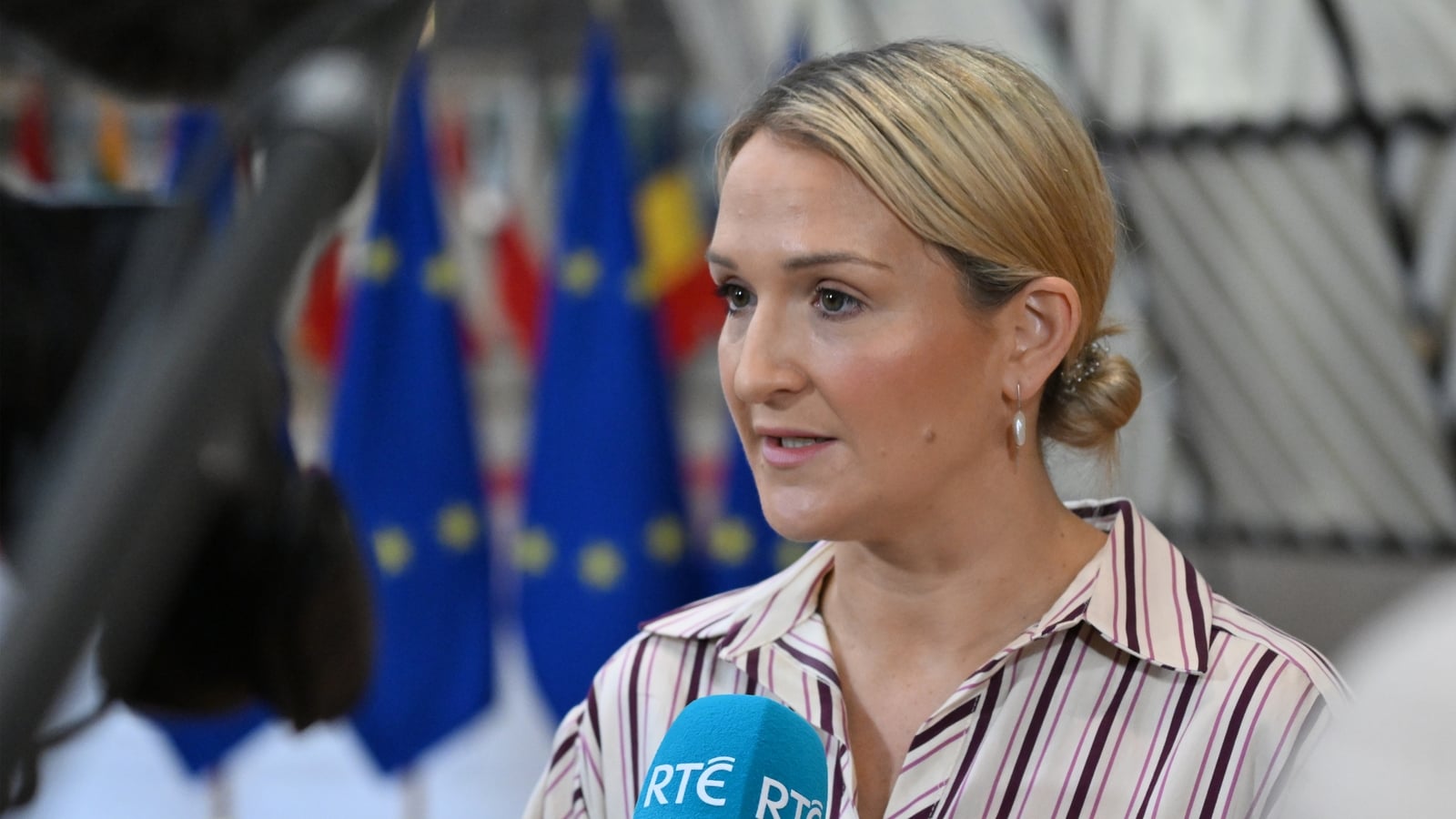
Irish troops should be deployed to Lebanon as part of a new EU mission and be involved in both peacekeeping and peace enforcement duties, according to the Minister for Foreign Affairs and Defence Helen McEntee.
Troops are currently deployed as part of the UN Interim Force in Lebanon (UNIFIL) but the mission ends at the end of this year following a Security Council vote, and the Defence Forces are due to withdraw by Easter.
Speaking on RTÉ’s This Week programme, she said: “I want us, and I know our troops in particular want, to be on the ground and working with their colleagues… Our troops want to continue that presence on the ground, and to continue to be able to support the Lebanese Armed Forces.”
A new EU mission to replace UNIFIL was passed by EU Foreign Ministers last month, however, Minister McEntee said: “We will not be able to do that if the Triple Lock is not reformed.”
We need your consent to load this rte-player contentWe use rte-player to manage extra content that can set cookies on your device and collect data about your activity. Please review their details and accept them to load the content.Manage Preferences
Asked if Irish troops participating in a peacekeeping role or peace enforcement role, Minister McEntee replied: “It’s likely to be both. And it’s important to stress that it currently the case now.
“There’s a misconception, or an attempt to suggest, that our troops are on the ground in one context, and one context only. Our troops are involved in peace enforcement at the moment.”
Asked if she would use the guillotine to ensure the Triple Lock legislation passes the Oireachtas before Christmas, which would no longer require a UN mandate before Irish troops could be deployed, the minister replied that she did not intend to rush matters but added: “I do plan to and would like to have this done by the end of the year.”
She contended that the Representative Association of Commissioned Officers were “very clear” last week of the “need to ensure that those joining the Defence Forces, those who are members of the Defence Forces, that they have opportunities to travel overseas… to put all of their training into good use”.
The minister said it was her “intention” to travel to the Irish peacekeeping headquarters in southern Lebanon today, UNP 2-45, and give medals to the soldiers “to recognise the significant contribution that they have made on the ground”.
She is also due to meet her Lebanese counterpart in Beirut and some of the aid agencies who are seeking to assist the thousands of people from southern Lebanon who have been forced to leave their homes in the south of the country by the Israel Defence Forces.
Irish neutrality ‘far more complex’ than Triple Lock debate – Labour
Labour TD Duncan Smith has said that removing the Triple Lock does not make Ireland a member of any common defence pact.
Speaking on the same programme, Mr Smith said Irish neutrality is “far more complex” than just the debate over the Triple Lock in recent weeks.
“It’s codified our relationship with the UN in terms of peacekeeping, and it is one expression of what our neutrality is and an important one at that.
“I’m a bit frustrated that this debate has been boiled down to save neutrality, remove or keep the Triple Lock. It is far more complex and nuanced and important than that,” he said.
Mr Smith added: “I was trying to make that point in the Dáil because we need to have a debate because this Government are silent about why they’re removing the Triple Lock.
“They’re being disingenuous to the Irish people because what they’re essentially doing is making a decision, and the decision is that the UN is broken, and I agree with that, but that we are not going to be committed to trying to fix the UN or try to take part in any UN peacekeeping missions, that we are in essence going to be throwing our lot in with the EU.”
We need your consent to load this rte-player contentWe use rte-player to manage extra content that can set cookies on your device and collect data about your activity. Please review their details and accept them to load the content.Manage Preferences
Mr Smith said that Labour have been speaking about a constitutional referendum on neutrality for years.
“We’ve had language since 2002 in the Labour Party on a constitutional referendum in relation to our neutrality and it is in essence that we wouldn’t join a military pact that would compel upon us action to defend another country and that anything would be done under the UN aegis,” he said.
“Other opposition parties might have different wordings for how they’d like to see a referendum and there is going to be difficulties in agreeing a wording but unfortunately that’s not what we’re discussing at the moment, and the minister is trying to rush this through,” Mr Smith said.
He added: “We can serve abroad in many different ways … What we had in our manifesto was that we would raise the limits for troops that you could send abroad to take part in training missions and others. That’s in the legislation as well.
“There were steps that the Opposition, like Labour, were going to take to ensure that we could take part with more flexibility abroad on missions that are in line with our values.
“But what’s going to happen here is this guardrail that we’ve had, which is kind of a difficult one, and I think I described it as such in the Dáil during the week, but it is a guardrail nonetheless, especially we’re in a world now where we have hegemonic powers like Russia, China, the United States and the EU is trying to operate a counter to them and we have the Russian threat on the eastern border.
“Poland’s going to have one of the biggest armies in the world and they’re all EU members. And in that context, we are now going to just throw our lot in with them for these foreign missions.”
Mr Smith said that that the Triple Lock was “a commitment to the United Nations, to multilateralism, that peace can only be achieved through global effort”.
“It might seem a bit aspirational, but I think it’s very important because the world is breaking down,
“The world is shifting dramatically and I’ve been at European conferences, I’ve also been at the United Nations and our debate is not mature enough in this country to understand the dynamics that are taking place in Europe because the Government haven’t led that,” he said.
Mr Smith added: “Instead of doing this we should be debating a national security strategy which is in the Government’s manifesto or in the Programme for Government.
“What’s not in the Programme for Government is removing the Triple Lock by the way, but a national security strategy is, and the Government refused to debate that they’re sitting on it.
“We should not be making any decisions in this area until we debate the security strategy.
“That is why this Government are being dishonest and disingenuous with the Irish people on this and that’s why we need to keep the Triple Lock at this time.”