
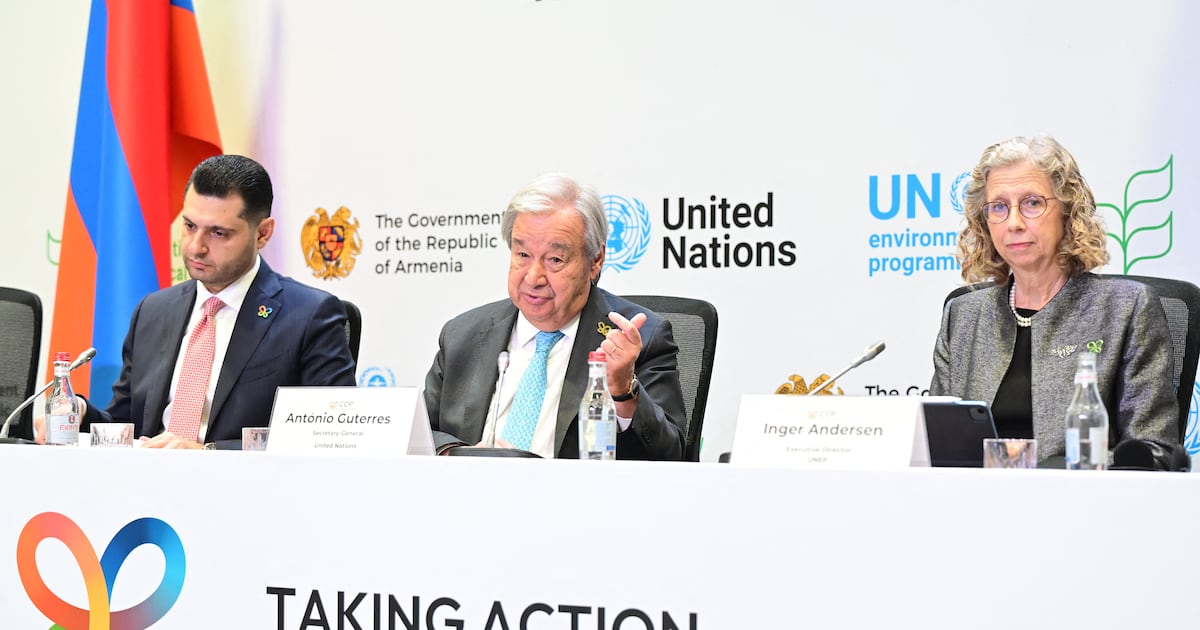
Irish wildlife champions are among thousands of politicians, officials, academics, campaigners, conservationists, industrialists and finance chiefs attending the Global Biodiversity Summit – or Cop17 – in Yerevan, Armenia.
Their task at the global summit, which started on October 19th and runs until next Friday, is to examine how a commitment made four years ago to halt and reverse nature loss by 2030 is playing out. Following on from this, they will aim to put in place supports to ensure it can be realised.
That commitment came 30 years after the 1992 Earth Summit in Rio de Janeiro produced the Convention on Biological Diversity (CBD). Under the convention, the world undertook to protect nature and use its resources sustainably and fairly.
In the three decades that followed, those promises were broken repeatedly, universally and disastrously.
So what has happened since 2022 when a renewed effort was pledged?
A World Wildlife Fund report published just before Yerevan put the loss of wildlife populations at 73 per cent in 50 years and said the “vast decline in nature at a global scale” was continuing.
The secretariat of the CBD said similar in their pre-summit report.
“Many of the critical elements of progress, including finance, capacity, co-operation and data are still missing in action,” UN secretary-general Antonio Guterres remarked.
“Nature won’t thrive on good intentions,” he warned.
Ireland can’t hide from those remarks. An assessment last year showed 90 per cent of protected habitats – and the plants and animals dependent on them – were unhealthy.
But the Irish government – when the Green Party was part of it – led the charge in a tough battle for the European Parliament to pass the landmark Nature Restoration Law in 2024, establishing aims that mirror the global 2022 agreement.
Ireland then became the first member state to submit its mandatory national Nature Restoration Plan to the EU.
So can Ireland and the EU hold their heads high at the Yerevan negotiations?
Fintan Kelly of the Irish Environmental Network is there with representatives of Fair Seas, the Irish Whale and Dolphin Group, BirdWatch Ireland, the Irish Wildlife Trust and Streamscapes. He acknowledges the good intentions but holds the same fears as Guterres.
“The EU will arrive to the table and say, ‘look, we’ve got this world-leading law, we’re in the process of implementing it, member states have their national plans so trust us, we’re doing this’. But we’re there to point out this isn’t the full picture,” he said.
Kelly cites the ending of the EU’s LIFE projects, which have been critical for localised nature restoration. He also criticises the lack of funding for environmental protection in the new Common Agricultural Policy package and the proposed weakening of environmental assessment requirements in the Birds and Habitats Directives.
The next seven-year EU budget currently under negotiation also proposes cuts in funding for the environment and there is no EU-wide, or Irish, fund to support action under the Nature Restoration Law yet.
“We want to set up meetings with MEPs and point out we’re really concerned about the direction of travel,” Kelly said of the campaigning opportunities the Irish organisations hope to grab while in Yerevan.
Jane Stout, professor of ecology at Trinity College Dublin, has just returned from Yerevan and describes the first week of negotiations as “a mixed bag” of positivity and concern.
“The positivity is around the fact that all the governments are there and the reach of the CBD is expanding,” she said. “When it was first ratified back in 1992, for example, private businesses were not even mentioned and they were seen very much as the problem. Now they’re seen as part of the solution, so there were lots of sessions on business and biodiversity.
“On the one side, that’s positive and hopeful because it’s bringing more people into the conversation. On the other side, it’s a reflection of the fact that they’re starting to worry that this isn’t just an environmental problem.”
Stout is referring to the belated realisation that once water becomes too polluted to use and soils too depleted to grow anything, once pollinators disappear and oceans stop supporting marine life, almost every industry loses its raw materials and the vital services that nature provides.
Wrangling finance out of industry and the richer countries to support a turnaround in nature’s fortunes is a key focus of the summit.
Minister for Nature Christopher O’Sullivan is in Yerevan and acknowledges Ireland has yet to put its own money where its good intentions lie.
“I have been working with colleagues across Government to establish a dedicated nature restoration fund for a number of months,” he said, adding he hoped to “be in a position to share more information soon”.
On the wider issues, he said his approach to the talks would be to emphasise what is at stake.
“We’re not on track to meet our 2030 targets, [which is] putting people, the economy and the wider environment – as well as wildlife and habitats – at risk of significant consequences,” he said.
“What we’re saying, as both the EU and as Ireland, is that we can’t give up. We need to do more. We need to work together to change this awful trajectory and protect the diversity of life on this amazing planet.”