
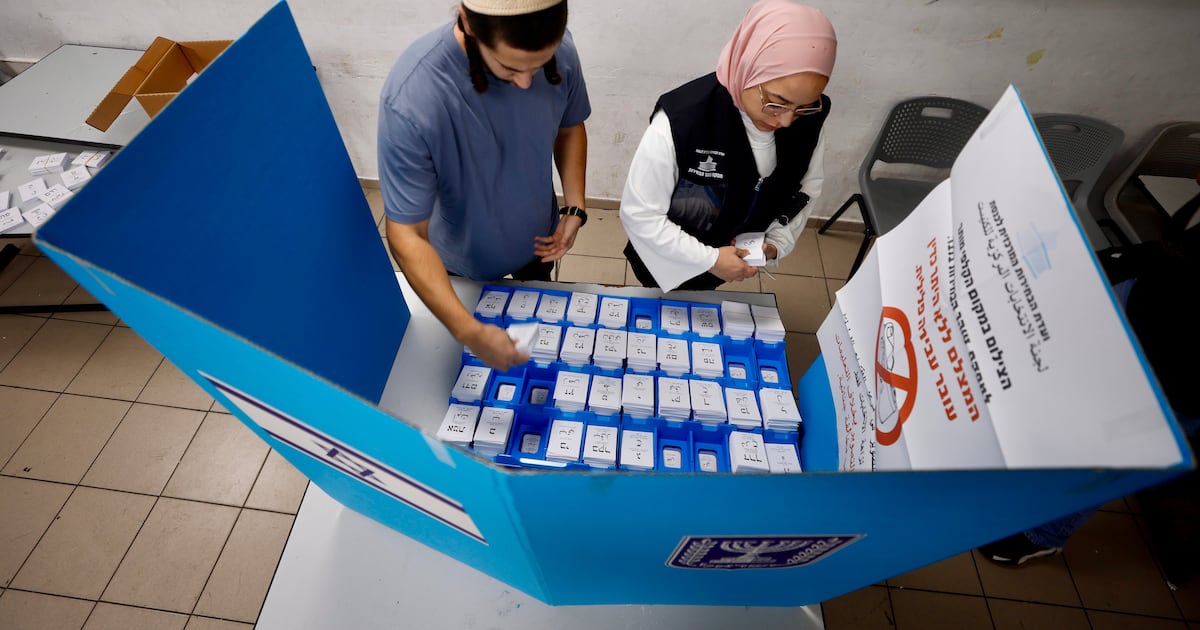
Israelis were on Tuesday voting in an election that many regard as the most important in the country’s near-80-year history, one that offers a choice between two radically different visions of its future.
The poll, the first since Hamas’s October 7th 2023 attack on Israel, pits prime minister Binyamin Netanyahu’s far-right coalition — which has ruled the country for four years — against a bloc of Jewish opposition groups centred around former general Gadi Eisenkot’s Yashar party.
By 2pm local time, turnout had reached 44.7 per cent, the highest figure recorded by that time on election day since 1973, with politicians from all camps urging their supporters to vote and queues forming at some polling stations.
In an effort to rally his base, Netanyahu said political leaders from Israel’s Arab minority — who make up a fifth of the population — were claiming that their voters were flocking to the polls, and exhorted right-wing supporters to do the same.
“The voter turnout there is very high. We are the ones who need to flock to the polling stations,” Netanyahu, who has repeatedly deployed divisive rhetoric to lash out at his opponents, said after voting in Jerusalem. “We can’t leave the battle here in the hands of the left and the Arab parties that want to bring an end to the Jewish state — that’s what’s at stake.”
[ Israeli elections: what you need to know Opens in new window ]
Opinion surveys suggest the race is on a knife-edge, with neither Netanyahu’s coalition nor the Jewish opposition parties on course to win an absolute majority in Israel’s parliament, unless they renege on pre-election promises not to rely on the backing of Arab parties.
Whether anyone can form a government is therefore expected to depend on post-election deal-making, which will be overseen by Israel’s president Isaac Herzog and could last several weeks.
However, the choice is widely seen as being as stark as any put before Israeli voters. “[This] is not about one settlement or one economic policy or one specific issue,” said Shmuel Rosner, an Israeli pollster. “It’s about the core identity of this place.”
Members of Netanyahu’s coalition, the most right-wing in Israeli history, are proposing measures ranging from emptying Gaza of Palestinians and annexing the occupied West Bank to resuming a controversial judicial overhaul that sparked months of protests when they launched it in 2023.
The opposition has pledged to reverse the parts of that overhaul that have already become law, launch a state inquiry into the failings surrounding October 7th and end the decades-old exemption from military service for ultra-Orthodox Jews — long a source of contention among other Jewish Israelis.
Netanyahu’s Likud party and its allies, who were in power on October 7th, have resisted calls for a state inquiry. Their coalition, which includes two ultra-Orthodox parties, has also repeatedly put off passing legislation on ultra-Orthodox conscription.
As voting got under way on Tuesday, multiple parties alleged that there had been voting irregularities. However, the electoral commission said there was no evidence of systematic tampering with votes.
The final days of campaigning have taken place in an increasingly febrile atmosphere, with Netanyahu seeking to portray himself as the only person who can protect Israel from Iran — which he insists is racing to build nuclear weapons — and other external dangers.
In a television interview on Sunday, he pledged to resume the US-Israeli war against Iran, and posted an article from a right-wing activist warning of a “second Holocaust” if he were not re-elected, illustrated with an image of a mushroom cloud over Tel Aviv.
Opposition politicians have hit back, accusing the veteran prime minister of playing politics with Israel’s security. “The man on whose watch the greatest disaster in the state’s history occurred refuses to understand that Israel’s security is not a political bargaining chip . . . and the State of Israel is not his personal property,” Eisenkot wrote on X on Sunday.
Many Netanyahu voters are unmoved by such criticisms. “The most important thing about this election is that Netanyahu will win,” said Moti, a start-up founder who voted in the settlement of Efrat in the West Bank and declined to give his second name. “He is a diplomat. He is strong. He has what it takes to be a leader.”
But others believe fresh leadership is needed. “I always voted for [Netanyahu]. But October 7 was the tipping point. To reach this type of situation did not take one or two weeks. It was 25 years in the making,” said Sharon, an English teacher from the town of Gedera, who declined to give her second name and said she would vote for B’Yachad, which is part of Eisenkot’s opposition bloc.
“I asked my students what other country has someone who has been in power for 20 years. And they said Russia. We need a change.”
The final result will depend on which parties make it into Israel’s 120-seat parliament. The final polls from last week suggested that Eisenkot’s bloc would win about 54 seats, Netanyahu’s coalition about 50, and the Arab and unaligned parties would win the remainder.
However, the outcome could deviate from pollsters’ forecasts depending on how many small groups cross the 3.25 per cent electoral threshold.
Herzog has said he will do everything in his power to avoid a series of inconclusive elections, such as the cycle that played out between 2019 and 2021, raising the prospect that he could push Eisenkot and Netanyahu to form a national unity government if neither can build an administration on their own.
However, if no politician can command a majority in the new Knesset, fresh elections would have to be called. – Copyright The Financial Times Limited 2026