
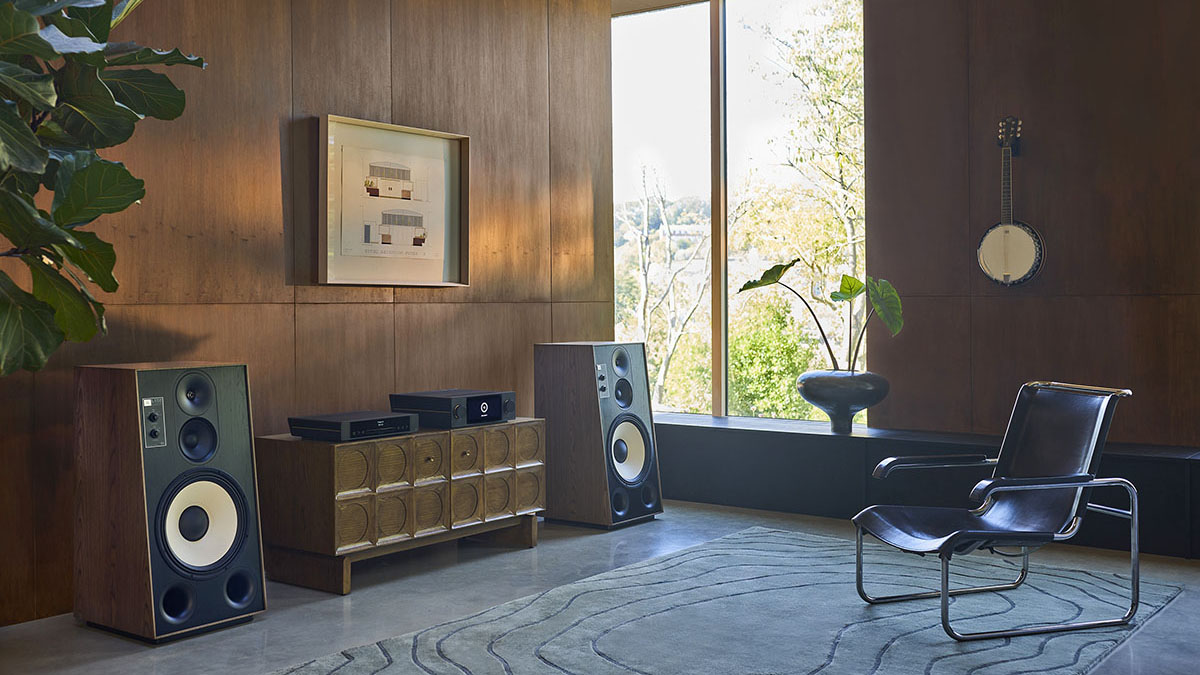
Harman Luxury Audio Group has announced the JBL L150 Classic, a three-way loudspeaker that combines modern acoustic engineering and takes the brand’s familiar walnut veneer and Quadrex grille design into a larger, angled cabinet profile. Combining a 15” Differential Drive woofer, dedicated pulp-cone midrange, and titanium dome tweeter, the new Classic Series flagship adds adjustable bass and treble voicing and bi-amplification capability. Availability is scheduled for 2027, priced at $9,999 per pair.
Harman Luxury Audio Group has announced the JBL L150 Classic, a three-way loudspeaker that combines modern acoustic engineering and takes the brand’s familiar walnut veneer and Quadrex grille design into a larger format, angled cabinet profile. Combining a 15” Differential Drive woofer, dedicated pulp-cone midrange, and titanium dome tweeter, the new Classic Series flagship adds adjustable bass and treble voicing and bi-amplification capability. Availability is scheduled for 2027, priced at $9,999 per pair.

Introduced publicly at Audio Video Show 2026 in Warsaw, Poland, October 23–25, the L150 Classic extends JBL’s ongoing development of home loudspeakers inspired by its 1970s designs. Beneath the recognizable exterior, the technical focus is on a large bass transducer with JBL’s Differential Drive motor architecture, a dedicated midrange operating between 310Hz and 1.8kHz, and a waveguide-loaded tweeter. The combination brings a different scale and acoustic configuration to a family previously anchored by the L100 Classic.
Differential Drive provides a substantive connection to JBL’s professional transducer engineering. The architecture uses two in-line voice coils operating in separate magnetic gaps, with reverse winding directions and opposing magnetic fields arranged so that both coils drive the diaphragm in the same direction. Introduced in the JBL EON system in 1995, the concept gives engineers additional freedom to manage motor geometry, heat removal, and weight. Those principles are relevant to a large home loudspeaker expected to reproduce substantial low-frequency output.
The announcement arrives during JBL’s 80th anniversary year, continuing the connection between the brand’s professional audio origins and its consumer loudspeaker business. Founded by James B. Lansing, JBL established its reputation through transducer development and systems for recording, cinema, and sound reinforcement, alongside an enduring presence in home audio. The Classic range has become a continuing product development platform within that portfolio. Earlier audioXpress coverage traced its expansion through the L100 Classic 75 and SA750 integrated amplifier. More recently, the L100 Classic 80 anniversary edition retained a three-way configuration with a 12-inch woofer, polymer-coated pulp midrange, and titanium dome tweeter. The L150 expands both woofer and midrange diameter while adopting a floorstanding enclosure with its own sloped baffle.

For the L150 Classic, JBL specifies a 15” pure pulp cone woofer supported by a cast frame, paired with a separate 6.5” (165mm) polymer-coated pure pulp midrange, also using a cast frame. The 310Hz lower crossover assigns the large woofer the bass region while leaving most of the vocal range to the dedicated midrange. Above 1.8kHz, a 28mm titanium dome tweeter operates with an acoustic lens and waveguide. This gives the high-frequency section an acoustic structure for shaping radiation, an important part of integrating a small dome with a substantially larger cone driver.
There is a useful parallel with JBL’s development of the 4369 Studio Monitor. That model also employs a 15” Differential Drive woofer, but combines it with an annular-ring compression driver and HDI horn in a two-way system. The L150 applies the brand’s large-format woofer expertise to a different three-way dome-tweeter design.

The L150’s vented enclosure uses two front-facing ports, while the angled cabinet profile directs the sloped front baffle toward the listener. JBL specifies a frequency response of 33Hz–22.5kHz with the low-frequency control at its nominal 0dB setting, changing to 30.5Hz–22.5kHz at the +2dB setting. These are manufacturer-stated response ranges; the supplied specification sheet does not identify a response tolerance. Independent front-panel high- and low-frequency controls provide adjustment for room conditions and listening preferences, with the quick-start guide identifying the default settings as the balanced response under anechoic conditions.
The crossover network has separated high- and low-frequency sections, accessible through dual sets of gold-plated binding posts for bi-wiring or bi-amplification. Nominal impedance is 4Ω, sensitivity is specified at 88dB with 2.83V input measured at 1m. This means the L150 Classic speakers call for an amplifier comfortable driving 4Ω loudspeakers, with enough current capability to maintain control during demanding bass passages. JBL recommends 25–250W RMS, leaving room for both integrated amplifiers and separate power amplifiers. The appropriate power will depend on room size and listening level, with more powerful amplification providing useful headroom for dynamic peaks in larger spaces.

Natural walnut veneer and a magnetically attached black Quadrex foam grille complete the familiar Classic presentation, but the dimensions make its position in the range clear. Each loudspeaker measures 935 × 470 × 539mm, including the grille, and weighs 52kg. The supplied guide also recommends at least 51cm clearance from surrounding walls, giving prospective installations a more realistic footprint than the cabinet dimensions alone suggest.
The JBL L150 Classic will be available in 2027 at a suggested retail price of $9,999 per pair. Further product information is available on the [JBL L150 Classic website.
www.jbl.com