
Rank-and-file gardaí will engage in five days of work-to-rule action next month, coinciding with a major EU Presidency meeting of leaders in Dublin on 13 November.
It follows a meeting of the Garda Representative Association Central Executive Committee.
The work-to-rule, which is being staged over dissatisfaction with garda working conditions, will commence on Tuesday 10 November and run until Saturday 14 November.
This includes the European Political Convention on 12 November, as well as the informal meeting of the EU heads of state or government on 13 November.
The GRA said it will meet on Monday to discuss ‘further accelerated actions’
In an update to members, the GRA said it is not ruling out a further escalation of action.
“The GRA’s executive will now meet on Monday morning, accompanied by their legal counsel, to discuss this position and further accelerated actions right up to and including a withdrawal of services,” said GRA General Secretary Ronan Slevin in the message to members.
The work-to-rule motion urges all members stationed in the Dublin Metropolitan Region (DMR) should report for duty at their home station at the beginning of their tours of duty and wait to be transported to their points of duty.
It also states that all members within 100km of their points of duty in the DMR and Shannon should report to their home station and wait to be transported to their points of duty.
“All members who are stationed more than 100km from their points of duty (in the DMR and Shannon) should not use their private vehicle to get to, or from, their points of duty during the extraordinary event,” the GRA said in its message to members.
The GRA has accused the Garda Commissioner Justin Kelly and garda management of breaching the Working Time Agreement and the European Working Time Directive.
In a statement, Mr Kelly said overtime would be reduced shortly in response to “complaints by the GRA”.
The garda commissioner said the reduction in the amount of overtime available will happen “once we complete some forthcoming major events”.
He said gardaí had “to work long hours and put a lot of effort in” as a result of major events, including a visit by US President Donald Trump, the EU Presidency and “a number of large-scale investigations”.
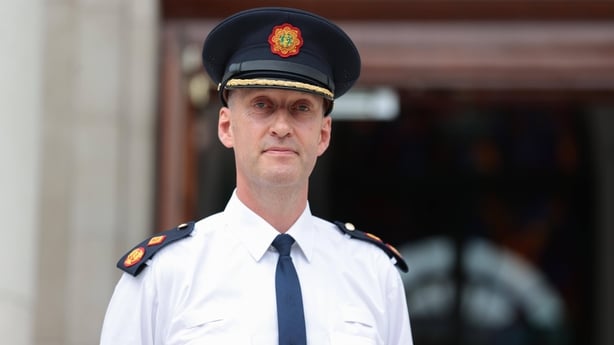
Justin Kelly said the vote taken by the GRA did not represent the majority of the organisation
Speaking in Co Cavan, Mr Kelly said: “I’m not unsympathetic to members of An Garda Síochána.
“I know they’ve worked long hours, they’ve put in a lot of effort for us, and I certainly do appreciate it.”
Earlier this week, the GRA published the results of a survey of its members, which it said showed that over 90% of the gardaí who responded are prepared to take action because of their dissatisfaction with their working conditions.
It said 45% of their members, over 4,000 gardaí, responded to two questions about their preparedness to take part in a work-to-rule, and to do so during the EU Presidency.
Of those who responded, 4,182 gardaí said they were prepared to take industrial action, while 3,977, or 93.6%, said they would do so during the EU Presidency.
Mr Kelly said the vote taken by the GRA did not represent the majority of the organisation.
He said: “It’s important that I do say: This is a minority of people in the organisation.”
Around 4,000 people said there should be consideration around industrial action, he said, adding “we have 18,500 people in the organisation – 14,800 are sworn”.
“So, in the overall organisation of sworn members, it’s only about a quarter of the people we’re talking about,” he said.
Ahead of the announcement of the work-to-rule, Tánaiste Simon Harris said Ireland has the capabilities to protect European leaders who will gather in Dublin for the two major summits next month.
Mr Harris said the Government is taking the security of the events “extraordinarily seriously”.
He had also expressed hope that members of the gardaí would not opt to engage in work-to-rule industrial action during the summits.