
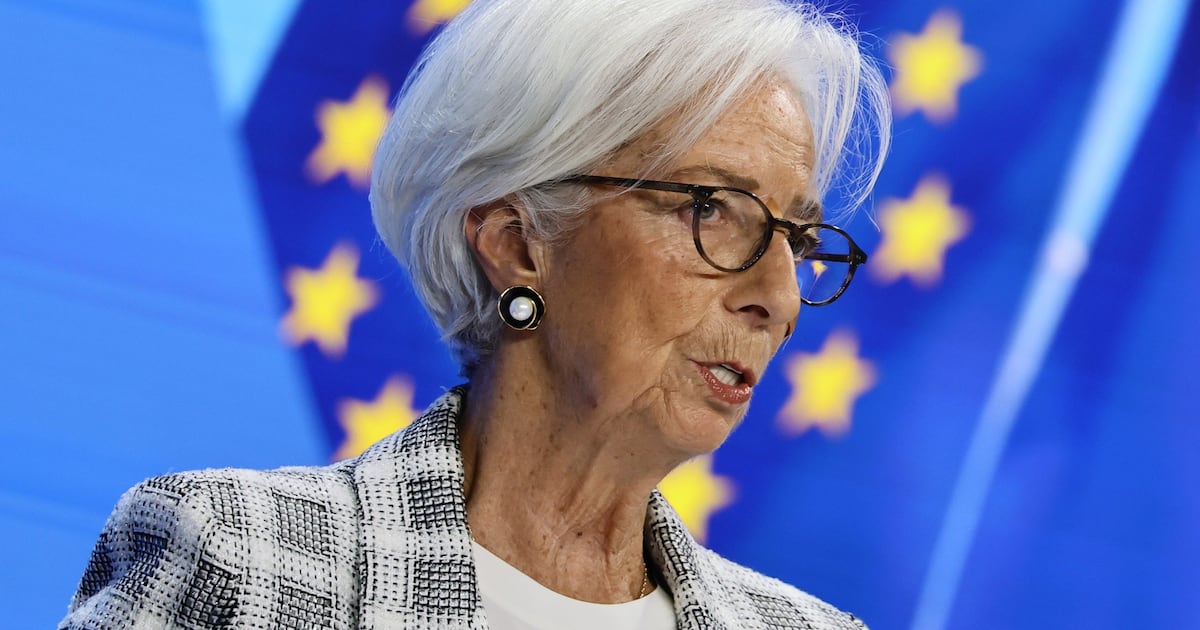
The European Central Bank (ECB) paused its run of interest rate hikes on Thursday at a meeting overshadowed by president Christine Lagarde’s announcement earlier in the day that she will leave her post next February, nine months before her term ends.
Her departure comes as the ECB battles a renewed surge in energy prices and as bond-market turmoil, particularly in France, threatens to dampen growth.
According to one report, Lagarde’s early exit is intended to give EU leaders time to select her successor before France’s presidential elections in the spring, with far-right candidate Marine Le Pen leading in the polls.
“I want to have the freedom of speech, the freedom of expression and the freedom to engage on matters that are not monetary policy matters,” Lagarde told reporters in Frankfurt.
“We have an obligation of neutrality” and “I don’t think that I can be comfortable in that neutrality,” she said.
Her remarks heightened speculation that she may be considering a return to French politics where budgetary concerns and political gridlock have sparked a bond-market rout in the final months of Emmanuel Macron’s presidency.
Lagarde’s tenure in charge of the EU’s most powerful economic institution has been shaped by the worst pandemic in a century, the bloodiest war in Europe since 1945, the biggest inflation shock in a generation and a trade war with the US.
Her announcement immediately set off a succession race with former Dutch and Spanish central bank governors Klaas Knot and Pablo Hernández de Cos seen as the front-runners.
ECB executive board member Isabel Schnabel will also leave her role one year early in January to take up a position at the International Monetary Fund while ECB chief economist Philip Lane’s term will expire in May.
Lagarde’s retirement plan overshadowed the ECB’s decision to keep interest rates unchanged. Policymakers kept the bank’s main deposit rate at 2.5 per cent, a move that markets had anticipated.
The bank has raised rates twice in the last five months as it combats the surge in inflation from energy prices. While there is concern that euro zone inflation may soon climb above 4 per cent, double the ECB’s target rate, rising bond yields are acting as a counterweight, allowing the bank to pause its monetary tightening at least for now.
Markets are still pricing in another rate hike in December and potentially another in the first quarter of next year.
“Energy prices have continued to rise, posing upside risks to the inflation outlook and downside risks to the growth outlook,” the ECB said in a statement accompanying Thursday’s decision.
Lagarde said the possibility of a rate hike was discussed this week before policymakers opted to leave the deposit rate at 2.5 per cent, the upper limit of a range within which monetary policy is deemed to have a neutral effect on the economy.
While she played down the risk that inflation was broadening beyond energy, she cautioned that risks were skewed to the upside. That stands in contrast to the economy with growth across the euro zone’s private sector slowing to its weakest pace in four months in October amid the upsurge in energy costs.
“Lagarde will probably bring the current rate hiking cycle to an end in December. That may provide her successor with some breathing room before any interest-rate changes need to be made,” Bloomberg Economics analysts David Powell and Simona Delle Chiaie said.