
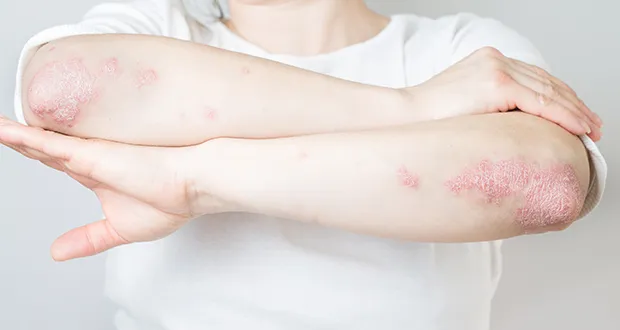
The Psoriasis Area and Severity Index (PASI) measures cutaneous disease severity and treatment response but does not directly assess symptoms, functional impairment, quality of life or psychological morbidity
Plaque psoriasis is a chronic, immune-mediated inflammatory disease characterised by erythematous, scaly plaques, frequently accompanied by pruritus and pain. Associated conditions include psoriatic arthritis, inflammatory bowel disease (IBD) and cardiometabolic disorders.
The Psoriasis Area and Severity Index (PASI) measures cutaneous disease severity and treatment response but does not directly assess symptoms, functional impairment, quality of life or psychological morbidity. NICE and European guidelines recommend assessing these additional domains alongside objective disease severity and associated comorbidities.
Limitations of PASI
PASI combines assessments of erythema, induration, scaling and affected skin area across four anatomical regions, producing a score from 0 to 72. PASI 75, PASI 90 and PASI 100 represent improvements of at least 75 per cent, 90 per cent and 100 per cent from baseline, respectively.
Neither PASI nor body surface area (BSA) assessment directly measures symptom burden or patient-reported impact. NICE recommends documenting BSA involvement, anatomical distribution, nail disease, and physician and patient global assessments. In specialist settings, a validated severity measure such as PASI is recommended.
NICE advises that PASI and BSA are not validated for children and young people and that erythema may be underestimated in darker skin types.
High-impact anatomical sites
NICE identifies the face, scalp, palms, soles, flexures and genitals as high-impact or difficult-to-treat sites.
Scalp psoriasis may cause itching, scaling and discomfort. Palmoplantar involvement can produce fissuring and pain, affecting walking and manual activities. Genital psoriasis may cause pruritus, soreness, burning and sexual difficulties. A systematic review by Meeuwis and colleagues documented its impact on sexual health and quality of life.
Nail psoriasis may produce pitting, onycholysis, oil spots and subungual hyperkeratosis, sometimes accompanied by pain and functional limitations.
In a multicentre study involving 1,985 patients, Cui and colleagues reported fingernail psoriasis in 68.9 per cent of patients with psoriatic arthritis compared with 42.6 per cent with cutaneous psoriasis alone. Onycholysis and subungual hyperkeratosis were independently associated with psoriatic arthritis, although these findings do not establish diagnostic significance.
The 2026 German S3 guideline permits classification of otherwise mild psoriasis as moderate-to-severe in specified circumstances, including substantial involvement of visible or high-impact sites, significant nail disease, pruritus causing scratching and recalcitrant plaques.
NICE recommends the Nail Psoriasis Severity Index (NAPSI) in specialist settings when nail involvement has substantial functional or cosmetic impact or when evaluating nail-specific treatment.
Pruritus, pain and sleep disturbance
In a cross-sectional study of 314 patients, Junsuwan and colleagues reported pruritus in 81.2 per cent. Female sex, BSA involvement of at least 10 per cent and genital psoriasis were independently associated with greater itch intensity. These clinic-based findings do not establish population-wide prevalence.
In an exploratory study of 139 patients, Ljosaa and colleagues reported skin pain in 42.6 per cent and skin discomfort in 36.7 per cent. Reported sensations included sensitivity, burning and itching.
Sleep disturbance is also associated with psoriasis. Sahin and colleagues identified sleep disturbance in 59 per cent of 334 patients with psoriasis compared with 34 per cent of 126 controls. Median sleep duration was six and seven hours, respectively. Anxiety and depression scores were among the factors most strongly associated with impaired sleep.
A 2024 meta-analysis by Guo and colleagues included 15 studies involving 1,274 patients and 775 controls. Psoriasis was associated with poorer sleep quality and increased odds of sleep disturbance (pooled odds ratio [OR] 6.64). Substantial heterogeneity was reported (I² = 67.5 per cent for sleep disturbance).
These observational findings demonstrate associations rather than causation.
Fatigue and functional impairment
Skoie and colleagues compared 84 patients with chronic plaque psoriasis and 84 matched controls. Clinically important fatigue occurred in 42–52 per cent of patients, depending on the assessment instrument, compared with 2–4 per cent of controls.
Fatigue was associated with Dermatology Life Quality Index (DLQI) scores in univariate analysis, but not after multivariable adjustment. No significant association with PASI was identified. These results cannot establish that fatigue is independent of disease severity in all populations.
NICE recommends assessing the effects of psoriasis on physical wellbeing, daily activities, employment and relationships.
Measuring quality of life
The DLQI, developed by Finlay and Khan, comprises ten questions addressing symptoms, daily activities, leisure, work or study, relationships and treatment. Scores range from 0 to 30, with higher scores indicating greater impairment.
Hongbo and colleagues established interpretation bands: 0–1, no effect; 2–5, small effect; 6–10, moderate effect; 11–20, very large effect; and 21–30, extremely large effect.
NICE recommends validated quality-of-life assessment, including DLQI in adults and the Children’s Dermatology Life Quality Index in younger patients. Direct enquiry about mood, coping, treatment difficulties and family circumstances is also recommended.
The 2026 German S3 guideline acknowledges limitations in interpreting DLQI responses, including answers to items considered irrelevant by patients.
Psychological morbidity
A 2014 systematic review and meta-analysis by Dowlatshahi and colleagues identified increased depressive symptom burden among patients with psoriasis, with prevalence estimates varying by study population and assessment method.
A 2023 systematic review and meta-analysis by Adesanya and colleagues examined 21 studies involving adults with psoriasis or atopic eczema, including 11 observational studies and ten randomised controlled trials.
Among adults with psoriasis, female sex was associated with depression (OR 1.62; 95 per cent confidence interval [CI] 1.09–2.40) and anxiety (OR 2.59; 95 per cent CI 1.32–5.07). Psoriatic arthritis was associated with depression (OR 2.26; 95 per cent CI 1.56–3.25) and anxiety (OR 1.98; 95 per cent CI 1.33–2.94).
Moderate-to-severe psoriasis was associated with increased odds of anxiety (OR 1.14; 95 per cent CI 1.05–1.25), but not significantly with depression.
Randomised trials involving psoriasis or atopic eczema generally reported more favourable depression and anxiety scores with targeted treatments than placebo. Follow-up was limited to 24 weeks or less, and the findings cannot be generalised to all targeted treatments.
NICE recommends assessment for depression when evaluating psoriasis severity and impact and when escalating treatment.
Recognising associated systemic disease
Psoriatic arthritis: NICE recommends annual assessment, particularly during the first ten years after psoriasis onset. The Psoriasis Epidemiological Screening Tool (PEST) can support screening but does not detect axial arthritis or inflammatory back pain. Suspected psoriatic arthritis warrants prompt rheumatology referral.
Inflammatory bowel disease: A 2018 meta-analysis by Fu and colleagues included nine observational studies involving approximately 7.8 million participants. Psoriasis was associated with increased risk of Crohn’s disease (risk ratio [RR] 2.53; 95 per cent CI 1.65–3.89) and ulcerative colitis (RR 1.71; 95 per cent CI 1.55–1.89) in cohort studies.
A separate meta-analysis of 93 studies reported pooled prevalences of Crohn’s disease and ulcerative colitis among patients with psoriasis of 0.7 per cent and 0.5 per cent, respectively, with bidirectional associations identified.
ECCO recognises psoriasis among IBD-associated extraintestinal manifestations. The epidemiological evidence does not establish causation. Fu and colleagues suggested gastroenterology consultation when patients with psoriasis present with bowel symptoms.
Cardiometabolic disease: Psoriasis is associated with obesity, hypertension, diabetes and cardiovascular disease, as recognised in American Academy of Dermatology–National Psoriasis Foundation guidelines.
NICE recommends cardiovascular risk assessment at presentation for adults with severe psoriasis and every five years thereafter, or more frequently when clinically indicated.
Implications for treatment decisions
NICE recommends conventional systemic treatment when psoriasis is inadequately controlled by topical therapy, significantly affects wellbeing and meets additional criteria. These include BSA greater than 10% or PASI greater than 10, localised disease causing functional impairment or substantial distress, or unsuitable, ineffective or rapidly relapsing phototherapy.
The 2026 German S3 guideline recommends considering efficacy, safety, comorbidities and individual circumstances when selecting systemic treatment.
For concomitant IBD, it recommends collaboration with gastroenterology and preferential consideration of approved treatments effective against the relevant bowel disease. It suggests against IL-17 inhibitors in patients with IBD.
The guideline identifies PASI 75 at the end of induction as a minimum response target, with PASI 90, absolute PASI below 2 or DLQI 0–1 as desirable goals. These are clinical targets rather than healthcare-system reimbursement criteria.
Conclusion
NICE and European guidelines recommend multidimensional psoriasis assessment incorporating cutaneous severity, anatomical involvement, symptoms, quality of life, psychological wellbeing and associated systemic disease.
Clinical studies document disease burdens not directly captured by PASI, although observational associations do not establish causation. Individualised assessment and treatment goals remain central to guideline-based psoriasis management. 
References available on request.