
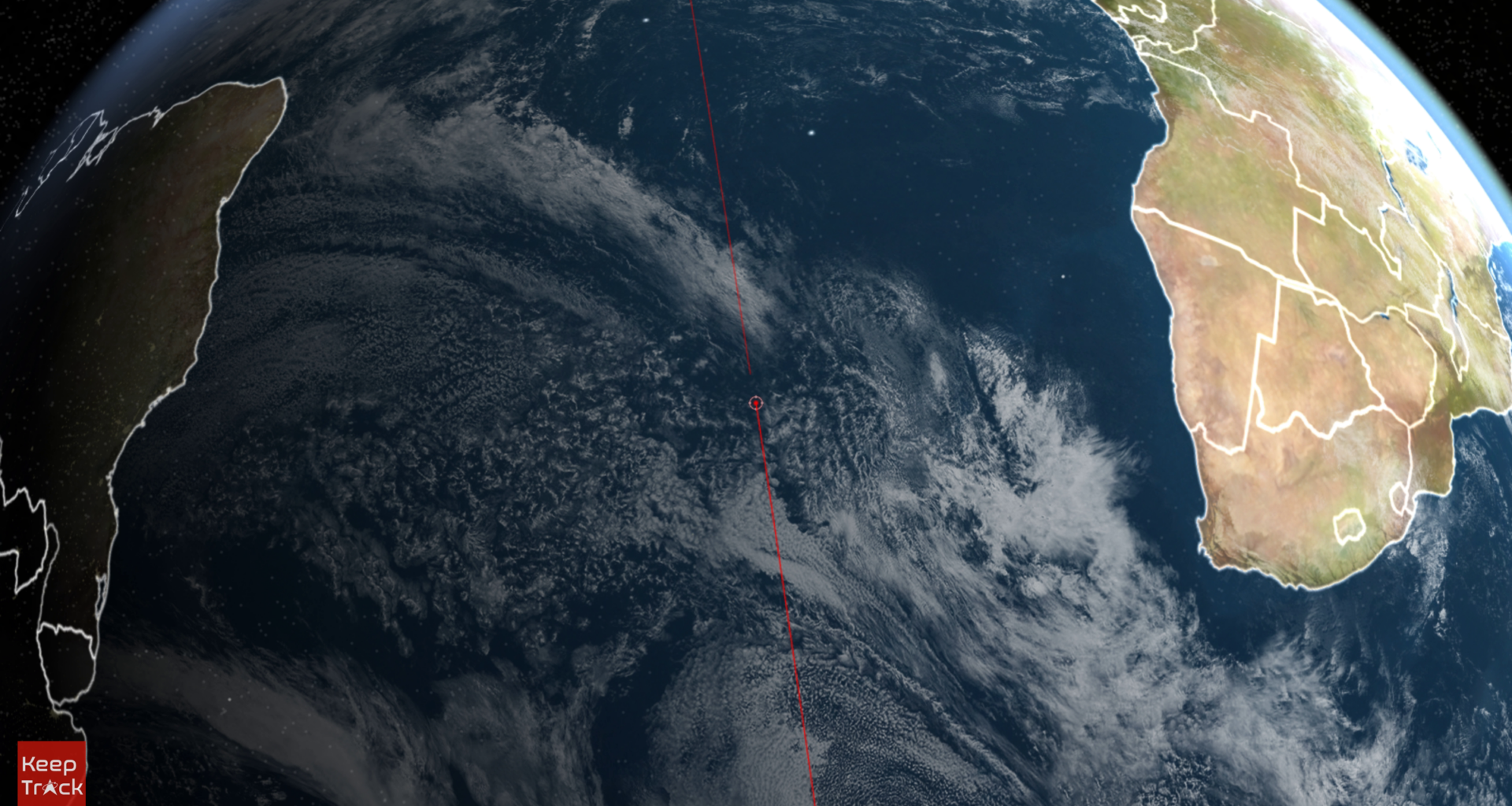
ASTRID 2 is a 30 kg Swedish science satellite built and operated by SSC, the Swedish Space Corporation. It launched on December 10, 1998, from Plesetsk on a Kosmos 11K65M, as part of Sweden’s small-satellite work on auroral space physics.
Nearly 28 years later, it is still catalogued in a near-polar orbit about 1,000 km up, and its latest element set records 39,672 revolutions. The most interesting current data is optical: ground photometry shows a repeating brightness cycle of 17.8 seconds and a brightness range of almost 10 magnitudes.
Mission and History
ASTRID 2 flew from Plesetsk’s LC132/1 pad with the international designator 1998-072B. The “B” suffix means it was not the first object catalogued from that launch. Its catalog record lists the mission and purpose only as science, with no payload detail beyond “Astrid 2.”
The spacecraft is small, at 1.1 m long and 0.3 m in diameter, with a 1.7 m span. Its record describes a box with two antennas, built on the Astrid bus in a Freja-C configuration. Four deployable fixed solar arrays and batteries supply power.
Dry mass and launch mass are both listed at 30 kg, so the record shows no propellant load, and it lists no motor. The record also leaves the status field blank, so this article makes no claim about whether the satellite still works. No decay date is listed.
Orbit Analysis
ASTRID 2 is in low Earth orbit at 82.95 degrees inclination, with the most recent history values giving 967 x 1,021 km. The latest TLE shows a mean motion of 13.73 revolutions per day, or a period of about 104.9 minutes, and a very low drag term (BSTAR 5.25e-5). Its first derivative of mean motion is 6.4e-7 revolutions per day squared, which points to very slow decay.
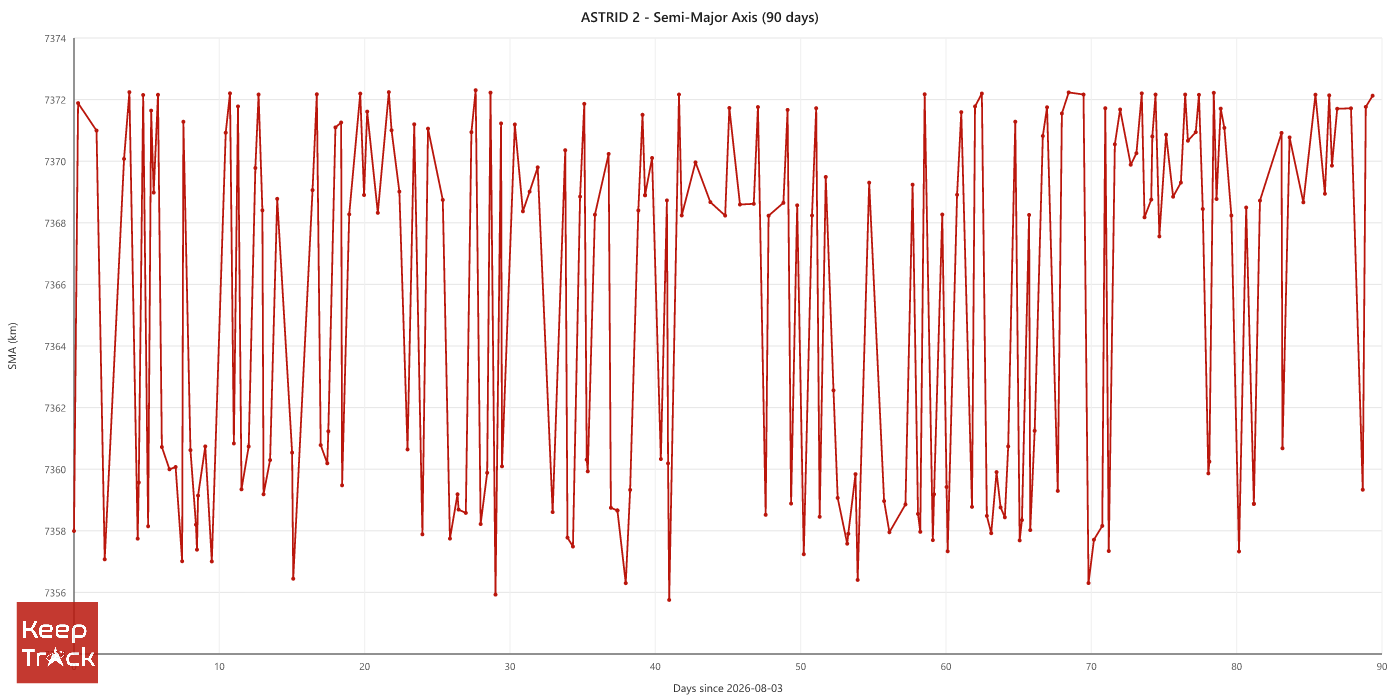
Across 209 element sets spanning 89 days, semi-major axis rose 14.1 km, from 7,358.0 km to 7,372.1 km, and ranged between 7,355.8 km and 7,372.3 km. That should not be read as orbit raising. The spacecraft has no listed propellant or motor, and the positive mean motion derivative points the other way.
The TLE mean motion also implies a semi-major axis near 7,366 km, about 6 km below the last history value. That gap suggests the series is tracking short-term variation or fit scatter rather than a real energy gain.
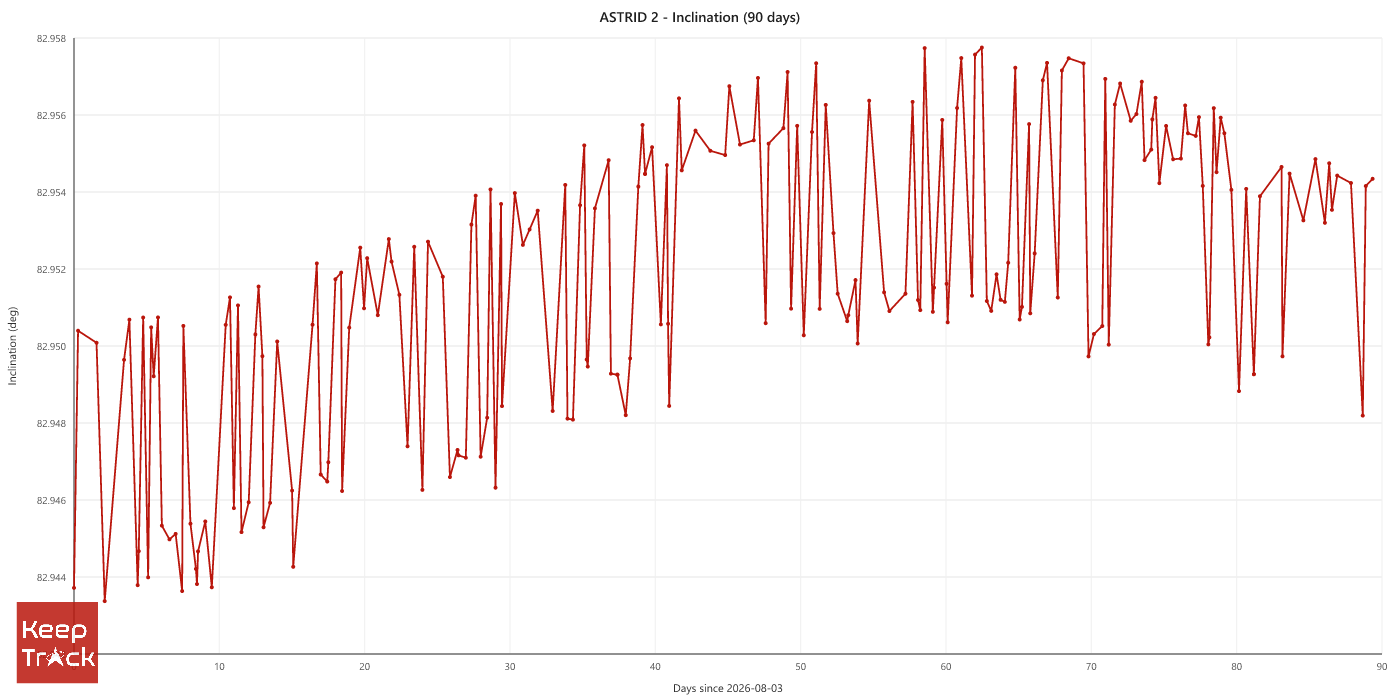
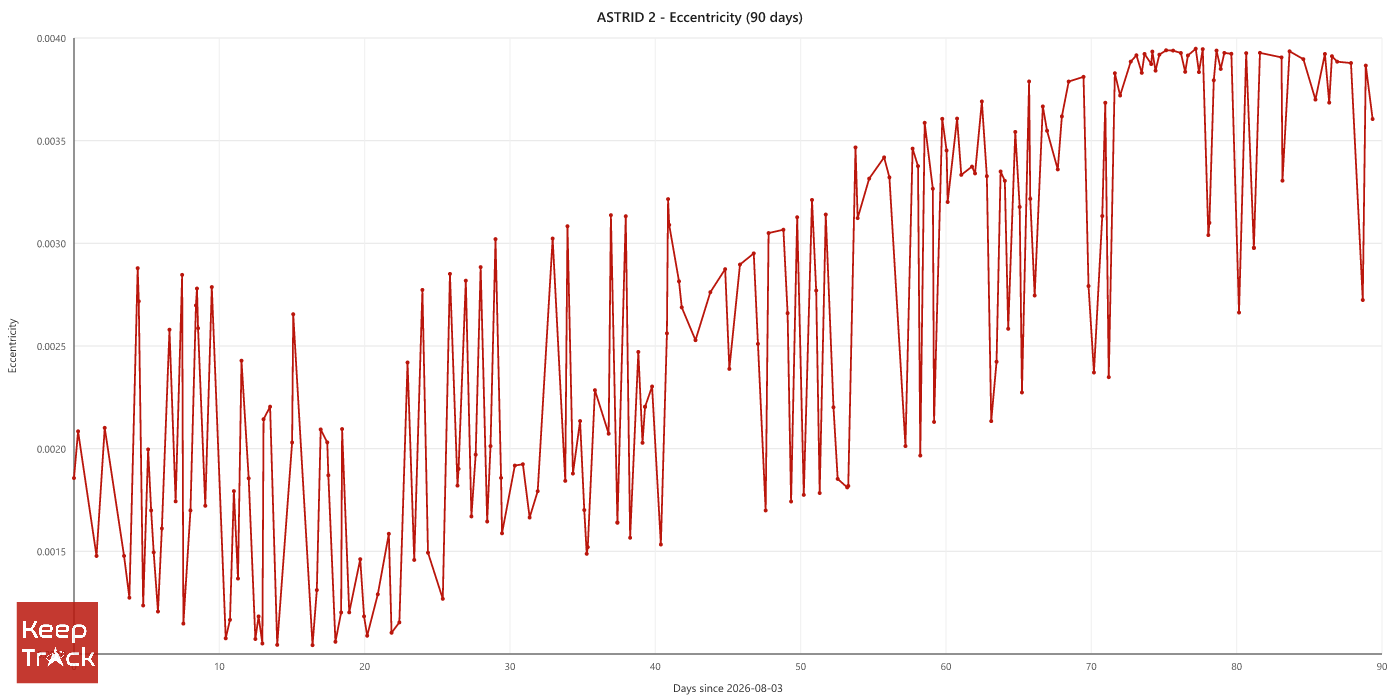
Inclination stayed inside a band of about 0.014 degrees, from 82.943 to 82.958, for a net change of +0.011 degrees. Eccentricity moved more in relative terms, from 0.00186 to 0.00361, within a range of 0.00104 to 0.00395. The latest TLE lists 0.00261, so the 53 km apogee-perigee spread above sits toward the high end of what these values imply.
Photometry
Photometric data from the MMT-9 (Mini-MegaTORTORA) survey classifies ASTRID 2 as periodic, with a period of 17.83 seconds, or about 3.4 cycles per minute. Its mean clear-band magnitude is 7.81 (sigma 1.25) and its median is 8.04, with observations ranging from magnitude 1.56 to 11.5. That spread is a brightness ratio of roughly 9,500 to 1. The light curve alone does not establish whether 17.83 seconds is the full rotation period or a harmonic of it, since a box with arrays can produce more than one glint per turn. The radar cross section is listed at 0.49 square meters.
Quick Facts
Detail
Value
NORAD ID
25568
COSPAR ID
1998-072B
Operator
SSC (Swedish Space Corporation)
Country
Sweden
Launch Date
December 10, 1998
Launch Site
Plesetsk, LC132/1
Launch Vehicle
Kosmos 11K65M
Mass
30 kg
Orbit
LEO, 967 x 1,021 km, 82.95° inclination
Purpose
Science
Track ASTRID 2 in real-time: Track ASTRID 2 or see the full record.