
Hydrogen chloride (HCl) gas was seen during Mars’ cold aphelion season, when none was expected; the detection is best explained by ongoing igneous processes in the Martian interior.
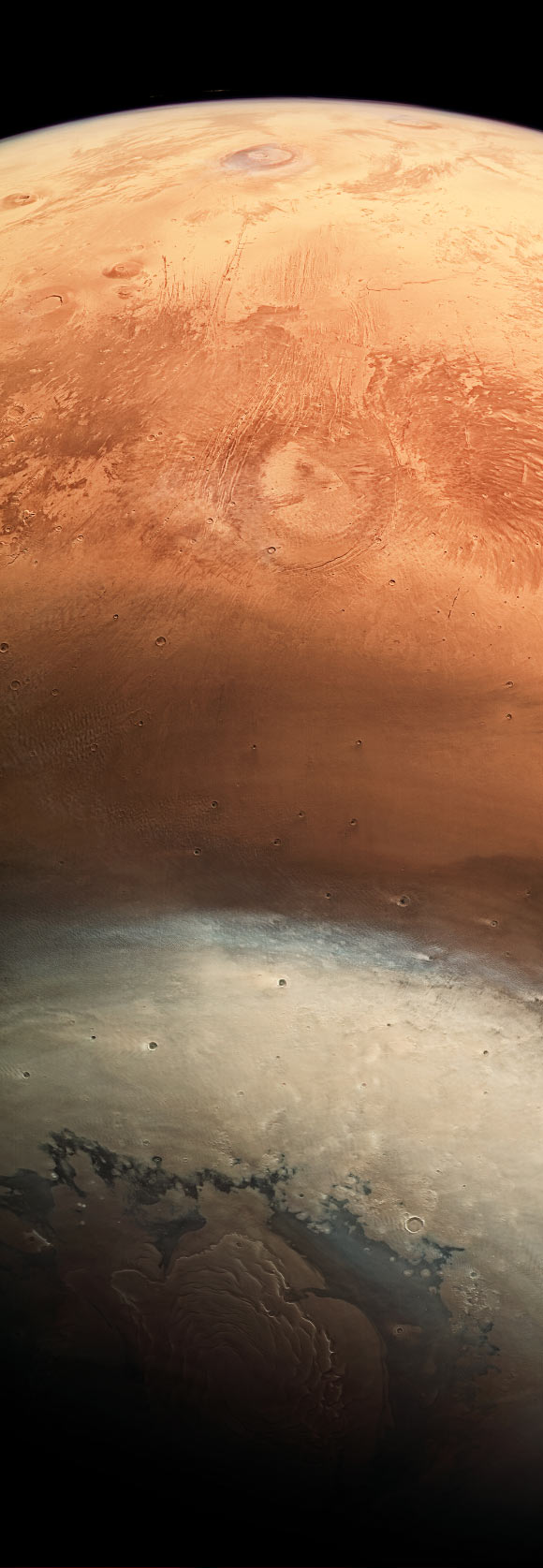
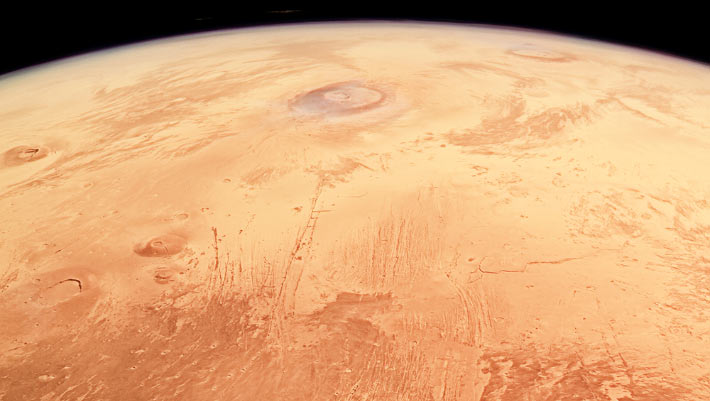
A stunning view of Mars from the north pole to the equator. Alba Mons is a vast shield volcano in the center of the image. Image credit: ESA / DLR / FU Berlin / CC BY-SA 3.0 IGO.
Mars is widely considered to be volcanically quiet, but a puzzling chemical signal in its thin atmosphere may suggest the planet’s interior is not entirely dormant.
“On Mars, as on Earth, the chlorine cycle initiated by volcanic degassing from the deep interior upon planetary accretion was fed by the subsequent volcanic eruptions, and, because of its high mobility and solubility, chlorine has been continuously recycled in water, sediments, permafrost, and ice clouds,” said Universität Bern researcher Nicolas Thomas and his colleagues.
“However, contrary to Earth, the absence of recycling due to plate tectonics probably makes the volcanic source the main input to the surface-atmosphere system on Mars.”
“The topic addressed here is is volcanism still contributing to this cycle on Mars today?”
The researchers analyzed data from the Atmospheric Chemistry Suite on ESA’s Trace Gas Orbiter, observing hydrogen chloride at parts-per-billion levels in the Martian atmosphere.
They documented these higher-than-expected concentrations during the cold aphelion season near the Alba Mons region.
They also examined high-resolution images from the HiRISE, CaSSIS and CTX cameras beneath the detection sites.
They identified narrow fissures, some only tens of centimeters wide and in places forming swarms tens of kilometers long on topographic ridges.
These features have not previously been identified on Mars, according to the team, and they align with large-scale tectonic and volcanic patterns in the region.
The scientists propose that such fractures could serve as pathways for hydrogen chloride rising from magmatic bodies at depth, possibly after interacting with ice-rich permafrost.
The system would not necessarily require a significant thermal signature, which could explain why heat-based searches for active volcanism have come up empty.
Assuming an atmospheric lifetime of one sol for hydrogen chloride, the authors estimate a seepage rate of less than 3 kilograms per second. This is comparable to the low end of fluxes at terrestrial volcanoes, which range from a few to more than 100 kilograms per second.
The researchers do not think the much larger seasonal release of hydrogen chloride during perihelion, estimated at around 180 kilograms per second, is directly volcanic.
However, they suggest some of that chlorine could ultimately have an igneous origin, cycling between the atmosphere and surface reservoirs such as perchlorates and ice.
“Overall, the presence and variability of hydrogen chloride in the Martian atmosphere appear to be governed by an interplay between episodic volcanic activity, atmospheric processing, and long-term sequestration into surface salts, perchlorates, and hydrogen chloride-bearing ices,” they said.
The study was published today in the journal Science Advances.
_____
Alexander Trokhimovskiy et al. 2026. Enigmatic HCl detections as a potential signature of igneous activity on Mars. Science Advances 12 (45); doi: 10.1126/sciadv.aeb9422