 Vulpes vulpes—the red fox. Silver foxes are melanistic red fox individuals. Credit: Wikimedia Commons
How do you turn a wild animal that might be alert, unpredictable, and likely aggressive into something more like a pet?
In the late 1950s, Soviet scientists launched an extraordinary fox experiment in Siberia. They took silver foxes raised on fur farms and began breeding together the individuals with the friendliest traits to humans. Within just six generations, some pups started voluntarily interacting with humans.
Over subsequent generations, the foxes became increasingly doglike. Some even developed floppy ears and shorter snouts, like our modern canine companions.
But what exactly had changed inside them, particularly in their brains?
Now, nearly seven decades later, scientists may have found part of the answer. In a new study, researchers discovered that foxes bred for tameness have fewer neurons in a brain area associated with aggression.
The findings suggest that changes in the brain’s aggression circuitry may have played a role in the domestication of wolves into dogs.
The Brain’s Aggression Circuit
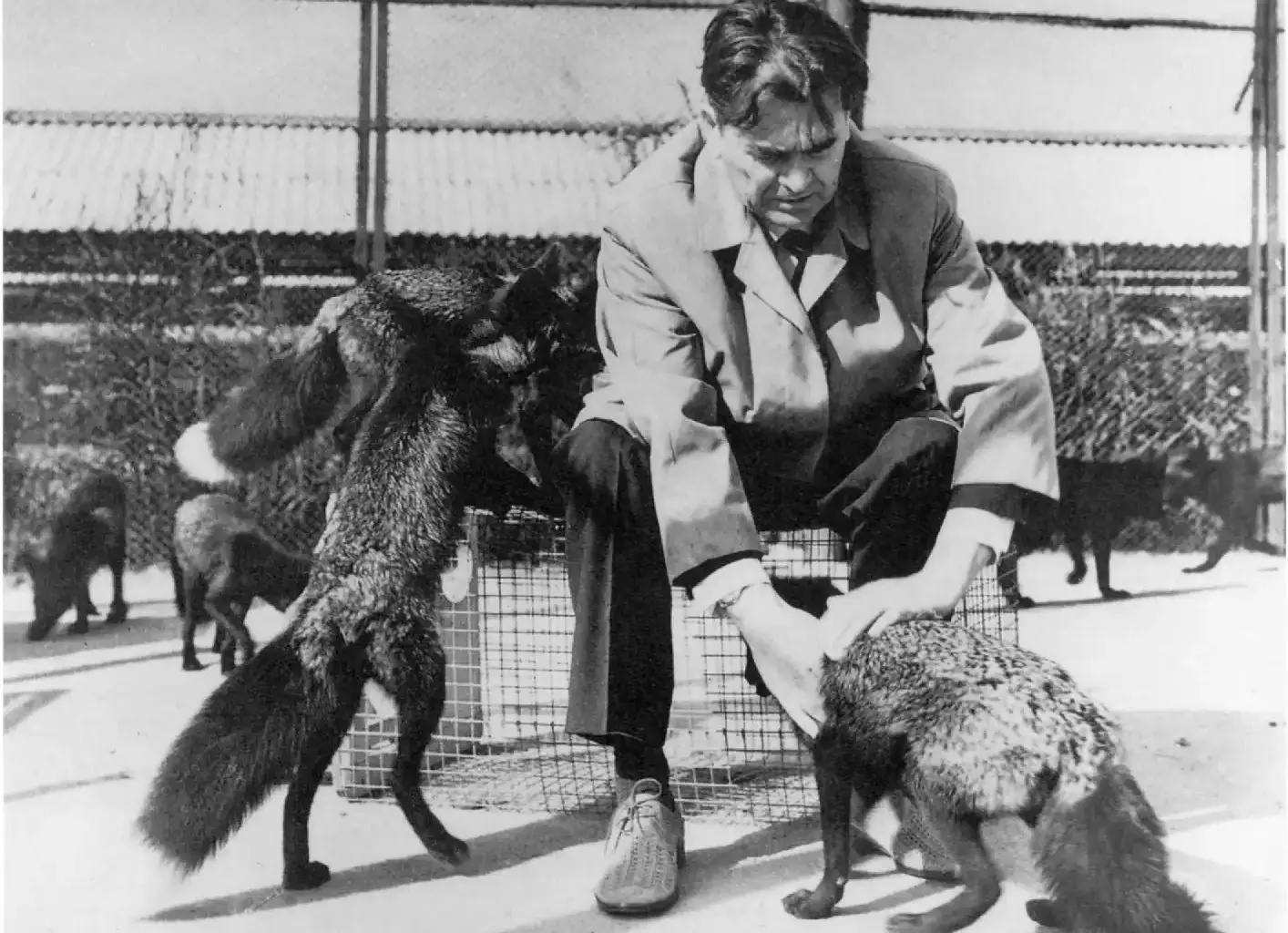
The story begins in 1959, when Soviet geneticist Dmitry Belyaev and his colleague Lyudmila Trut launched an unusual breeding experiment in Siberia. They wanted to better understand how wild animals become domesticated, so they started with silver foxes from fur farms.
In each generation, the researchers selected the animals that showed the least fear or aggression responses toward humans and bred them together. Friendliness was the only criterion.
×
Thank you! One more thing…
Please check your inbox and confirm your subscription.
 Belyaev with his foxes. Credit: Institute of Cytology and Genetics of the Russian Academy of Sciences
After just six generations, some foxes actively sought human contact. Over time, they began displaying doglike behaviors and physical traits—like the aforementioned floppy ears and shorter snouts.
The experiment continued for decades. In 1970, the Soviet researchers also began breeding a separate group of foxes that showed aggressive responses toward humans. Over generations, they developed two contrasting populations: one unusually friendly toward people, the other deliberately selected to be hostile.
These two groups provided an unusual opportunity to investigate how selective breeding changes the brain.
“We wanted to understand what are the neurological underpinnings of these changes in behaviors that occurred very rapidly with this selection,” said Eirene Markenscoff-Papadimitriou, an assistant professor of molecular biology and genetics at Cornell University and the study’s senior author, in a statement.
 Eirene Markenscoff-Papadimitriou with a tame silver fox. Credit: Eirene Markenscoff-Papadimitriou
Working with the scientists maintaining the Russian fox colony, the Cornell team examined nine preserved fox brains: three from the friendly group, three from the aggressive group, and three from wild foxes.
They focused on the ventromedial hypothalamus, a small brain region involved in aggression and social behavior. Previous experiments in mice had shown that activating certain neurons in this brain region could trigger aggressive attacks.
Using fluorescent probes to distinguish different cell types, the scientists found that tame foxes had fewer of these “aggression neurons” than aggressive foxes, suggesting that selective breeding for friendliness can reshape the cellular makeup of the brain. However, the study sample is small and cannot establish, for now, whether these differences actually cause tameness.
Becoming a Dog
 Who’s a good boy? Credit: Wikimedia Commons
Wolves didn’t become dachshunds and pugs right away (by the way, please stop enabling the breeding of these breeds).
Their domestication was a prolonged evolutionary process, and scientists still debate how it began. Perhaps less fearful wolves stuck around human settlements to scavenge the scraps. Perhaps humans stole and raised wolf pups. Over generations, the human-friendlier animals could have gained an advantage.
 Scientist, Marina Nurgalieva, holds a baby fox in the experiment, (1970s/80s), Siberia, Russian SFSR.Credit: Institute of Cytology and Genetics of Siberia
The fox experiment demonstrates how rapidly inherited behavioral tendencies can change under guided selection.
And remarkably, another study published just three days before the Cornell paper provides complementary evidence from dogs themselves.
In research published October 30, 2026, in Molecular Biology and Evolution, scientists analyzed two canine genetic datasets containing 1,987 and 722 individuals. They found evidence that selection for reduced aggression and fear was more consistently shared across major dog lineages than selection for physical characteristics. Their analysis also suggested that some of these behavioral changes occurred early in dog domestication.
Together, the studies suggest that one of the earliest steps toward becoming a dog may have involved changes in the biological systems governing fear, aggression, and social behavior.
Did the Brain Change Before the Body?
 Another good boy. Credit: Wikimedia Commons
The Siberian fox experiment became famous partly because selecting animals for tameness appeared to produce physical changes too, including floppy ears, and altered facial proportions. Researchers have called this proposed package of changes domestication syndrome.
But the story has grown more complicated.
A 2020 scientific review challenged the traditional interpretation. The researchers found that the foxes originally came from Canadian fur farms and that some supposedly new physical traits may have existed before the Siberian experiment began.
Previous brain research complicates the picture even further. A 2021 study of 30 fox brains found that both tame and aggressive foxes had more gray matter than foxes bred without selection for behavior. Surprisingly, the increases occurred in many of the same regions, including areas involved in emotion, memory and decision-making, despite the animals being selected for opposite behaviors.
So it’s not clear whether brain changes came before physical changes, or whether domestication simply removes aggression. Where the strength of the new studies lies is in offering a candidate group of neurons that may help explain how selection changes social behavior over generations.
 Two more good boys. Credit: Wikimedia Commons
For the ancestors of dogs, becoming comfortable around humans was likely only the beginning. But that first behavioral transformation may have opened the door to everything that followed, from the prehistoric wolf lingering near a campfire to the dog curled up beside us today.
The study was published in the journal Current Biology.