
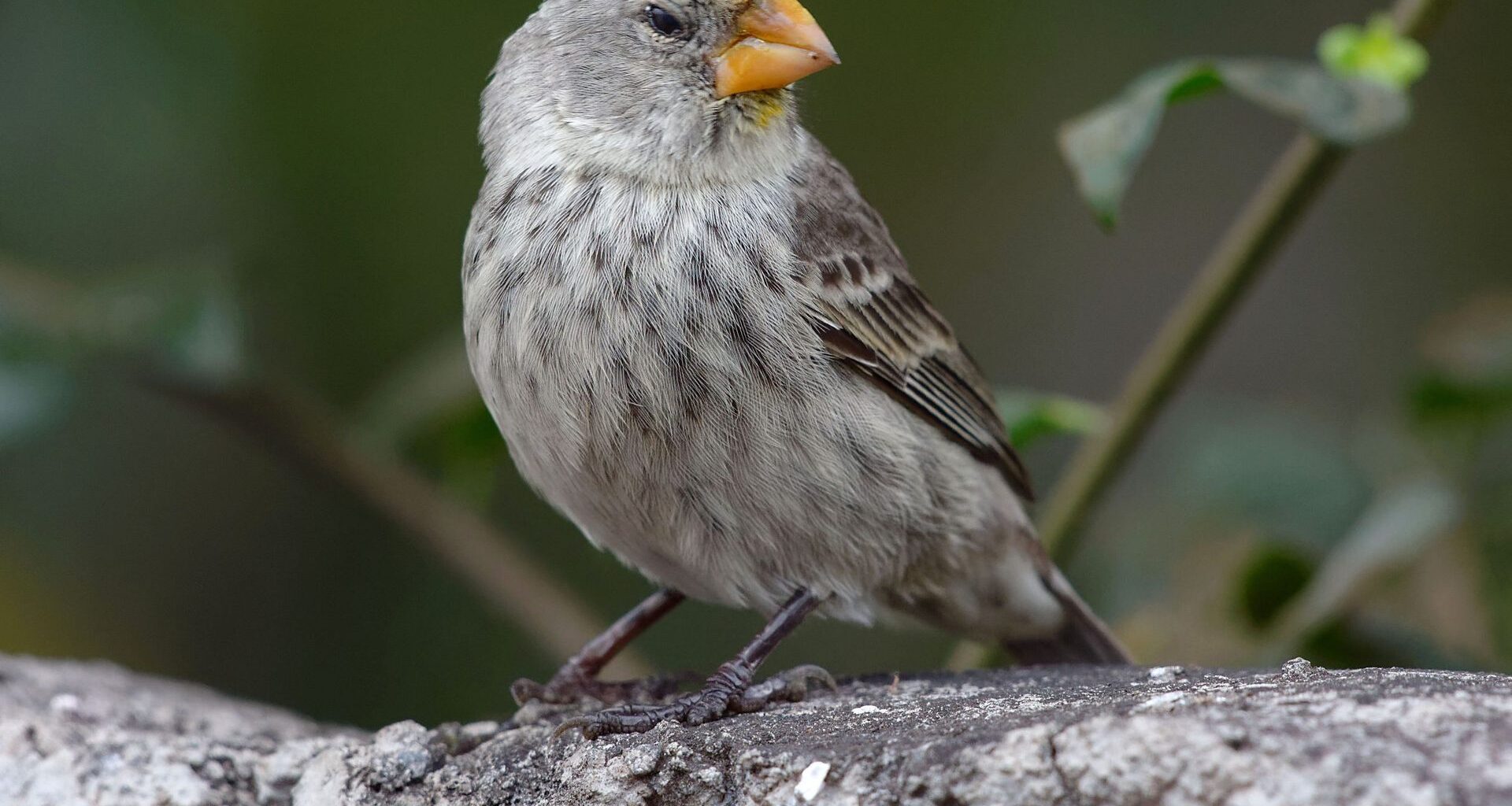
A DNA study traces how vampire flies spread across the Galápagos, offering clues to protecting Darwin’s finches from the deadly parasites.
A fly’s larvae can kill every chick in a Darwin’s finch nest by feeding on their blood and tissue.
That fly, the avian vampire fly, is now considered the greatest threat to land birds in the Galápagos Islands.
The finches evolved far from any continent, but the fly came from the mainland.
A new DNA study suggests it most likely got in through San Cristóbal, the island closest to mainland Ecuador and historically the first stop for cargo ships.
From there, the flies appear to have spread west. Knowing that route gives conservation teams a clearer idea of where to focus their efforts.
Abbie Hay, a PhD student, and Rachael Dudaniec, an associate professor, led the study at Macquarie University’s School of Natural Sciences in Australia.
They worked with scientists from the Charles Darwin Foundation and other groups to compare island flies with flies from mainland Ecuador, where the species is native.
Larvae feed on growing chicks
Scientists know the vampire fly as Philornis downsi. It probably reached the islands with human help sometime before 1964, but it wasn’t identified in finch nests until 1997.
The fly’s larvae feed on growing chicks and sometimes on their mothers.
The fly has been found on 15 of the 17 Galápagos islands where scientists have checked, and it attacks at least 11 species of Darwin’s finches.
Island species can be especially vulnerable to new parasites. Species that evolved in isolation often lack defenses against these newcomers, the authors wrote.
Sonia Kleindorfer, now at the University of Vienna, has led more than two decades of research on the fly and the finches, and this study builds on that work.
Following the DNA
The researchers collected flies during the 2024 bird breeding season, from January to April, on five islands: Santa Cruz, Isabela, Floreana, San Cristóbal and Santiago. Santiago is the only one of the five without a human settlement.
Some adult flies were caught in traps. Others were collected from nests as pupae, the stage between larva and adult, after the birds had finished nesting.
In all, the team gathered 235 island flies and 39 mainland flies.
After removing poor-quality samples and close relatives, they compared 169 island flies at more than 33,000 points in their DNA where a single letter varied.
The DNA differences let the team work out which groups had been mixing, without following individual flies between islands.
Groups that mix tend to become genetically similar, while groups that stay apart gradually become more different.
One island stands out
The island flies had much less genetic variety than the mainland flies, and the two formed separate genetic groups.
That fits a genetic bottleneck, where a population starts with just a few founders and carries only part of the original group’s variety.
San Cristóbal stood apart from the other islands. Its flies were the most genetically different from the rest, yet they also had the most genetic variety.
Isabela showed the opposite pattern. Even though it’s by far the largest island in the study, its flies had the least genetic variety.
Three neighboring islands, Isabela, Santa Cruz and Santiago, are just 10 to 17 miles (16 to 27 kilometers) apart, and their flies mixed a lot.
Santa Cruz and Santiago seemed to exchange the most flies, both with each other and with nearby islands.
Shipping routes fit the pattern
When the team estimated which way fly genes were moving between islands, only San Cristóbal showed a clear one-way pattern. More of its genes moved out toward the other islands than came back in.
Westward is also the way the wind blows. The southeast trade winds carry air from South America northwest across the islands, which puts San Cristóbal upwind of the others.
Cargo has traveled the same way. Ships from the port of Guayaquil historically stopped at San Cristóbal first, and the cargo then went to Santa Cruz and on to Isabela and Floreana.
Adult flies feed on fruit and vegetables, so shipments of fresh produce could carry them between islands.
“Our results suggest that the fly may be traveling from the mainland to San Cristóbal with human assistance, and from there to other islands through a combination of human activity and natural dispersal,” Dudaniec said.
Adult vampire flies have been found riding on tourist boats between islands. A related species, the stable fly, has been reported to travel up to 140 miles (225 kilometers) on the wind.
That’s farther than San Cristóbal is from any of the other four islands, but how far the vampire fly itself can fly between islands hasn’t been documented.
Where control could start
Right now, conservation workers fight the fly by applying insecticide by hand and by using self-fumigating nesting material.
A wasp called Conura annulifera, which attacks only this fly, looks promising as a natural enemy that could be released to keep it in check.
Choosing where to start matters. Pests with more genetic variety are more likely to evolve resistance to a control agent, the authors wrote, which makes isolated islands that receive fewer new flies better starting points.
“By identifying which populations are genetically connected, we can better understand where flies may be coming from and where control efforts could have the greatest impact,” Dudaniec said.
San Cristóbal presents a challenge. Its flies are the most genetically distinct, but they also have the most genetic variety, and new ones may still be arriving from the mainland.
The island may need several control methods at once, plus tighter checks on what arrives.
Floreana may be an easier place to begin. The team suggested that the island, home to just 111 people, could be a more efficient site for a control trial.
Questions about the invasion remain
San Cristóbal had the smallest sample in the study, just 21 flies, mostly from nests in one small area. With so few flies, the researchers may have underestimated the island’s genetic variety.
The one-way movement out of San Cristóbal also has two possible explanations.
Flies may still be arriving there and spreading out today, or the DNA may reflect the route of the first flies to settle on the island.
None of the flies collected on other islands looked like a recent arrival from San Cristóbal.
Telling the two explanations apart will take a separate study of the population’s history, the authors wrote.
The mainland source is a mystery, too. Flies from all three mainland sites differed genetically from the island flies, so none of them looks like the population that started the invasion.
One of those sites was a forest about 9 miles (15 kilometers) from the port of Guayaquil. Flies may be reaching the port from somewhere else before they board ships.
The authors wrote that testing flies from places that ship fresh produce to Guayaquil could help trace the invasion back to its source.
The full study was published in the journal Molecular Ecology.
—–
Like what you read? Subscribe to our newsletter for engaging articles, exclusive content, and the latest updates.
Check us out on EarthSnap, a free app brought to you by Eric Ralls and Earth.com.
—–