

Analysis: Low-cost seismometers are normally used to record earthquakes, but one in Co Waterford picked up the deep, rhythmic song of a fin whale
By Martin Möllhoff, Dublin Institute for Advanced Studies
On 2 December 2023, a small instrument on a concrete plinth inside the visitor centre at the Copper Coast Geopark in Bunmahon, Co Waterford, recorded something extraordinary: the deep, rhythmic song of a fin whale. This was the first time anywhere in the world that the song of this ocean giant had been detected by a low-cost, land-based seismometer of the kind run by citizen scientists.
The Raspberry Shake seismometer, part of the QuakeShake programme run by the Dublin Institute for Advanced Studies with Geological Survey Ireland, is normally used to record earthquakes. That day, it picked up something else entirely. You can watch the recording scroll by below and hear it sped up so that the song falls within the range of human hearing.
From QuakeShake, fin whale calls detected on a seismometer in Co Waterford in 2023
The finding shows how closely we are linked to the ocean. When a fin whale sings off our coast, the whole nearby coastal region vibrates with it: our houses, our gardens, the ground beneath our feet. We cannot feel it, as the shaking is far too faint, but our most sensitive instruments can pick it up clearly.
How does a whale end up on a seismogram?
Sound travels well through water, far better than light, which is why whales rely on it to communicate across large distances. Fin whale song is one of the loudest sounds any animal produces, about 190 decibels underwater, which compares to a jet engine taking off. When fin whales sing close enough to shore, the sound does not stop at the coastline. It passes into the seafloor and continues travelling through the ocean floor as a seismic wave. A seismometer on land, tuned to the right frequency, can detect this passing wave.
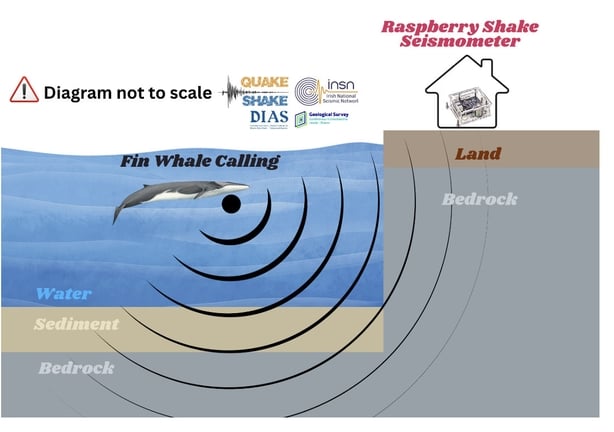
A fin whale’s song travels through the sea as sound, passes into the seafloor and carries on through the rock as a seismic wave, a faint vibration of the ground. A sensitive seismometer on land, such as a Raspberry Shake, can then record it. Image credit: Laura Reilly/DIAS
Research by the author and Prof. Chris Bean at DIAS showed that fin whale song can be detected by onshore instruments up to about 5.5 kilometres inland. The team used independently verified fin whale sightings from the Irish Whale and Dolphin Group to locate the song, and the timing and locations matched closely, providing strong evidence that the signals were fin whales.
Why had nobody noticed this before? Fin whale pulses, at a very low pitch of around 20 Hertz, sit above the frequencies usually examined when hunting for earthquakes, so they tend to be screened out. Finding them took a manual search: using the same sightings records, the team picked out times when fin whales were close to the coast, in areas where a seismometer was collecting data, and looked for the song there.
The Waterford whale listeners
In June 2025, QuakeShake’s Community Seismology Officer, Laura Reilly, and the team held a public meeting at the Copper Coast Geopark visitor centre. Funded by Research Ireland’s Discover Programme, the event raffled five Raspberry Shakes to people who agreed to host one at home within 2km of the coast, hoping to record more fin whale calls and earthquakes. With a few months, this growing network had reported fin whale song at Helvic Head, Stradbally, Bunmahon and Annestown.
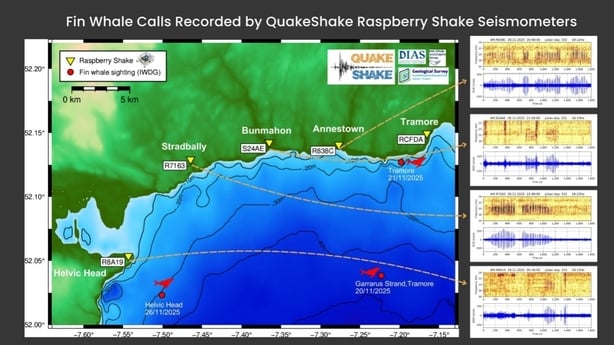
Seismometers in the QuakeShake network (yellow triangles) and fin whale sightings reported to the IWDG (red whale symbols). The panels on the right show the whale’s song as a regular, repeating pattern in the seismic recordings. Image credit: Laura Reilly and Martin Möllhoff/DIAS)
As the map shows, sightings in November 2025 did not coincide exactly with the song recordings. That fits fin whale behaviour: they tend to sing about 30 metres down rather than at the surface, and the songs were mostly picked up at night, when no one can see them.
Through a partnership with An Taisce’s Clean Coasts and Green-Schools programme, QuakeShake provided a Raspberry Shake to St James’ National School in Stradbally, County Waterford. The pupils have become fin whale experts in their own right and can explain how their seismometer picked up the whales’ calls and share their favourite facts. Fin whales are nicknamed “the greyhound of the sea” because they are slim and fast, and can grow up to 27 metres long.
What it means for the whales
Fin whales are classed as vulnerable, and human activity like ship strikes, entanglement in fishing gear and busy shipping lanes is their greatest threat. Knowing where and when they are present in coastal waters is essential to reducing those risks.
St James’s NS pupils explain about their Quake Shake seismometer and fin whales swimming past their school.
Why listen from land at all?
Traditionally, scientists monitor whales with hydrophones, underwater microphones, but these are expensive to deploy and difficult to stream live. Land-based seismometers, by contrast, are often already deployed to monitor earthquakes, and their data is easy to stream live.
The DIAS team estimates that around 14% of the world’s permanent seismic stations and 17.5% of Raspberry Shake citizen-science instruments sit within 3 kilometres of a coastline, roughly 1,650 sensors worldwide that could join the listening effort without installing anything new. Listening from dry land will not replace marine surveying, but it adds a powerful, low-cost way to keep an ear, quite literally, on these giants as they sing their way along the Irish coast.
The annual public QuakeShake meeting takes place during Science Week on Tuesday 10 November in Enniscorthy, Co Wexford. Registration is free, but tickets should be booked in advance
Follow RTÉ Brainstorm on WhatsApp and Instagram for more stories and updates
Dr Martin Möllhoff is Director of Seismic Networks at the Dublin Institute for Advanced Studies
The views expressed here are those of the author and do not represent or reflect the views of RTÉ