
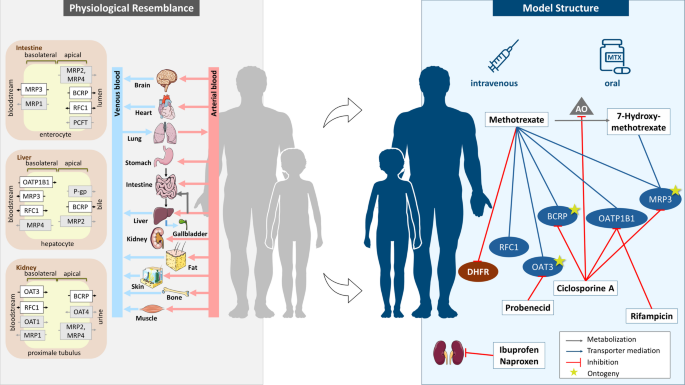
Hider, S. L., Bruce, I. N. & Thomson, W. The pharmacogenetics of methotrexate. Rheumatology 46, 859 (2007).
Slørdal, L., Kolmannskog, S., Prytz, P. S., Moe, P. J. & Aarbakke, J. Pharmacokinetics of methotrexate and 7-hydroxy-methotrexate after high-dose (33.6 g/m2) methotrexate therapy. Pediatr. Hematol. Oncol. 3, 127–134 (1986).
Maryam, H., Meenal, M. Methotrexate. National Library of Medicine (2024). https://www.ncbi.nlm.nih.gov/books/NBK556114/.
Nagamine, A. et al. Target concentration achievement for efficacy and safety of patients with osteosarcoma treated with high-dose methotrexate based on individual pharmacokinetics: a retrospective study. Oncol. Lett. 25, 70 (2022).
Ramsey, L. B. et al. Consensus guideline for use of glucarpidase in patients with high-dose methotrexate induced acute kidney injury and delayed methotrexate clearance. Oncologist 23, 52–61 (2018).
Roth, M., Obaidat, A. & Hagenbuch, B. OATPs OATs and OCTs: the organic anion and cation transporters of the SLCO and SLC22A gene superfamilies. Br. J. Pharmacol. 165, 1260–1287 (2012).
Choughule, K. V., Joswig-Jones, C. A. & Jones, J. P. Interspecies differences in the metabolism of methotrexate: an insight into the active site differences between human and rabbit aldehyde oxidase. Biochem. Pharmacol. 96, 288–295 (2015).
Dervieux, T. et al. HPLC determination of thiopurine nucleosides and nucleotides in vivo in lymphoblasts following mercaptopurine therapy. Clin. Chem. 48, 61–68 (2002).
Grim, J., Chladek, J. & Martinkovi, J. Pharmacokinetics and pharmacodynamics of methotrexate in non-neoplastic diseases. Clin. Pharmacokinet. 42, 139–151 (2003).
Prasad, B. et al. Ontogeny of hepatic drug transporters as quantified by LC-MS/MS Proteomics. Clin. Pharmacol. Ther. 100, 362–370 (2016).
Dette, C. M. U. et al. Advancing rare disease therapeutics through digital twins: opportunities in drug development and precision dosing. Comput. Struct. Biotechnol. J. 28, 592–608. https://doi.org/10.1016/j.csbj.2025.11.047 (2025).
Britz, H. et al. Physiologically based pharmacokinetic models of probenecid and furosemide to predict transporter mediated drug-drug interactions. Pharm. Res. 37, 250 (2020).
European Medicines Agency: EMA/CHMP/458101/2016 – Reporting of physiologically based pharmacokinetic (PBPK) modelling and simulation (2019). https://www.ema.europa.eu/en/reporting-physiologically-based-pharmacokinetic-pbpk-modelling-simulation-scientific-guideline.
U.S. Food and Drug Administration: FDA-2016-D-3969 – Physiologically Based Pharmacokinetic Analyses — Format and Content Guidance for Industry (2018). https://www.fda.gov/regulatory-information/search-fda-guidance-documents/physiologically-based-pharmacokinetic-analyses-format-and-content-guidance-industry.
Wojtyniak, J., Britz, H., Selzer, D., Schwab, M. & Lehr, T. Data digitizing: accurate and precise data extraction for quantitative systems pharmacology and physiologically‐based pharmacokinetic modeling. CPT Pharmacometr. Syst. Pharmacol. 9, 322–331. https://doi.org/10.1002/psp4.12511 (2020).
Chemicalize Methotrexate Entry. https://chemicalize.com/app/calculation (2026).
Chen et al. Pubchem 2025 update. Nucleic Acids Res. (2025). https://pubchem.ncbi.nlm.nih.gov/compound/5484402#section=Chemical-and-Physical-Properties.
Chemicalize 7-Hydroxymethotrexate Entry. https://chemicalize.com/app/calculation (2026).
Uhlén, M. et al. Tissue-based map of the human proteome. Science (1979) 347, 8596 (2015).
Fisher, R. S., Rock, E. & Malmud, L. S. Effects of meal composition on gallbladder and gastric emptying in man. Dig. Dis. Sci. 32, 1337–1344 (1987).
Selzer, D., Rüdesheim, S., Dette, C. M. U., Marok, F. Z. & Lehr, T. Ospgsa: global sensitivity analysis for open systems pharmacology models (2026). https://github.com/Clinical-Pharmacy-Saarland-University/ospgsa.
Borgonovo, E. A new uncertainty importance measure. Reliab. Eng. Syst. Saf. 92, 771–784 (2007).
De Carlo, A., Tosca, E. M., Melillo, N. & Magni, P. A two-stages global sensitivity analysis by using the δ sensitivity index in presence of correlated inputs: application on a tumor growth inhibition model based on the dynamic energy budget theory. J. Pharmacokinet. Pharmacodyn. 50, 395–409 (2023).
Cuquerella-Gilabert, M. et al. Leveraging two‐stage δ global sensitivity analysis method to inform parameter estimation in PBPK models. Pharm Stat 25, 859 (2026).
Jamaladdin, N. et al. Key pharmacokinetic parameters of 74 pediatric anticancer drugs providing assistance in preclinical studies. Clin. Pharmacol. Ther. 114, 904–913 (2023).
Dong, W. C. et al. Simultaneous determination of unbound plasma concentration of methotrexate and 7-hydroxymethotrexate in children patients receiving high-dose methotrexate therapy. Drug Des. Devel Ther. 19, 4383–4396. https://doi.org/10.2147/DDDT.S516431 (2025).
Hunt, J. P. et al. Maximum likelihood estimation of renal transporter ontogeny profiles for pediatric PBPK modeling. CPT Pharmacometr. Syst. Pharmacol. 13, 576–588 (2024).
Open Systems Pharmacology Suite Community. PK-Sim® Ontogeny Database Documentation, Version 7.3 (2024). https://github.com/Open-Systems-Pharmacology/OSPSuite.Documentation/blob/master/PK-Sim%20Ontogeny%20Database%20Version%207.3.pdf.
Namour, F. et al. Pharmacokinetics, safety, and tolerability of GLPG0259, a Mitogen-Activated Protein Kinase-Activated Protein Kinase 5 (MAPKAPK5) inhibitor, given as single and multiple doses to healthy male subjects. Drugs R D. 12, 141–163. https://doi.org/10.2165/11633120-000000000-00000 (2012).
Stoller, G. R., Samuel, A. J., James, C. D., Robert, J. L. & Bruce, A. C. Pharmacokinetics of high-dose methotrexate (NSC-740). Rep. Div. Cancer Treat. NCI. 2, 285–290 (1976).
U.S. Food and Drug Administration: FDA-2010-D-0133 – Pharmacokinetics in Patients with Impaired Renal Function — Study Design, Data Analysis, and Impact on Dosing 8 (2024). https://www.fda.gov/regulatory-information/search-fda-guidance-documents/pharmacokinetics-patients-impaired-renal-function-study-design-data-analysis-and-impact-dosing.
Guest, E. J., Aarons, L., Houston, J. B., Rostami-Hodjegan, A. & Galetin, A. Critique of the two-fold measure of prediction success for ratios: application for the assessment of drug-drug interactions. Drug Metab. Dispos. 39, 170–173 (2011).
Rajagopalan, P. T. R. et al. Interaction of dihydrofolate reductase with methotrexate: ensemble and single-molecule kinetics. Proc. Natl. Acad. Sci. U S A. 99, 13481 (2002).
Jones, H. & Rowland-Yeo, K. Basic concepts in physiologically based pharmacokinetic modeling in drug discovery and development. CPT Pharmacometrics Syst. Pharmacol. 2, 1–12 (2013).
Schaller, S. et al. Evaluation of BCRP-related DDIs between methotrexate and cyclosporin A using physiologically based pharmacokinetic modelling. Drugs R D. 25, 1–17. https://doi.org/10.1007/s40268-024-00495-1 (2024).
Hwang, S. et al. Comprehensive evaluation of OATP- and BCRP‐mediated drug–drug interactions of methotrexate using physiologically‐based pharmacokinetic modeling. Clin. Pharmacol. Ther. 116, 1013–1022 (2024).
Aherne, G. W., Piall, E., Marks, V., Mould, G. & White, W. F. Prolongation and enhancement of serum methotrexate concentrations by probenecid. BMJ 1, 1097–1099 (1978).
Tracy, T. S. et al. The effects of a salicylate, ibuprofen, and naproxen on the disposition of methotrexate in patients with rheumatoid arthritis. Eur. J. Clin. Pharmacol. 42, 121–125 (1992).
Servier Medical Art by Servier is licensed under a Creative Commons Attribution 4.0 Unported License. https://creativecommons.org/licenses/by/4.0/ (2026).
Skibińska, L., Ramlau, C., Załuski, J. & Olejniczak, B. Methotrexate binding to human plasma proteins. Pol. J. Pharmacol. Pharm. 42, 151–157 (1990).
Slørdal, L., Sager, G., Jæger, R. & Aarbakke, J. Interactions with the protein binding of 7-hydroxy-methotrexate in human serum in vitro. Biochem. Pharmacol. 37, 607–611 (1988).
Yousefi, G., Foroutan, S. M., Zarghi, A. & Shafaati, A. Synthesis and characterization of methotrexate polyethylene glycol esters as a drug delivery system. Chem. Pharm. Bull. (Tokyo). 58, 147–153 (2010).
Mir, O. et al. Hyper-alkalinization without hyper-hydration for the prevention of high-dose methotrexate acute nephrotoxicity in patients with osteosarcoma. Cancer Chemother. Pharmacol. 66, 1059–1063 (2010).
Chen, Z. S. et al. Transport of methotrexate, methotrexate polyglutamates, and 17beta-estradiol 17-(beta-D-glucuronide) by ABCG2: effects of acquired mutations at R482 on methotrexate transport. Cancer Res. 63, 4048–4054 (2003).
Inoue, K. & Yuasa, H. Molecular basis for pharmacokinetics and pharmacodynamics of methotrexate in rheumatoid arthritis therapy. Drug Metab. Pharmacokinet. 29, 12–19 (2014).
Patik, I. et al. Functional expression of the 11 human Organic Anion Transporting Polypeptides in insect cells reveals that sodium fluorescein is a general OATP substrate. Biochem. Pharmacol. 98, 649–658 (2015).
Ifergan, I., Jansen, G. & Assaraf, Y. G. The Reduced Folate Carrier (RFC) is cytotoxic to cells under conditions of severe folate deprivation. J. Biol. Chem. 283, 20687–20695. https://doi.org/10.1074/jbc.M802812200 (2008).
Bedoui, Y. et al. Methotrexate an old drug with new tricks. Int. J. Mol. Sci. 20, 5023. https://doi.org/10.3390/ijms20205023 (2019).
Tanaka, G. & Kawamura, H. Anatomical and physiological characteristics for Asian reference man: Male and female of different ages: Tanaka model. Report Number: NIRS-M-115. In Division of Radioecology, National Institute of Radiological Sciences. Hitachinaka 311 – 12 Japan. (1996).
Valentin, J. Basic anatomical and physiological data for use in radiological protection: reference values. Ann. ICRP. 32, 1–277 (2002).
National Center for Health Statistics. Third National Health and Nutrition Examination Survey, (NHANES III) (1997). https://wwwn.cdc.gov/nchs/nhanes/nhanes3/default.aspx.
Ishii, E. et al. Oral mucositis and salivary methotrexate concentration in intermediate-dose methotrexate therapy for children with acute lymphoblastic leukemia. Med. Pediatr. Oncol. 17, 429–432 (1989).
Ylinen, E., Jahnukainen, K., Saarinen-Pihkala, U. M. & Jahnukainen, T. Assessment of renal function during high-dose methotrexate treatment in children with acute lymphoblastic leukemia. Pediatr. Blood Cancer. 61, 2199–2202. https://doi.org/10.1002/pbc.25137 (2014).
Winograd, B. et al. Renal excretion and pharmacokinetics of methotrexate and 7-hydroxy-methotrexate following a 24-h high dose infusion of methotrexate in children. Eur. J. Clin. Pharmacol. 30, 231–238 (1986).
Kearney, P. J., Light, P. A., Preece, A. & Mott, M. G. Unpredictable serum levels after oral methotrexate in children with acute lymphoblastic leukaemia. Cancer Chemother. Pharmacol. 3, 859 (1979).
Peters, S. A. & Dolgos, H. Requirements to Establishing Confidence in Physiologically Based Pharmacokinetic (PBPK) models and overcoming some of the challenges to meeting them. Clin. Pharmacokinet. 58, 1355–1371 (2019).
Taylor, Z. L. et al. Systematic review of pharmacogenetic factors that influence high-dose methotrexate pharmacokinetics in pediatric malignancies. Cancers (Basel). 13, 2837. https://doi.org/10.3390/cancers13112837 (2021).
Hutzler, J. M., Yang, Y. S., Brown, C., Heyward, S. & Moeller, T. Aldehyde oxidase activity in donor-matched fresh and cryopreserved human hepatocytes and assessment of variability in 75 donors. Drug Metab. Dispos. 42, 1090–1097 (2014).
Foti, A., Dorendorf, F. & Leimkühler, S. A single nucleotide polymorphism causes enhanced radical oxygen species production by human aldehyde oxidase. PLoS One. 12, e0182061. https://doi.org/10.1371/journal.pone.0182061 (2017).
Ogungbenro, K. & Aarons, L. Physiologically based pharmacokinetic modelling of methotrexate and 6-mercaptopurine in adults and children. Part 1: methotrexate The CRESim & Epi-CRESim Project Groups. J. Pharmacokinet. Pharmacodyn. 41, 159–171. https://doi.org/10.1007/s10928-014-9354-4 (2026).
Le Merdy, M., Mullin, J. & Lukacova, V. Development of PBPK model for intra-articular injection in human: methotrexate solution and rheumatoid arthritis case study. J. Pharmacokinet. Pharmacodyn. 48, 909–922 (2021).
Brandhonneur, N., Noury, F., Bruyère, A., Saint-Jalmes, H. & Le Corre, P. PBPK model of methotrexate in cerebrospinal fluid ventricles using a combined microdialysis and MRI acquisition. Eur. J. Pharm. Biopharm. 104, 117–130 (2016).
Batey, M. A. et al. Population pharmacokinetics of adjuvant cyclophosphamide, methotrexate and 5-fluorouracil (CMF). Eur. J. Cancer. 38, 1081–1089 (2002).
Campagne, O. et al. Population pharmacokinetics of methotrexate and 7-hydroxymethotrexate and delayed excretion in infants and young children with brain tumors. Eur. J. Pharm. Sci. 193, 106669 (2024).
Fukuhara, K., Ikawa, K., Morikawa, N. & Kumagai, K. Population pharmacokinetics of high-dose methotrexate in Japanese adult patients with malignancies: a concurrent analysis of the serum and urine concentration data. J. Clin. Pharm. Ther. 33, 677–684 (2008).
Korell, J. et al. A Population pharmacokinetic model for low-dose methotrexate and its polyglutamated metabolites in red blood cells. Clin. Pharmacokinet. 52, 475–485 (2013).
Pesenti, G., Foppoli, M. & Manca, D. A minimal physiologically based pharmacokinetic model for high-dose methotrexate. Cancer Chemother. Pharmacol. 88, 595–606. https://doi.org/10.1007/s00280-021-04305-2 (2021).
Mould, D. & Upton, R. Basic concepts in population modeling, simulation, and model-based drug development—part 2: introduction to pharmacokinetic modeling methods. CPT Pharmacometrics Syst. Pharmacol. 2, 1–14 (2013).
Darwich, A. S. Model-informed precision dosing: background, requirements, validation, implementation, and forward trajectory of individualizing drug therapy. Annu. Rev. Pharmacol. Toxicol. 61, 225–245 (2021).