
Captier, G. et al. Plagiocephaly: morphometry of skull base asymmetry. Surg. Radiol. Anat. 25, 226–233 (2003).
Netherway, D. J. et al. Three-dimensional computed tomography cephalometry of plagiocephaly: asymmetry and shape analysis. Cleft Palate. Craniofac. J. 43, 201–210 (2006).
Friedman, M. The evolutionary origin of flatfish asymmetry. Nature 454, 209–212 (2008).
Norberg, R. A. Ocurrence and independent evolution of bilateral ear asymmetry in owls and implications on owl taxonomy. Philos. Trans. R. Soc. Lond. B Biol. Sci. 280, 375–408 (1977).
Pecsics, T., Laczi, M., Nagy, G., Kondor, T. & Csörgő, T. Analysis of skull morphometric characters in Owls (Strigiformes). Ornis Hung 26, 41–53 (2018).
Fahlke, J. M., Gingerich, P. D., Welsh, R. C. & Wood, A. R. Cranial asymmetry in Eocene archaeocete whales and the evolution of directional hearing in water. Proc. Natl. Acad. Sci. 108, 14545–14548 (2011).
Fahlke, J. M. & Hampe, O. Cranial symmetry in baleen whales (Cetacea, Mysticeti) and the occurrence of cranial asymmetry throughout cetacean evolution. Sci. Nat. 102, 1–16 (2015).
Fordyce, R. E., Muizon, C. de Evolutionary history of cetaceans: a review. In: Mazin, J. M., Buffrenil, V. de (eds). Secondary Adaptation to Life in the Water 169–233 (Pfeil Verlag, 2001).
Compagnucci, C., Fish, J. & Depew, M. J. Left–right asymmetry of the gnathostome skull: its evolutionary, developmental, and functional aspects. genesis 52, 515–527 (2014).
Coombs, E. J., Clavel, J., Park, T., Churchill, M. & Goswami, A. Wonky whales: The evolution of cranial asymmetry in cetaceans. BMC Biol. 18, (2020).
Klima, M. Development of the Cetacean Nasal Skull. Vol. 149 (Springer Science & Business Media, 1999).
Klima, M. Cetacean phylogeny and systematics based on the morphogenesis of the nasal skull. Aquat. Mamm. 21, 79–79 (1995).
Huggenberger, S., André, M. & Oelschläger, H. H. A. The nose of the sperm whale: overviews of functional design, structural homologies and evolution. J. Mar. Biol. Assoc. UK 96, 783–806 (2016).
Cranford, T. W. The sperm whale’s nose: sexual selection on a grand scale? Mar. Mammal Sci. 15, 1133–1157 (1999).
Lambert, O., Muizon, C. de, Urbina, M. & Bianucci, G. A new longirostrine sperm whale (Cetacea, Physeteroidea) from the lower Miocene of the Pisco Basin (southern coast of Peru). J. Syst. Palaeontol. 18, 1707–1742 (2020).
Lambert, O., Bianucci, G. & Muizon, C. de. Macroraptorial sperm whales (cetacea, odontoceti, physeteroidea) from the miocene of Peru. Zool. J. Linn. Soc. 179, 404–474 (2017).
Bianucci, G. & Landini, W. Killer sperm whale: a new basal physeteroid (Mammalia, Cetacea) from the Late Miocene of Italy. Zool. J. Linn. Soc. 148, 103–131 (2006).
Lambert, O., Bianucci, G. & Muizon, C. de. A new stem-sperm whale (Cetacea, Odontoceti, Physeteroidea) from the Latest Miocene of Peru. Comptes Rendus – Palevol 7, 361–369 (2008).
Benites-Palomino, A. et al. Nasal compartmentalization in Kogiidae (Cetacea, Physeteroidea): insights from a new late Miocene dwarf sperm whale from the Pisco Formation. Pap. Palaeontol. (2021).
Clarke, M. R. & Pascoe, P. L. Cephalopod species in the diet of a sperm whale (Physeter catodon) stranded at Penzance, Cornwall. J. Mar. Biol. Assoc. UK 77, 1255–1258 (1997).
Clarke, M. R., Martins, H. R. & Pascoe, P. L. The Diet of Sperm Whales (Physeter macrocephalus Linnaeus 1758) off the Azores. Philos. Trans. R. Soc. B Biol. Sci. 339, 67–82 (1993).
Benites-Palomino, A., Vélez-Juarbe, J., Salas-Gismondi, R. & Urbina, M. Scaphokogia totajpe, sp. nov., a new bulky-faced pygmy sperm whale (Kogiidae) from the late Miocene of Peru. J. Vertebr. Paleontol. 39, e1728538 (2020).
Muizon, C. D. E. Les vertébré s fossiles de la Formation Pisco (Perou). Troisième partie: les odontocètes (Cetacea, Mammalia) du Miocène. É Ditions Rech. Sur Civilis. 78, 1 (1988).
Ochoa, D. et al. Revisiting the Late Neogene chronostratigraphic and paleontological record of the Pisco Basin (Peru): Implications on the onset and evolution of modern marine-coastal Humboldt Current ecosystems. Int. J. Earth Sci. (2021).
Ochoa, D. et al. Age and provenance of the Mio-Pleistocene sediments from the Sacaco area, Peruvian continental margin. J. South Am. Earth Sci. 116, 103799 (2022).
Lanzetti, A., Coombs, E. J., Portela Miguez, R., Fernandez, V. & Goswami, A. The ontogeny of asymmetry in echolocating whales. Proc. R. Soc. B Biol. Sci. 289, 20221090 (2022).
Laeta, M. et al. Cranial asymmetry in odontocetes: a facilitator of sonic exploration? Zoology 160, 126108 (2023).
Churchill, M., Geisler, J. H., Beatty, B. L. & Goswami, A. Evolution of cranial telescoping in echolocating whales (Cetacea: Odontoceti). Evolution 72, 1092–1108 (2018).
Vicari, D. et al. Ecomorphology of toothed whales (Cetacea, Odontoceti) as revealed by 3D skull geometry. J. Mamm. Evol. 30, 475–491 (2023).
Schulte, H. von. The skull of Kogia breviceps Blainv. Bull. Am. Mus. Nat. Hist. 37, 361 (1917).
Collareta, A. et al. A new physeteroid from the late Miocene of Peru expands the diversity of extinct dwarf and pygmy sperm whales (Cetacea: Odontoceti: Kogiidae). Comptes Rendus Palevol https://doi.org/10.5852/cr-palevol2020v19a5 (2020).
Karol, R., Litchfield, C., Caldwell, D. K. & Caldwell, M. C. Compositional topography of melon and spermaceti organ lipids in the pygmy sperm whale Kogia breviceps: Implications for echolocation. Mar. Biol. 47, 115–123 (1978).
Song, Z., Zhang, Y., Thornton, S. W., Li, S. & Dong, J. The influence of air-filled structures on wave propagation and beam formation of a pygmy sperm whale (Kogia breviceps) in horizontal and vertical planes. J. Acoust. Soc. Am. 142, 2443–2453 (2017).
Song, Z. et al. Acoustic property reconstruction of a pygmy sperm whale (Kogia breviceps) forehead based on computed tomography imaging. J. Acoust. Soc. Am. 138, 3129–3137 (2015).
Schulte, H. von & Smith, M. de F. The external characters, skeletal muscles, and peripheral nerves of Kogia breviceps (Blainville). Bull. Am. Mus. Nat. Hist. 38, 27–72 (1918).
Bianucci, G. & Gingerich, P. D. Aegyptocetus tarfa, n. gen. et sp. (Mammalia, Cetacea), from the middle Eocene of Egypt: clinorhynchy, olfaction, and hearing in a protocetid whale. J. Vertebr. Paleontol. 31, 1173–1188 (2011).
Bianucci, G. et al. A heavyweight early whale pushes the boundaries of vertebrate morphology. Nature https://doi.org/10.1038/s41586-023-06381-1 (2023).
de Buffrénil, V., Canoville, A., D’Anastasio, R. & Domning, D. P. Evolution of sirenian pachyosteosclerosis, a model-case for the study of bone structure in aquatic tetrapods. J. Mamm. Evol. 17, 101–120 (2010).
Houssaye, A. Pachyostosis’ in aquatic amniotes: a review. Integr. Zool. 4, 325–340 (2009).
Quigley, B. M. et al. Observations of a benthic foraging behavior used by common bottlenose dolphins (Tursiops truncatus) in Barataria Basin, Louisiana, USA https://repository.library.noaa.gov/view/noaa/48028 (2022).
Okamura, T. & Fujiwara, S. The range of atlanto-occipital joint motion in cetaceans reflects their feeding behavior. J. Anat. 236, 434–447 (2020).
Velez-Juarbe, J., Domning, D. P. & Pyenson, N. D. Iterative evolution of sympatric seacow (Dugongidae, Sirenia) assemblages during the past∼ 26 million years. PLoS One 7, e31294 (2012).
Paolucci, F., Buono, M. R., Fernández, M. S. & Cuitiño, J. Systematic revision of a Miocene sperm whale from Patagonia, Argentina, and the phylogenetic signal of tympano-periotic bones in Physeteroidea. Acta Palaeontol. Pol. 66, 63–76 (2021).
Paolucci, F., Buono, M. R., Fernández, M. S., Marx, F. G. & Cuitiño, J. I. Diaphorocetus poucheti (Cetacea, Odontoceti, Physeteroidea) from Patagonia, Argentina: one of the earliest sperm whales. J. Syst. Palaeontol. 18, 335–355 (2020).
Maddison, W. P. & Maddison, D. R. Mesquite: a modular system for evolutionary analysis. Version 2.75. 2011. URL Httpmesquiteproject Org (2015).
Paolucci, F., Fernandez, M., Buono, M. R. & Cuitiño, J. I. ‘Aulophyseter’ rionegrensis (Cetacea: Odontoceti: Physeteroidea) from the Miocene of Patagonia (Argentina): a reappraisal. Zool. J. Linn. Soc. (2020).
Peri, E. et al. A new physeteroid cetacean from the Lower Miocene of southern Italy: CT imaging, retrodeformation, systematics and palaeobiology of a sperm whale from the Pietra leccese. Boll. Della Soc. Paleontol. Ital. 61, 188 (2022).
Swofford, D. L. PAUP*: phylogenetic analysis using parsimony, version 4.0b10. 21 Libro citeulike-article-id:2345226 (2003)
Goloboff, P. A., Farris, J. S. & Nixon, K. C. TNT, a free program for phylogenetic analysis. Cladistics 24, 774–786 (2008).
Lebrun, R. MorphoDig, an open-source 3D freeware dedicated to biology. In Proc. of 5th IPC5 International Palaeontological Congress (2018).
Boessenecker, R. W., Fraser, D., Churchill, M. & Geisler, J. H. A toothless dwarf dolphin (Odontoceti: Xenorophidae) points to explosive feeding diversification of modern whales (Neoceti). Proc. R. Soc. B Biol. Sci. 284, (2017).
Team, R. C. A language and environment for statistical computing. https://cir.nii.ac.jp/crid/1370298757441457025 (2021).
Adams, D. C. & Otárola-Castillo, E. geomorph: an r package for the collection and analysis of geometric morphometric shape data. Methods Ecol. Evol. 4, 393–399 (2013).
Schindelin, J. et al. Fiji: an open-source platform for biological-image analysis. Nat. Methods 9, 676–682 (2012).
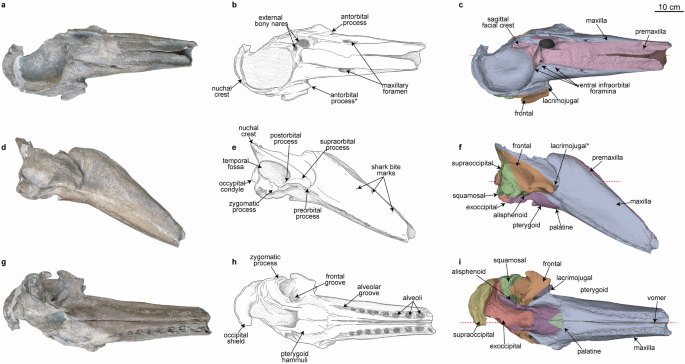
Benites Palomino, A. M. et al. 3D model related to the publication: extreme cranial asymmetry in extinct benthic feeding sperm whales. MorphoMuseuM e304 https://doi.org/10.18563/journal.m3.304 (2026).