
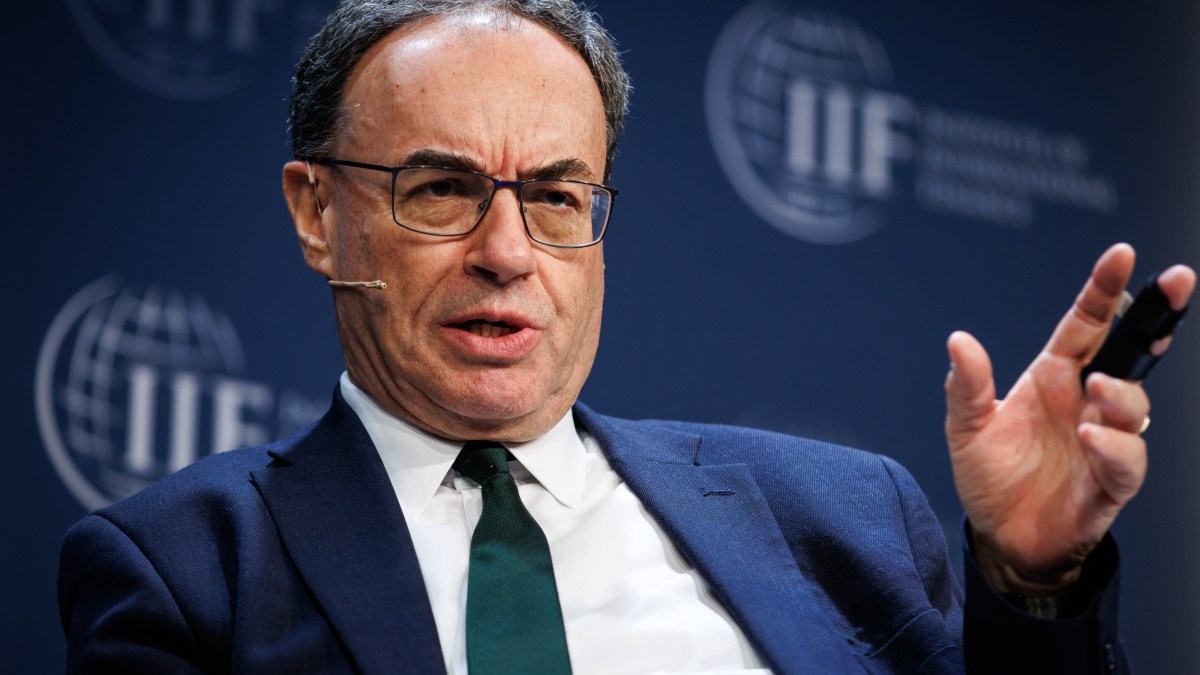
Andrew Bailey has warned that the economic impacts of Brexit will be negative “for the foreseeable future” in the strongest intervention yet by the governor of the Bank of England on the consequences of Britain’s exit from the EU.
He said that he was careful not to give a personal view on Brexit, and that it was his job as a public official to implement the decision “taken by the people of the UK”.
“But if you ask me what the impact is on economic growth, I do have to answer that question as a public official,” he said. “And the answer is that, for the foreseeable future, it is negative but over the longer time there should be a positive, albeit partial, counterbalance.”
• Wes Streeting: I’m glad we can now admit that Brexit is a problem
Bailey made the remarks in Washington DC where he was addressing a group of fellow central bankers. He has previously talked about the impact on trade from Brexit, which he has said “weighed” on the level of supply in the economy, and has called on the UK to rebuild relations with the EU.
The chancellor Rachel Reeves has also previously called for Britain to have stronger ties with its once-close trading partner and last week cited the impact of Brexit as among the reasons for the tight backdrop to next month’s budget.
Reeves told Sky News that Brexit was one of the reasons she was looking at “tax and spending” ahead of her budget on November 26.
“There is no doubting that the impact of Brexit is severe and long lasting,” she said, adding: “People thought the UK economy would be 4 per cent smaller because of Brexit.”
Four years ago the Office for Budget Responsibility said that Britain’s economy would be four per cent smaller than if the country had stayed in the EU.
While Bailey’s own views on Brexit are not known, he has previously acknowledged that it has imposed restrictions on trade.
His latest remarks follow the US president Donald Trump’s decision to impose tariffs on numerous countries around the world.
Bailey said that the UK economy would adjust to Brexit. “Make an economy less open and it will restrict growth, though over a longer time trade will adjust and rebuild,” he said. “And this appears to be what has happened. The same argument holds. The same argument holds for the world economy and tariffs.”
Bailey’s speech also touched on advances in the economy through AI, and warned of the impact to financial stability. “There is nothing inconsistent with thinking that AI is the next big technology and being concerned that it may along the way challenge financial stability through stretched valuations, and particularly in a environment of larger global supply shocks,” he said.
He also spelt out why Reeves was so focused on economic growth, with an example of the easier choices she would face if the economy had grown at 2.5 per cent over the last 15 years rather than the 1.5 per cent it achieved. The UK’s debt-to-GDP ratio — closely watched as an indication of how much more it can borrow — would be 82 per cent now, instead of 96 per cent. “If the denominator grows more slowly, economic policy making gets more difficult,” he said.
His speech also touched on advances in the economy through AI, and warned of the impact to financial stability. “There is nothing inconsistent with thinking that AI is the next big technology and being concerned that it may along the way challenge financial stability through stretched valuations, and particularly in an environment of larger global supply shocks,” he said.
Bailey’s predecessor Mark Carney — who is now the prime minister of Canada — waded in to the Brexit debate ahead of the referendum in 2016, warning that leaving the EU could possibly tip Britain into recession. His remarks drew sharp criticism from a number of pro-Brexit politicians.