
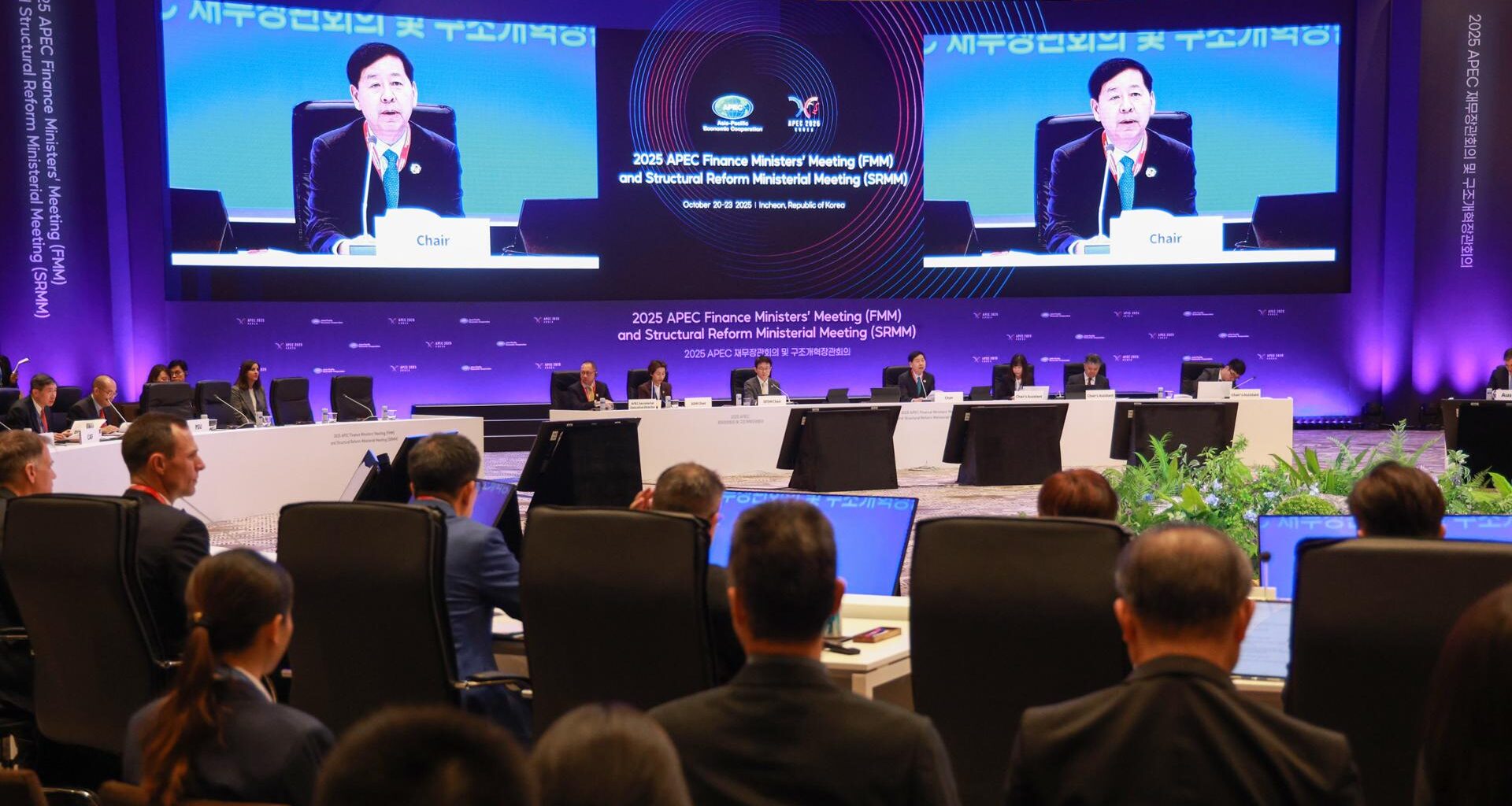
Member economies of the Asia-Pacific Economic Cooperation (APEC) are dedicated to building a road map for innovative financial and fiscal policies that can provide access and opportunity for all, finance ministers from the member economies said Tuesday.
To achieve the goal, the participants are planning to introduce the Incheon Plan, outlining innovations in the 21 member economies’ financial structures over the next five years.
They discussed the plan during the APEC Finance Ministers’ Meeting, which is running in Incheon from Tuesday through Thursday ahead of next week’s APEC Economic Leaders’ Meeting in Gyeongju, North Gyeongsang Province, under the theme “Building a Sustainable Tomorrow: Connect, Innovate, and Prosper.”
In line with this theme, the Incheon Plan is based on three core pillars — innovation, finance and fiscal policy — which reflect the overarching goals of the Finance Ministers’ Meeting for sustainable growth. A fourth pillar has also been added: access and opportunity for all.
“This year, we are poised to take an important step: adopting the Incheon Plan, a new five-year road map for the APEC finance track,” Deputy Prime Minister and Minister of Economy and Finance Koo Yun-cheol said in his opening speech at the Inspire Entertainment Resort on Incheon’s Yeongjong Island.
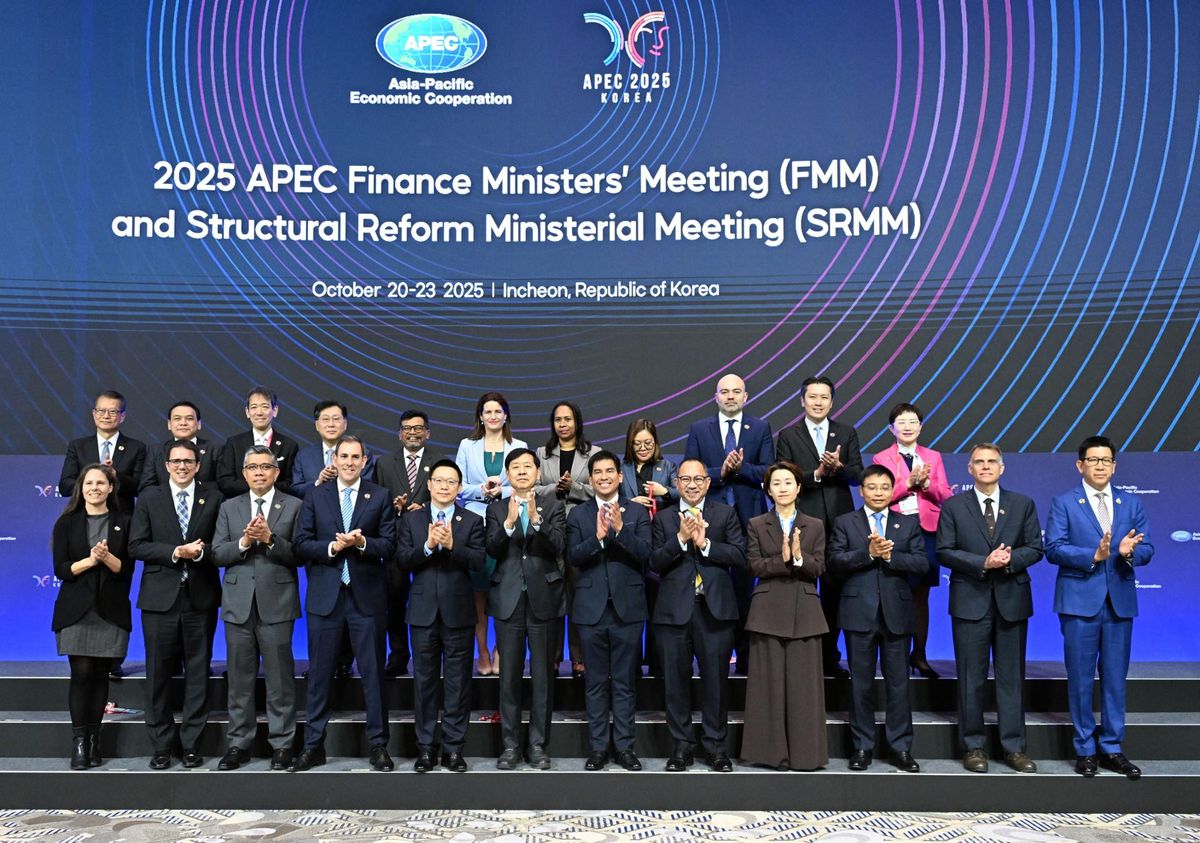
Deputy Prime Minister and Minister of Economy and Finance Koo Yun-cheol, front row sixth from left, applauds with other dignitaries during the Asia-Pacific Economic Cooperation Finance Ministers’ Meeting, held at the Inspire Entertainment Resort on Incheon’s Yeongjong Island, Tuesday. Yonhap
The Incheon Plan will succeed the Cebu Action Plan, which concludes this year after providing long-term direction for the APEC finance track over the past decade.
Regarding the first three pillars, Koo said that Korea, as host of the 2025 APEC Finance Ministers’ Meeting, has made innovation “the foremost priority” to respond to rapid digital transformation, especially in light of the growing impact of artificial intelligence (AI).
“As we enter the era of AI transformation, the finance ministers must take the lead, fostering an innovation-friendly environment and supporting the private sector, while continuously reflecting on its role and sharing solutions,” Koo said.
On the second pillar of finance, he noted that AI-driven digital finance is spreading at a remarkable speed.
“Our task is to foster innovation while building a responsible financial ecosystem — one that balances opportunity with risk, and ensures that financial access reaches vulnerable groups and remote communities,” he said.
Addressing the third pillar — fiscal policy — Koo emphasized the need to channel resources into critical areas, including AI transformation, for economies to grow sustainably.
“Fiscal policies should address not only the traditional sectors of defense, welfare and education but also new societal challenges such as population aging and climate change,” he said. “Simultaneously, we must strengthen the sustainability of our public finances through a range of measures, including restructuring expenditures, reforming tax exemptions and deductions, and closing loopholes to recover lost revenues.”
The finance minister highlighted the fourth pillar — access and opportunity for all — as one that broadens the traditional focus on financial inclusion within APEC Finance Ministers’ Meetings.
This year’s meeting is being held jointly with the APEC Structural Reform Ministerial Meeting for the first time.
The meetings are being attended by 11 finance ministers, including those from Australia, Hong Kong, New Zealand, Taiwan, Thailand and Vietnam, as well as vice ministers from Brunei, China and Japan.
Also in attendance are the secretary-general and representatives from international organizations, such as the United Nations Development Programme, the International Monetary Fund, the Organisation for Economic Co-operation and Development, the World Bank and the Asian Development Bank.