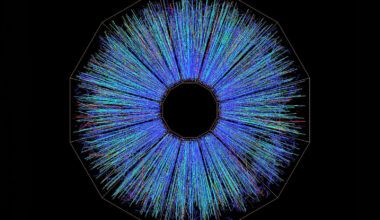
PPhysics Read More Pinning down the structure of quark-gluon plasma, the universe’s first fluid | MIT NewsNovember 6, 2026 In the first fraction of a second following the Big Bang, matter existed as a trillion-degree plasma of…
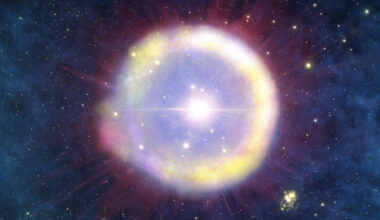
SScience Read More Colliding Stars in Early Universe May Explain Stellar Monsters, Study SuggestsNovember 4, 2026 Crowded star clusters in the early Universe could have built giant stars, seeded black holes and fed the…
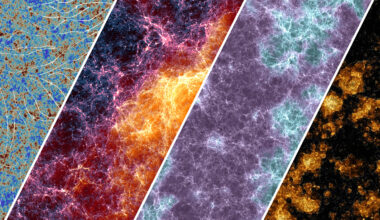
SSpace Read More Watch the universe emerge from the dark ages, with Lumina | MIT NewsOctober 26, 2026 Over the 2 billion years that Lumina simulates, it captures the emergence of two huge transformations in cosmic…
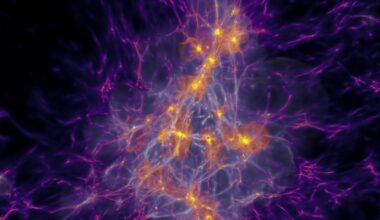
SScience Read More MEGATRON simulations connect the first stars with the universe’s smallest galaxiesOctober 24, 2026 MEGATRON simulations offer a possible explanation for the similar iron content of many of the smallest galaxies.Radiation delayed…
SScience Read More Record-Breaking Fast Radio Burst from Early Universe Traced to Tiny, Star-Forming GalaxyOctober 13, 2026 This fast radio burst, designated FRB 20240304B, is the most distant ever detected, having traveled more than 10…
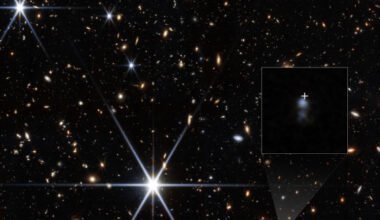
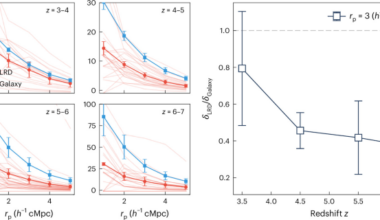
PPhysics Read More Reduced incidence of little red dots at z < 3 based on number density and halo mass evolutionOctober 9, 2026 Labbé, I. et al. A population of red candidate massive galaxies 600 Myr after the Big Bang. Nature…
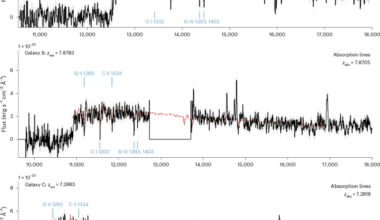
PPhysics Read More Early metal-enriched baryon cycling before the midpoint of cosmic reionizationSeptember 24, 2026 Observations and data reduction The data analysed in this work were obtained as part of the JWST Cycle…
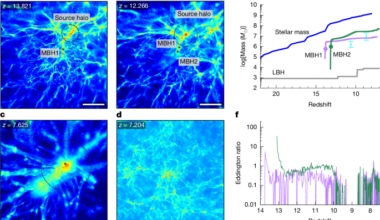
PPhysics Read More Overmassive black holes and little red dots naturally form in simulationsSeptember 16, 2026 Our cosmological initial conditions are based on the simulation Phi-4096 of ref. 51. In this work, a dark-matter-only N-body…
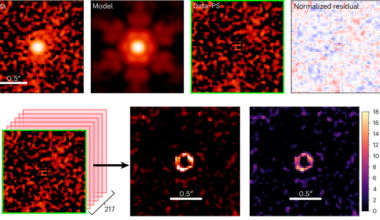
PPhysics Read More Extended components of little red dots in the rest-frame opticalAugust 25, 2026 Furtak, L. J. et al. JWST UNCOVER: extremely red and compact object at zphot = 7.6 triply imaged…
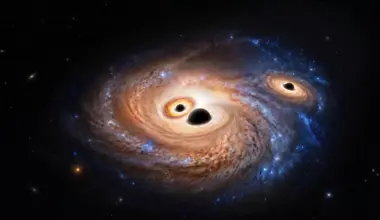
SScience Read More JWST Finds Three Black Holes in One Distant GalaxyAugust 19, 2026 Black holes grow in two main ways: by swallowing gas or by merging with other black holes. Gas…
SSpace Read More CosmoCube could use the Moon as a natural radio shield to study the Universe’s hidden era before the first stars and galaxies appeared |August 19, 2026 Image: CosmoCube’s Website Long before stars illuminated the cosmos, the Universe passed through a mysterious period known as…
SScience Read More Rocky Planets May Have Started Forming Just 100 Million Years after Big BangAugust 12, 2026 New simulations suggest supernova explosions of the Universe’s first stars scattered the ingredients for rocky planets only 100…