
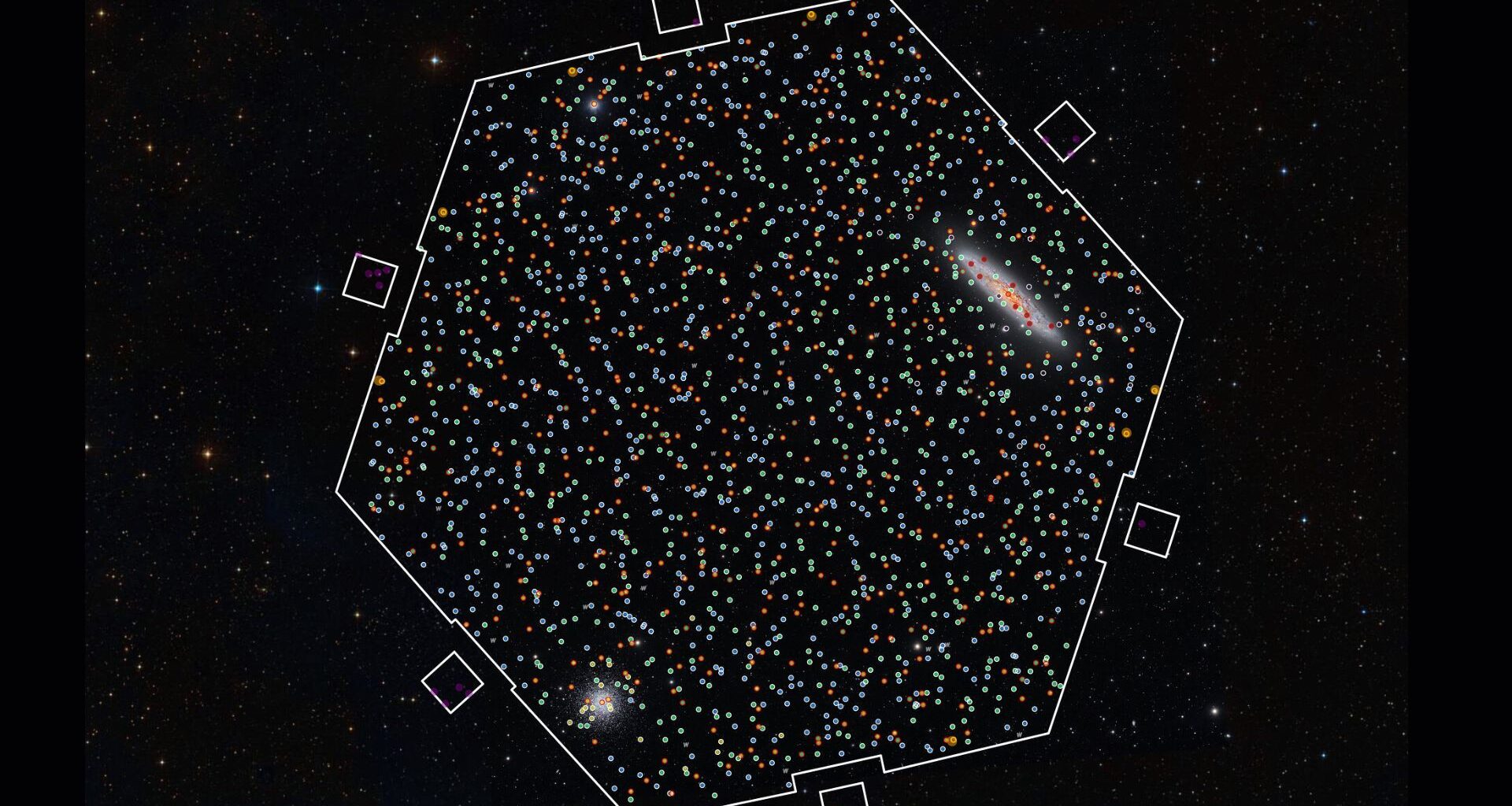
On October 18, 2025, the European Southern Observatory‘s (ESO) 4MOST (4-meter Multi-Object Spectroscopic Telescope) instrument observed the sky with its full array of 2,400 optical fibers for the first time, successfully capturing and analyzing the light from a vast range of cosmic objects.
Unlike traditional telescopes that observe one or a few objects at a time, 4MOST’s engineering allows it to conduct massive, simultaneous surveys, seeing more things at one time. The instrument’s wide hexagonal field of view covers a large portion of the sky in each observation, making it ideal for studying cosmic evolution and dark energy.
You may like
Where is it?
4MOST and the VISTA telescope are located at the Paranal Observatory in Chile.
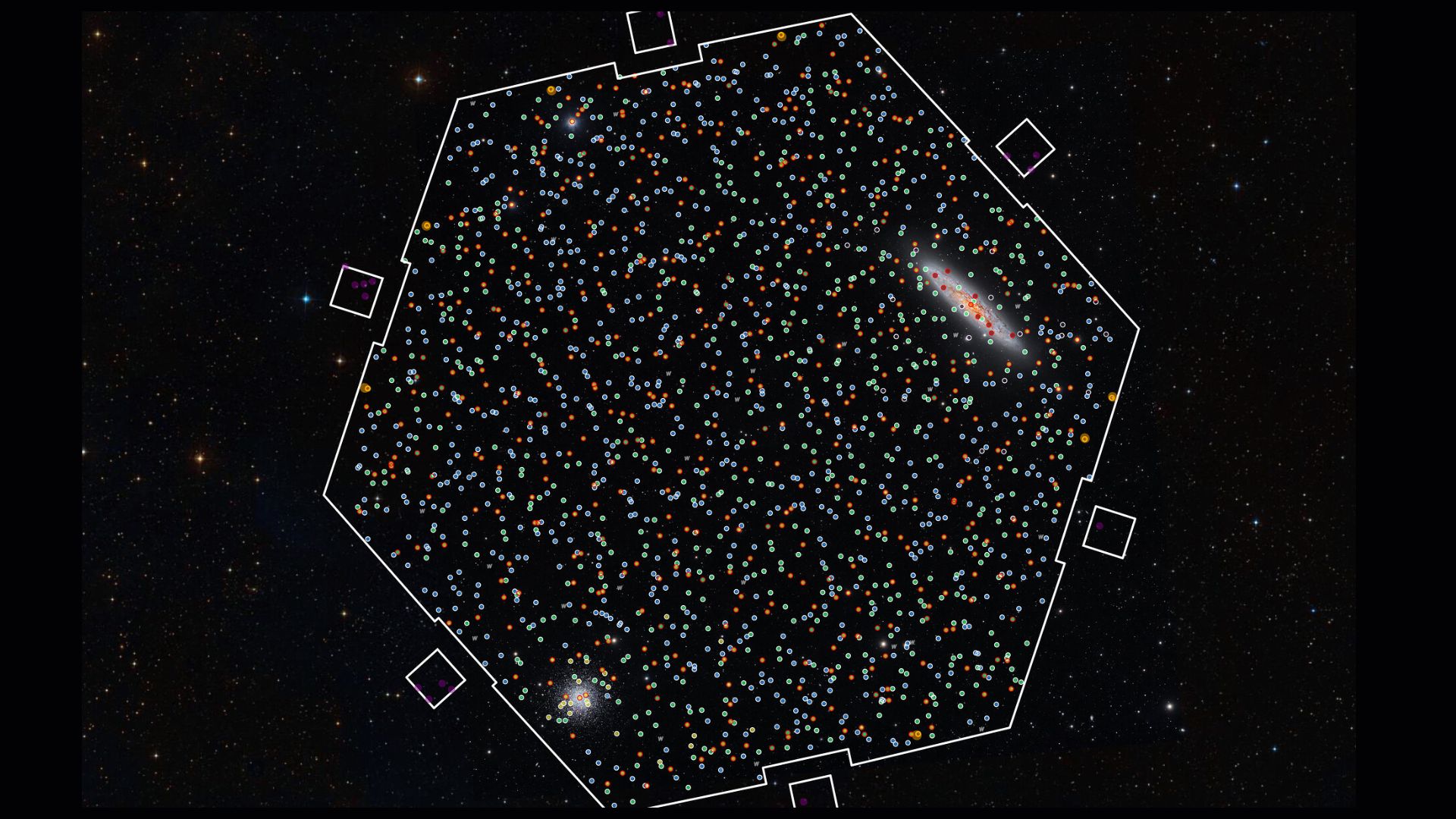
4MOST’s optical fibers help break cosmic objects into their color spectra. (Image credit: AIP/Background: Harshwardhan Pathak/Telescope Live)Why is it amazing?
During its first observations, 4MOST turned its hexagonal gaze toward a region in the southern sky that includes two popular celestial targets: the Sculptor Galaxy (NGC 253) and the global cluster NGC 288. Each of the colored dots in the image represents a distinct object whose light was captured and analyzed by one of 4MOST’s 2,400 fibers.
From each target, the instrument collected a spectrum, a detailed fingerprint of light that reveals key physical properties such as chemical composition, temperature, radial velocity and more.
Over the next decade, 4MOST will deliver millions of spectra, helping scientists tackle some of astronomy’s biggest questions.
Want to learn more?
You can read more about the European Southern Observatory’s recent research, as well as other telescopes in Chile.