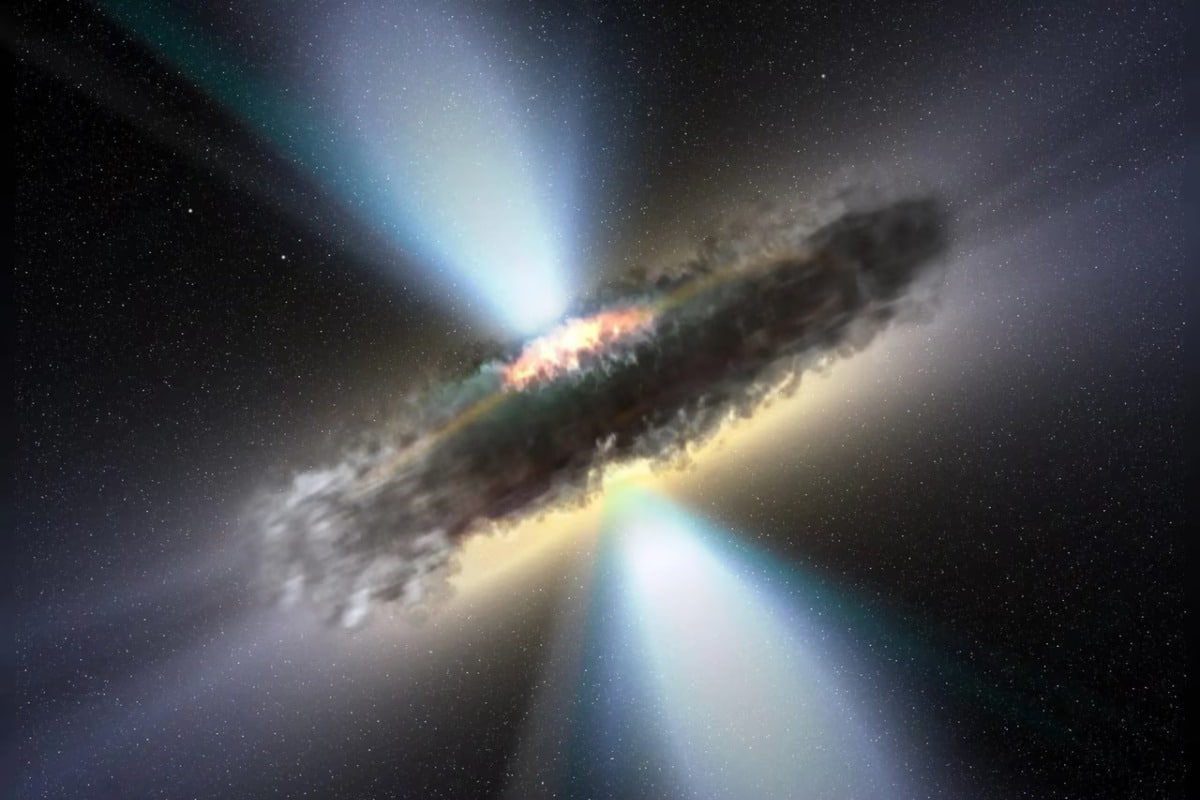
A cosmic ocean unlike anything we’ve ever imagined has just been found. Astronomers have discovered the largest reservoir of water in the known universe — holding an astonishing 140 trillion times more water than all of Earth’s oceans combined. Located 12 billion light-years away, this mind-bending find reshapes what we know about the role of water in the cosmos.
Water, the essential ingredient for life as we understand it, clearly isn’t confined to our little blue planet. In November 2024, researchers detected the largest and most distant source of water ever seen in space — a discovery that raises profound questions about where water comes from and how widespread it truly is.
A quasar of staggering scale
At the center of this discovery lies a cosmic giant known as APM 08279+5255 — a quasar more than 12 billion light-years from Earth. Inside it lurks a supermassive black hole of truly extreme proportions:
• A mass 20 billion times greater than our Sun
• Energy output equal to one thousand trillion Suns
• A total of 140 trillion times more water than Earth’s oceans
Matt Bradford, a scientist at NASA’s Jet Propulsion Laboratory, described this extraordinary environment in Astrophysical Journal Letters: “The area surrounding this quasar is truly unique in its ability to produce such an enormous mass of water.” The finding confirms that water was already abundant in the universe’s earliest epochs — even when galaxies were just beginning to form.
A galactic oasis with surprising traits
The massive cloud of water encircling APM 08279+5255 is no ordinary feature of space. Its environment stands out for its extreme conditions:
PropertyValueComparisonTemperature-63°CAbout five times hotter than the galactic averageDensity—Between 10 and 100 times denser than typical regionsExtentHundreds of light-years—
This extraordinary setup is driven by the quasar’s intense X-ray and infrared radiation. The surrounding water vapor serves as a tracer gas, helping scientists map and understand this exotic region. Researchers estimate that the reservoir could continue to feed the black hole until it swells to six times its current size.

The largest water reservoir in the universe contains 140 trillion times more water than Earth. © Borchee, iStock
Water: the universe’s most familiar stranger
The discovery of APM 08279+5255 is part of a growing body of research showing that water is truly universal. Astronomers have found it in all kinds of unexpected places:
• In interstellar clouds like the Orion Nebula, 1,344 light-years away, where both ice and vapor are abundant.
• In protoplanetary disks around young stars such as PDS 70, where new planets are forming amid water vapor.
• On comets and asteroids like 67P/Churyumov-Gerasimenko, which carry vast amounts of frozen water.
• Even in the atmospheres of exoplanets like K2-18b, a super-Earth about 124 light-years from us.
Taken together, these findings reveal that water is woven into the very fabric of the universe — from the birthplaces of stars to the worlds that might someday host life. They also provide fresh insight into how Earth’s own water may have arrived, and where life could arise beyond our solar system.
A new chapter in cosmic exploration
Finding this enormous reservoir around APM 08279+5255 marks a turning point in our understanding of the universe’s watery side. It’s a discovery that prompts new questions about how galaxies evolve, how black holes grow, and how the building blocks of life are distributed through space.
Future telescopes and missions will keep hunting for these hidden galactic oases, hoping to trace the origins of life itself. Water — so familiar here on Earth — is emerging as one of the great actors on the cosmic stage, reminding us that we live in a far wetter and more wondrous universe than we ever dreamed.