
The new moon on November 20, 2025, will be a rare celestial event, marking the most distant new moon from Earth for the next 18 years. At a distance of 406,681 kilometers (252,706 miles), this new moon will be the farthest Earth’s natural satellite will travel from us until December 1, 2043. While the event will not be visible, its significance lies in the astronomical mechanics that govern the lunar body’s orbit around Earth.
The Moon’s Shifting Orbit And Extreme Distances
The Moon’s orbit is elliptical, meaning its distance from Earth is not fixed. The closest point in this orbit is called the perigee, while the farthest point is known as the apogee. The perigee can range from 356,355 kilometers to 370,399 kilometers (221,429 to 230,155 miles), while the apogee fluctuates between 404,042 kilometers and 406,725 kilometers (251,060 to 252,272 miles). As the lunar body moves through its orbit, these points shift, influencing events like supermoons and micromoons.
A supermoon occurs when a full moon is closest to Earth at perigee, while a micromoon happens when the full moon is at its farthest point at apogee. Similarly, the new moon, when the Moon is between the Earth and the Sun, also experiences these shifts.
“The Moon reaches its farthest distance on November 20, 2025, around 02:46 UTC. This is about four hours before the moment of New Moon at 06:47 UTC,” explained Graham Jones, an astrophysicist and science communicator, making it the farthest new moon until 2043.
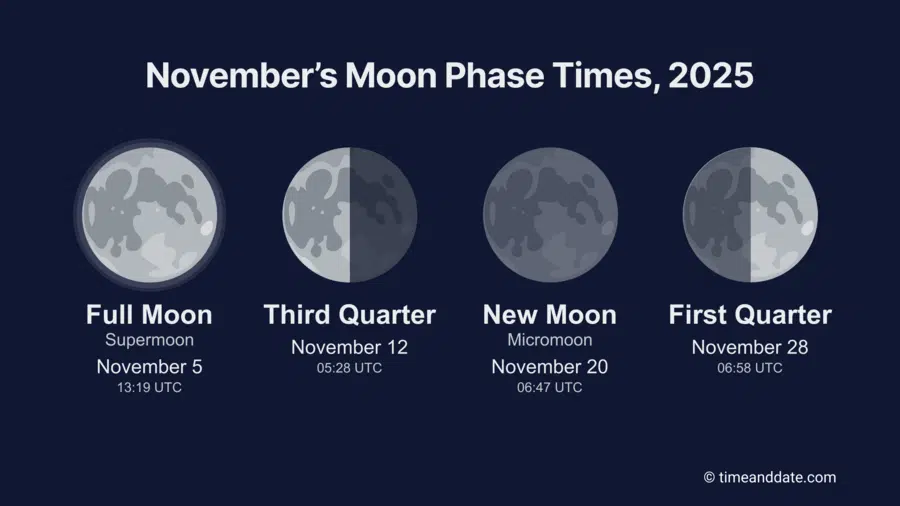 Dates and times for the main phases of the Moon in November 2025. Credit: TimeAndDate
A Rare Record-Breaking Event
As TimeAndDate explains, on the night of November 20, the orb will reach 406,681 kilometers away, a distance that will not be surpassed by any new moon until December 1, 2043, when the distance will be 406,699 kilometers. This new moon will also be the third farthest new moon of the century, following the March 14, 2002 new moon at 406,700 kilometers. The farthest new moon in the next century will occur on February 3, 2125, at 406,709 kilometers.
These lunar events remind us how dynamic the Moon’s orbit is and how even slight variations in its position can have profound effects on phenomena such as tidal forces. While this new moon won’t be visible, it plays a key role in advancing our understanding of orbital mechanics.
Where on Earth Will You Be Farthest from the Moon?
The furthest point from the satelitte’s surface during this event will be in the North Atlantic Ocean, southeast of Bermuda. This location is on the opposite side of the globe from Western Australia. In this specific region, the distance from the Earth’s surface to the celestial body will be about 411,300 kilometers (255,600 miles), the maximum achievable distance on Earth. Though no full moons this century will surpass this new moon in distance, an upcoming micromoon on January 27, 2032, will be the farthest full moon for the next 75 years.