
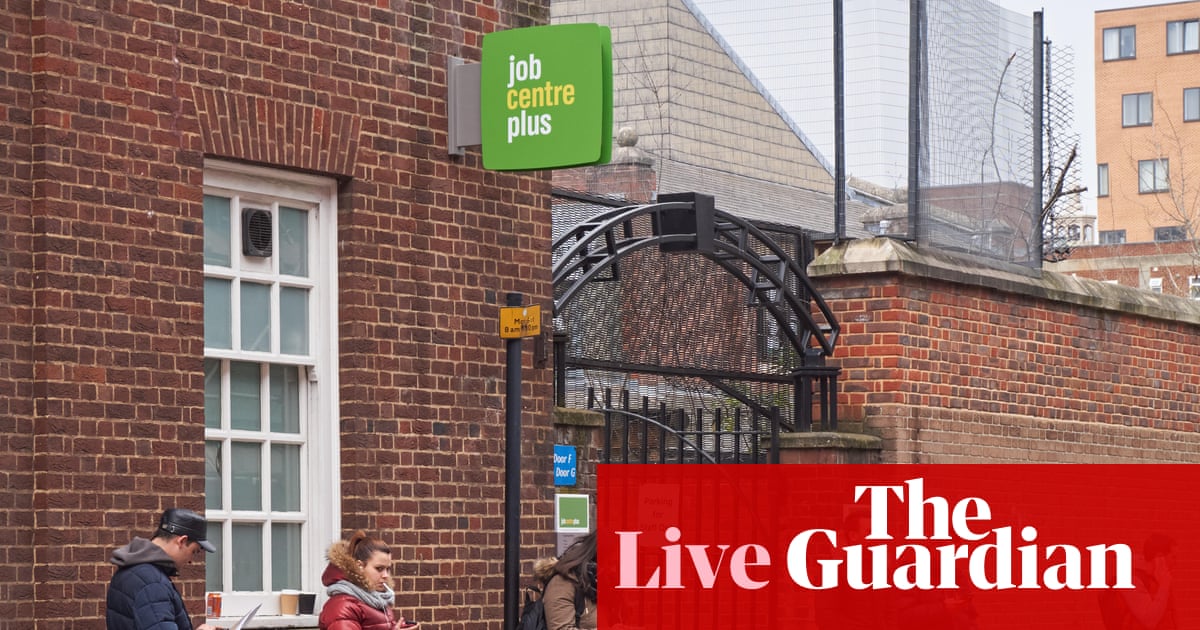
Introduction: UK unemployment hits 5%, first time since 2021
Good morning, and welcome to our rolling coverage of business, the financial markets and the world economy.
The weakening in Britain’s jobs market has gathered pace, with new data showing the jobless rate has hit its highest level since the Covid-19 pandemic.
The UK unemployment rate has jumped to 5% in the July to September quarter, the highest level since February 2021. That’s up from 4.8% a month earlier, and higher than expected.
In another blow, the Office for National Statistics estimate that the number of employees on payrolls fell by 32,000 in September, and by another 32,000 in October to 30.3 million.
And with the jobs market cooling, wage growth slowed too. Annual growth in employees’ average earnings slipped to 4.6% in the quarter, down from 4.7% in the three months to August.
ONS director of economic statistics Liz McKeown says:
“Taken together these figures point to a weakening labour market. The number of people on payroll is falling, with revised tax data now showing falls in most of the last 12 months. Meanwhile the unemployment rate is up in the latest quarter to a post pandemic high. The number of job vacancies, however, remains broadly unchanged.
“Wage growth in the private sector slowed further, but we continue to see stronger public sector pay growth, reflecting some pay rises being awarded earlier than they were last year.”
This jump in unemployment, and slowing wages, will heighten concerns that the economy is cooling – as Rachel Reeves prepares her budget due on 26 November – and could spur the Bank of England to cut interest rates again as soon as December.
The agenda
7am GMT: UK labour market report.
8am GMT: UK grocery inflation report
10am GMT: ZEW eurozone economic confidence index
11am GMT: US NFIB Business Optimism Index
2.30pm GMT: Business Secretary Peter Kyle makes first appearance at Business and Trade committee
Updated at 02.16 EST
Key events
Show key events only
Please turn on JavaScript to use this feature
Deutsche Bank: Labour market data strengthens case for a Christmas rate cut
Sanjay Raja. Deutsche Bank’s chief UK economist, says this morning’s jobs report strengthens the case for a Christmas rate cut, adding:
Today’s data should give the MPC more confidence to cut Bank Rate further by year-end. Labour market slack continued to widen – even surprising market expectations.
Pay momentum continued to slow, as expected. And while Budget uncertainty may be hampering hiring plans heading into Q4-25, one thing is clear: today’s data should continue to strengthen the case for a Christmas rate cut.
ShareBank of England expected to cut interest rates as jobs market weakens
Several economists are predicting the Bank of England could cut interest rates as soon as December, following this morning’s weak jobs report.
Suren Thiru, economics director at ICAEW (the Institute of Chartered Accountants in England and Wales), reckons the odds of a rate cut next month have risen, now that unemployment has jumped to 5% and wage growth has slowed.
“These figures suggest that the UK’s labour market is suffering from pre-Budget jitters, as businesses already weakened by April’s rise in national insurance look to cut recruitment further in anticipation of another difficult Budget.
“This weakening in wage growth is likely to accelerate over the winter as the downward pressure from an ailing economy, significant staffing costs and more job losses increasingly restrains pay awards.
“The jobs market could bear the brunt of Budget tax rises as weaker customer demand, amid a possible income tax hike and increasing costs on business, may mean higher unemployment than the Bank of England currently predicts.
“These underwhelming figures add credence to the more dovish tilt to last week’s policy decision and the current rate at which the labour market is loosening notably increases the chances of a December interest rate cut.”
Richard Carter, head of fixed interest research at Quilter Cheviot, points out that BoE governor Andrew Bailey is the ‘swing voter’ on its Monetary Policy Committee, who could be swayed into creating a majority for a cut:
“An early Christmas present could come in the form of an interest rate cut from the Bank of England following a rise in unemployment and a softening in wage growth. The monetary policy committee had a tight 5-4 split on whether to hold or cut rates at last week’s meeting, with Andrew Bailey’s deciding vote erring on the side of caution.
“Today’s figures from the Office for National Statistics show wage growth pressures, albeit still relatively high, are slowly easing. Annual growth in regular earnings excluding bonuses saw a decline to 4.6% compared to 4.7% last month, and total earnings including bonuses fell to 4.8% compared to 5%. Any further signs of easing in the next labour market print could sway a few more on the committee to cut on the 18th December.
Thomas Pugh, chief economist at audit, tax and consulting firm RSM UK, points out that problems at the Office for National Statistics do make today’s data somewhat unreliable….
“A rise in the unemployment rate to 5.0% in September, the highest level since the pandemic, and a further slowing in private sector pay growth throws the door wide open to a December rate cut – as long as the budget is as deflationary as the Chancellor hinted at last week.
“Overall, the labour market appears to still be weakening with the unemployment rate ticking up and employment falling on both the LFS and payrolls measures. Admittedly, the unemployment rate is being driven up by an erratic looking jump in unemployment on the single month figures. Even though the ONS has made improvements to the Labour Force Survey, which is where the official measures of employment statistics are derived from, it continues to be distorted by a low response rate making it less reliable than in the past.
This morning, the money markets are now indicating they expect 65 basis points of BoE rate cuts by the end of next year, up from 55 bps on Monday. That means two quarter-point cuts by December 2026 are fully priced in, with a third now more likely.
The business tax rises announced in last year’s budget, and uncertainty over what the chancellor will announce this time, are being blamed for the rise in UK unemployment.
Isaac Stell, investment manager at tax advisory service Wealth Club, calls it a “self-inflicted wound”:
There can be no doubt that the fiscal levers pulled by the Government and the Chancellor have significantly contributed to these figures and the responsibility lies at their feet.
With speculation around the Budget reaching fever pitch, businesses have postponed hiring and are less likely to commit to any form of investment until they know where the economic land lies. The stakes couldn’t be higher for the government and with further tax rises guaranteed at the budget, the fiscal landscape for employers and employees looks to be on ever shakier ground.”
Ashley Webb, UK economist at Capital Economics, also blames the rise in employer national insurance contributions for workforce cuts:
The 32,000 fall in payroll employment in October was the eleventh monthly decline over the past year and suggests that businesses continued to trim headcounts after the Chancellor announced the rises in payroll taxes and the minimum wage in last year’s October Budget.
Admittedly, the number of job vacancies paused its recent downward trend and remained broadly unchanged at 723,000 in the three months to Octobe
ShareReal wage growth slows too
Inflation is taking a large chunk out of UK pay growth.
While regular pay growth was 4.6% in July to September, that falls to just 0.8% in real terms once you adjust for CPI inflation.
That’s down from 0.9% in the previous three-months.
It was last lower than 0.8% in June to August 2023, when it was 0.7%.
SharePublic sector pay outpaces private sector
Wage growth in the public sector was much more rapid than in the private sector over the summer, today’s jobs report shows.
Annual average regular earnings growth was 6.6% for the public sector in July to September, compared with 4.2% for the private sector.
The ONS cautions that the public sector annual growth rate is affected by some public sector pay rises being paid earlier in 2025 than in 2024, which caused a base effect.
Reminder: overall regular pay growth slowed to 4.6%, which is the lowest since February to April 2022.
A chart showing UK wage growth Illustration: ONSShare
This morning’s labour market report shows a jump in unemployment among men in the last couple of months.
While the overall jobless rate has risen to 5% in July-September, up from 4.7% in April-June, there’s a clear gender split. Among men, joblessness is up from 4.8% to 5.4%, while among women it’s unchanged at 4.5%.
A chart showing UK unemployment rates Photograph: ONS
The ONS says:
In the latest quarter (July to September 2025), those unemployed for up to 6 months or over 12 months increased but the number of those unemployed between 6 and 12 months decreased.
The number of people unemployed for up to 6 months, between 6 and 12 months, and over 12 months, increased over the year, since July to September 2024.
The increase in the number of people unemployed in the latest quarter was the result of an increase in the number of unemployed men. We will explore this further as more data becomes available.
ShareSterling drops after UK jobs report
The pound has dropped by half a cent against the US dollar, as traders react to the jump in UK unemployment, and the slowdown in wage growth.
This has pushed sterling down to $1.3123, and indicates the City may expect the Bank of England to respond by lowering interest rates.
Last week, the Bank narrowly voted to leave borrowing costs unchanged, by fivevotes to four.
Updated at 02.16 EST
Introduction: UK unemployment hits 5%, first time since 2021
Good morning, and welcome to our rolling coverage of business, the financial markets and the world economy.
The weakening in Britain’s jobs market has gathered pace, with new data showing the jobless rate has hit its highest level since the Covid-19 pandemic.
The UK unemployment rate has jumped to 5% in the July to September quarter, the highest level since February 2021. That’s up from 4.8% a month earlier, and higher than expected.
In another blow, the Office for National Statistics estimate that the number of employees on payrolls fell by 32,000 in September, and by another 32,000 in October to 30.3 million.
And with the jobs market cooling, wage growth slowed too. Annual growth in employees’ average earnings slipped to 4.6% in the quarter, down from 4.7% in the three months to August.
ONS director of economic statistics Liz McKeown says:
“Taken together these figures point to a weakening labour market. The number of people on payroll is falling, with revised tax data now showing falls in most of the last 12 months. Meanwhile the unemployment rate is up in the latest quarter to a post pandemic high. The number of job vacancies, however, remains broadly unchanged.
“Wage growth in the private sector slowed further, but we continue to see stronger public sector pay growth, reflecting some pay rises being awarded earlier than they were last year.”
This jump in unemployment, and slowing wages, will heighten concerns that the economy is cooling – as Rachel Reeves prepares her budget due on 26 November – and could spur the Bank of England to cut interest rates again as soon as December.
The agenda
7am GMT: UK labour market report.
8am GMT: UK grocery inflation report
10am GMT: ZEW eurozone economic confidence index
11am GMT: US NFIB Business Optimism Index
2.30pm GMT: Business Secretary Peter Kyle makes first appearance at Business and Trade committee
Updated at 02.16 EST