
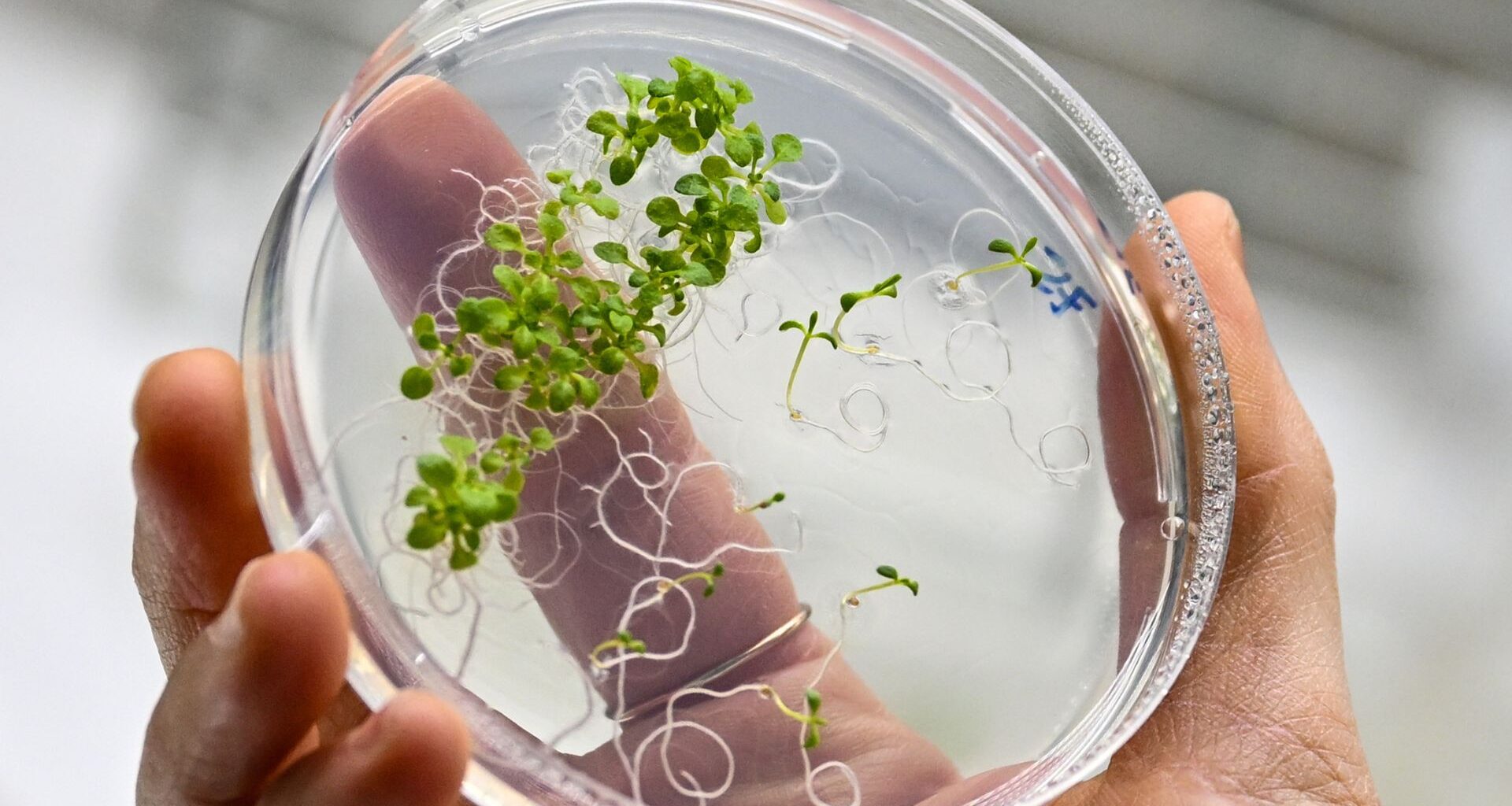
A team in Taiwan has engineered a new way for plants to absorb and use carbon dioxide, potentially reshaping the fight against climate change.
By inserting an extra biochemical cycle into a model plant, the researchers boosted growth, seed yield, and fat production without increasing water demand.
Plants normally rely on the Calvin-Benson-Bassham cycle to fix carbon dioxide into organic compounds. The key enzyme in this cycle, Rubisco, is notoriously inefficient. That limitation has capped how much carbon plants can lock away.
To overcome this, the Taiwanese researchers introduced a new pathway called the malyl-CoA-glycerate cycle, or the McG cycle.
Unlike the Calvin cycle, it outputs a two-carbon molecule directly usable in lipid production. It also takes in carbon at two steps, capturing more carbon per cycle.
Crucially, the McG cycle links with the Calvin cycle, allowing the two systems to balance out excess molecules. The design uses eight reactions, all driven by enzymes that exist in nature, though not together in the same species.
Testing in a model plant
The team added the McG cycle genes to Arabidopsis thaliana, a small weed often used in plant research.
The results were striking. Modified plants grew two to three times heavier than controls. They produced more leaves, larger leaves, and more seeds.
“Plants with the McG cycle had increased lipids, seed yield, and overall biomass,” said Madeleine Seale in a summary of the work.
Radioactive tracing confirmed the captured carbon flowed into the expected molecules.
Imaging also showed cells packed with lipid-filled pockets. In some cases, triglyceride levels rose by factors of 100 or more.
These gains appeared across different growing conditions. The plants captured more carbon without drawing more water, an important factor for real-world applications.
Hurdles before real-world use
Despite the promise, researchers caution against early conclusions. Arabidopsis is a lab-friendly weed, not a crop or tree. Large plants may respond differently to excess lipid buildup.
Nutrient-rich soil in laboratories also does not reflect the challenges of field conditions.
Another question is how much of the extra carbon remains sequestered. If the lipids oxidize after the plant dies, much of the benefit could vanish.
However, biofuel production might turn this pathway into a tool for renewable energy, since fats can be converted into fuel.
For now, the study provides proof of concept. “This work provides a proof of concept for enhancing carbon fixation and plant growth without the need to directly alter Rubisco performance,” Seale said.
The ability to rewire plant metabolism marks a milestone. Scientists have modified a cycle that has operated for billions of years, and instead of breaking it, they made plants thrive.
The study is published in the journal Science.