

NASA’s Psyche probe, on a mission to explore the metal-rich asteroid 16 Psyche, recently captured remarkable images of Earth and the Moon from 180 million miles away. These stunning visuals, taken during a routine instrument check, marked a significant step in calibrating the spacecraft’s complex imaging systems. As the probe travels deeper into space, its primary focus remains the asteroid, which could reveal crucial information about planetary formation.
A Leap Forward in Space Imaging Technology
NASA’s Psyche probe, designed to study an unusual asteroid, has already made headlines with its impressive imaging feats. The recent photos of Earth and the Moon, taken from a staggering distance of 180 million miles, highlight the probe’s evolving capabilities. These images were not just a celebration of technology but part of a crucial calibration process to ensure the spacecraft’s cameras perform optimally when it reaches its asteroid target. During these early stages of its journey, NASA engineers and scientists are focusing on refining the probe’s multispectral camera, which will be vital for capturing the surface features of 16 Psyche.
The images captured are part of an ongoing effort to test how well the camera handles faint light and densely packed star fields. As Jim Bell, a scientist from Arizona State University, explains,
“After this, we may look at Saturn or Vesta to help us continue to test the imagers.”
This careful calibration of the Psyche’s imaging instruments will prepare the probe for the dimmer and more distant target of the asteroid. The data collected during this phase allows engineers to tweak the system and ensure the long-term success of the mission. According to NASA’s Jet Propulsion Laboratory (JPL), these tests also help ensure that the camera can reliably capture faint objects in challenging conditions.
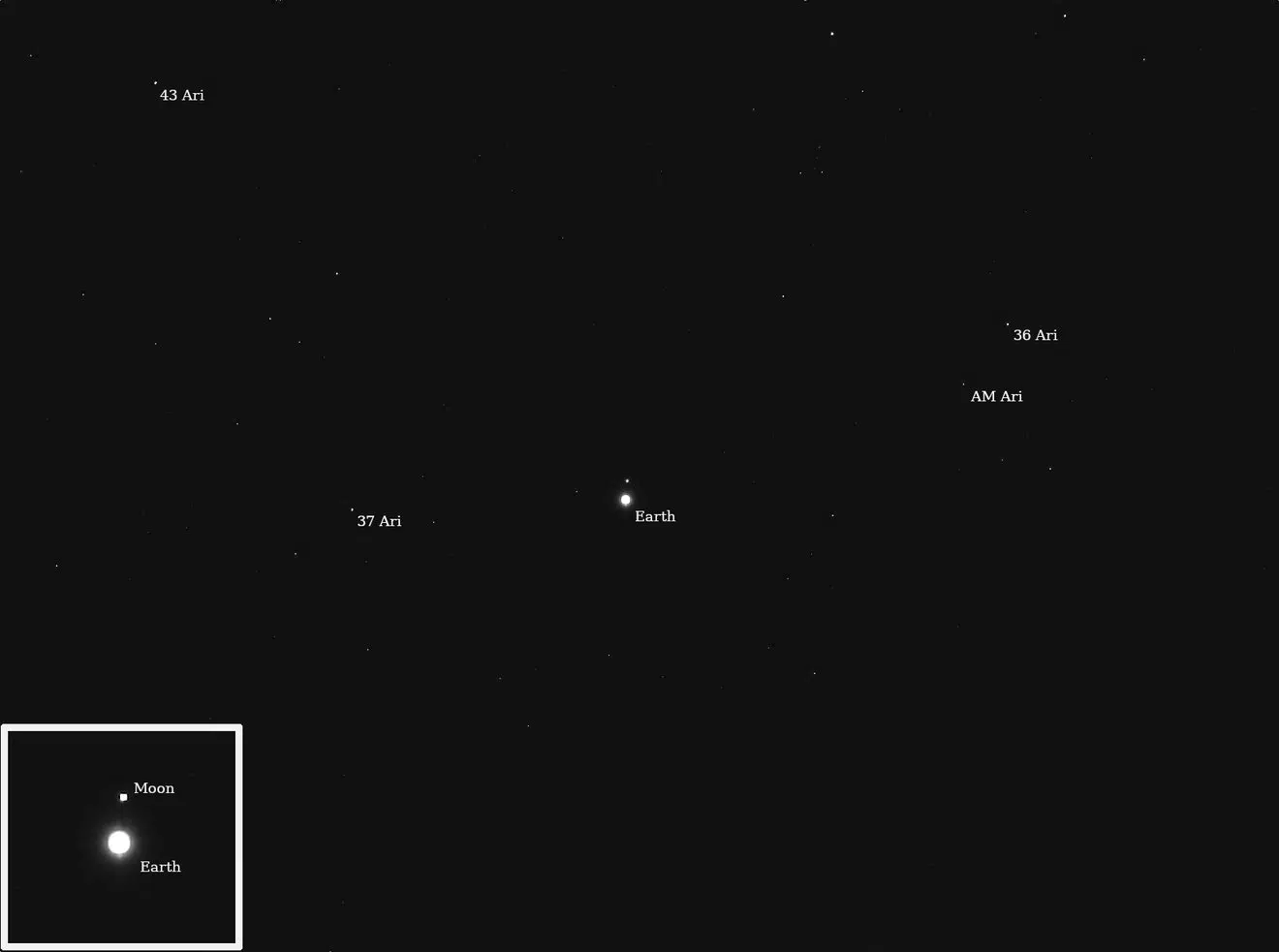 NASA’s Psyche captured images of Earth and our Moon from about 180 million miles (290 kilometers) away in July 2025, as it calibrated its imager instrument. When choosing targets for the imager testing, scientists look for bodies that shine with reflected sunlight, just as the asteroid Psyche does. Credit: NASA/JPL-Caltech/ASU
Understanding the Psyche Mission and Its Role in Planetary Science
The primary goal of the Psyche mission is to explore asteroid 16 Psyche, a unique metal-rich object that might represent the exposed core of an early planetesimal. By examining this asteroid, scientists hope to gain valuable insights into the building blocks of rocky planets, such as Earth. The asteroid is particularly intriguing because it could hold remnants of a molten core that once generated a magnetic field, a characteristic that is essential for understanding planetary differentiation.
While the images of Earth and the Moon served as important calibration targets, they were also symbolic of the larger objectives of the mission. According to Bob Mase, the project manager at NASA’s Jet Propulsion Laboratory (JPL), “We are up and running, and everything is working well.” This marks a significant milestone for the spacecraft, which is equipped with cutting-edge instruments, including a gamma-ray and neutron spectrometer. These tools will help identify the asteroid’s elemental composition, such as the presence of iron and nickel, and give scientists a deeper understanding of how metallic cores form.
How Calibration Shapes the Psyche Probe’s Success
Calibration might sound like a mundane process, but for deep-space missions like Psyche, it’s a critical step that can make or break the mission. The spacecraft’s camera, designed to capture images across different wavelengths of light, must be perfectly tuned to handle a range of conditions — from the faint glow of distant celestial bodies to the intense reflections of sunlight off Psyche itself. The images of Earth and the Moon were part of a test to assess how well the camera performs under such conditions.
“We’re sort of collecting solar system ‘trading cards’ from these different bodies and running them through our calibration pipeline to make sure we’re getting the right answers,” says Bell.
This methodical approach ensures that by the time the probe reaches its target asteroid, it will be able to capture the most accurate data possible, without unexpected issues arising from its instruments. The engineers will continue to run tests and make adjustments over the next several years, ensuring that the Psyche spacecraft is fully prepared to gather crucial data when it finally arrives at the asteroid in 2029.
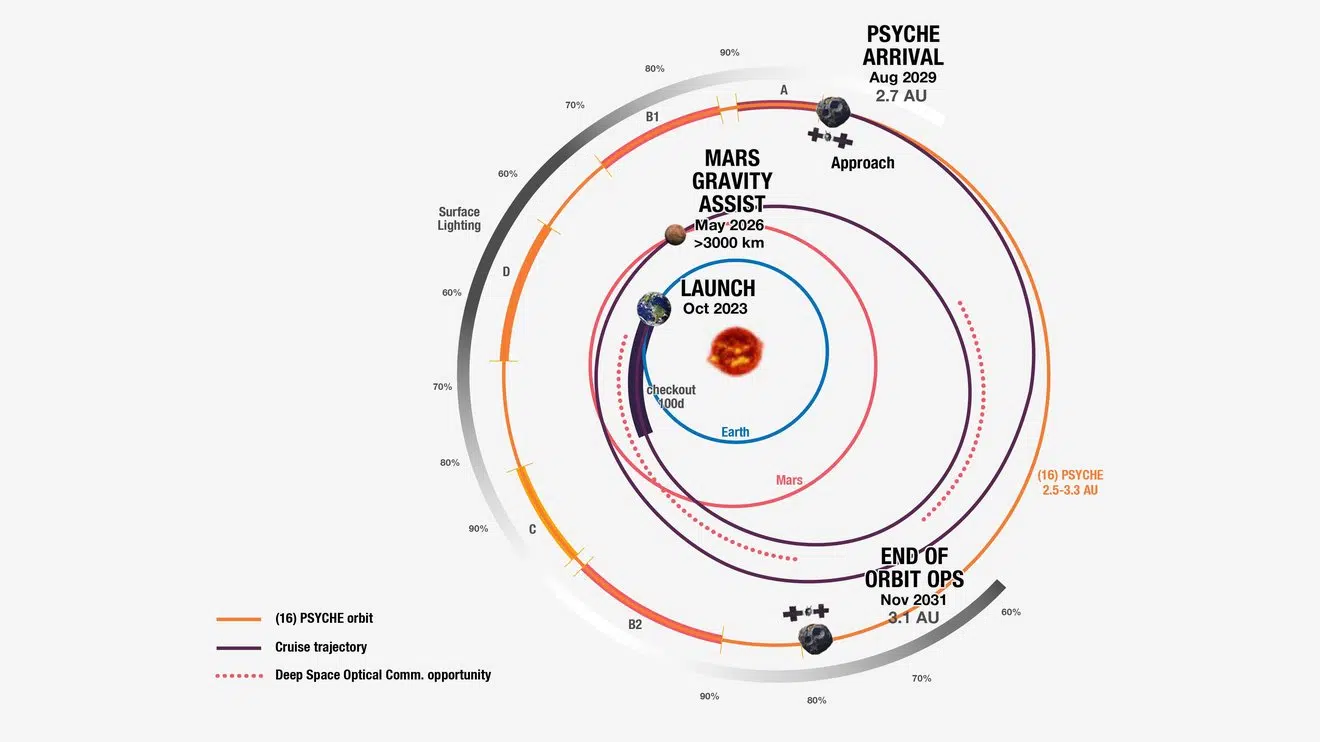 The Psyche spacecraft is taking a spiral path around the solar system in order to get a boost from a Mars gravity assist in 2026. It will arrive at the asteroid Psyche in 2029.
Credit: NASA/JPL-Caltech
A Journey into the Unknown
The Psyche mission is more than just a journey to a distant asteroid; it’s an exploration into the fundamental processes that shaped our solar system. If the asteroid turns out to be the exposed core of a planetesimal, it could provide unprecedented insights into how rocky planets like Earth formed and evolved. By using the latest technology to study its composition and magnetic properties, NASA hopes to unravel the mysteries of these cosmic building blocks.
The success of this mission hinges on the careful calibration and testing of the spacecraft’s instruments, ensuring that when the time comes, Psyche can gather the most precise data possible. As the spacecraft travels through space, it will continue to build on this foundation, slowly preparing for its final objective — an in-depth study of one of the most unique objects in our solar system.