

The Japanese Yen (JPY) sticks to modest intraday recovery gains against a softer US Dollar (USD), though it lacks follow-through and remains close to a nine-month low touched the previous day. Concerns about the US economy keep the USD bulls on the defensive and weigh on investors’ sentiment, which, in turn, is seen as a key factor underpinning the JPY’s safe-haven status. Apart from this, speculations that Japanese authorities would step into the market to stem further weakness in the domestic currency offer additional support to the JPY.
Meanwhile, investors remain uncertain about the Bank of Japan’s (BoJ) policy tightening path on the back of Japanese Prime Minister Sanae Takaichi’s expansionary fiscal policy stance and her preference for interest rates to stay low. This has been a key factor behind the JPY’s relative underperformance recently and might cap further gains. Furthermore, less dovish Federal Reserve (Fed) expectations could limit USD losses and act as a tailwind for the USD/JPY pair. Traders also seem reluctant ahead of FOMC minutes, due for release later today.
Japanese Yen draws support from flight to safety and intervention fearsA panel, consisting of lawmakers from Japan’s ruling Liberal Democratic Party, proposed on Tuesday compiling a supplementary budget exceeding ¥25 trillion to fund Prime Minister Sanae Takaichi’s planned stimulus package. This fuels anxiety over the supply of new government debt and pushes the yield on the 40-year Japanese government bonds to a record high.Takaichi said last week that Japan still faced the risk of returning to deflation and added that she strongly hopes the Bank of Japan achieves inflation driven by wages rather than primarily through rising food costs. Takaichi urged the BoJ to cooperate with government efforts to reflate the economy and also voiced her displeasure over the idea of raising interest rates.Meanwhile, speculations that the recent decline in the Japanese Yen could trigger intervention from government authorities hold back bearish traders from placing fresh bets. Adding to this, the prevalent risk-off environment offers some support to safe-haven JPY, which, along with the lack of US Dollar buying, keeps a lid on further gains for the USD/JPY pair.The USD bulls await the release of delayed US macro data for clues about the health of the world’s largest economy amid signs of a softening labor market and the Federal Reserve’s next move. In fact, Fed Vice Chair Philip Jefferson said the central bank needs to proceed slowly, while Fed Governor Christopher Waller continued to build the case for further rate cuts.Hence, the market focus will remain glued to the release of FOMC meeting Minutes, due later this Wednesday, which will play a key role in influencing the near-term USD price dynamics. The attention will then shift to the closely-watched US Nonfarm Payrolls report for September on Thursday. The latter should provide some meaningful impetus to the USD/JPY pair.USD/JPY dips towards 155.00 could be seen as buying opportunity
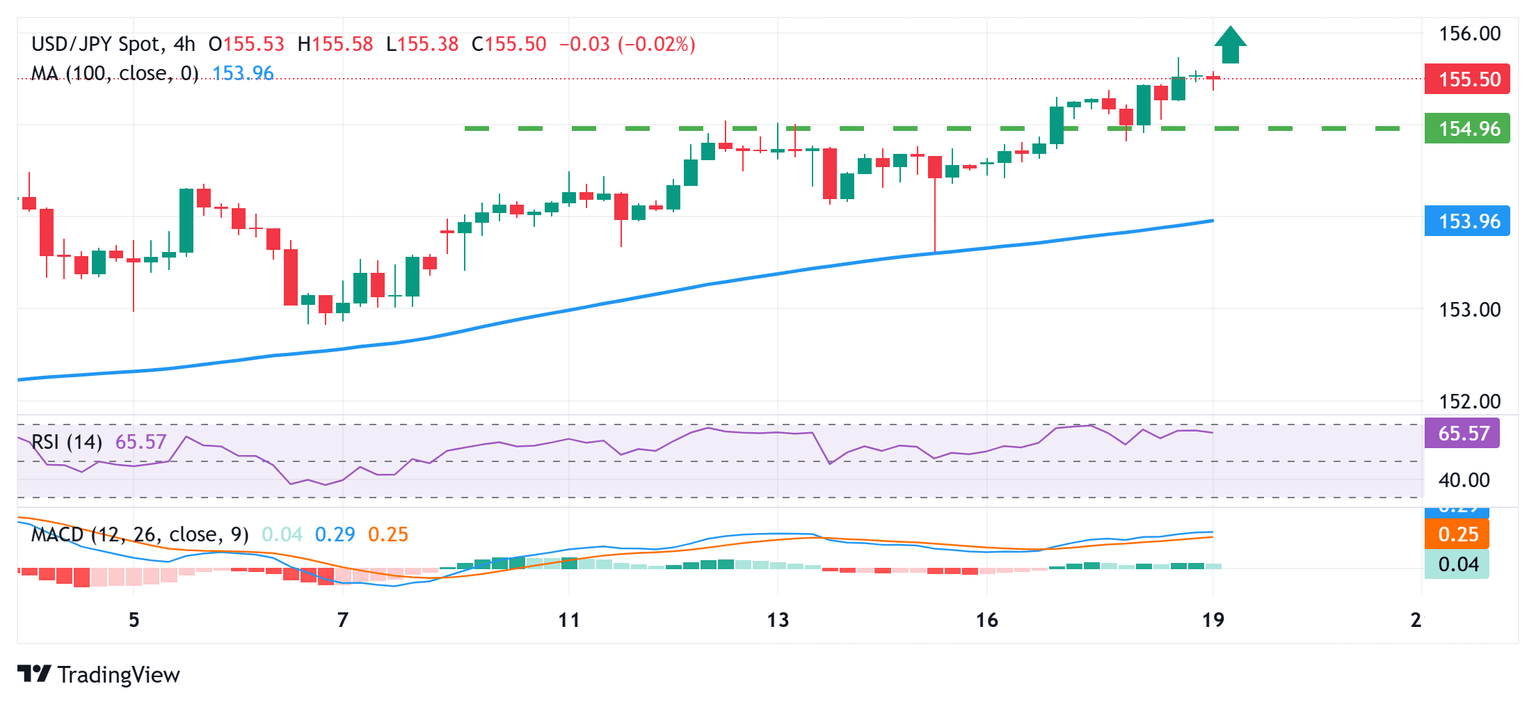
This week’s back-to-back close above the 155.00 psychological mark and positive oscillators suggest that the path of least resistance for the USD/JPY pair remains to the upside. Hence, some follow-through strength, towards reclaiming the 156.00 round figure, looks like a distinct possibility. The momentum could extend further towards the next relevant hurdle near the 156.50-156.60 region, above which spot prices to climb to the 157.00 mark en route to the 157.35 area.
On the flip side, corrective pullbacks might now find decent support near the 155.00 mark, and any further weakness is more likely to attract fresh buyers near the 154.50-154.45 horizontal resistance breakpoint. The latter should act as a key pivotal point, below which the USD/JPY pair could extend the fall towards the 154.00 round figure en route to the next relevant support near the 153.60-153.50 region and the 153.00 mark.
Bank of Japan FAQs
The Bank of Japan (BoJ) is the Japanese central bank, which sets monetary policy in the country. Its mandate is to issue banknotes and carry out currency and monetary control to ensure price stability, which means an inflation target of around 2%.
The Bank of Japan embarked in an ultra-loose monetary policy in 2013 in order to stimulate the economy and fuel inflation amid a low-inflationary environment. The bank’s policy is based on Quantitative and Qualitative Easing (QQE), or printing notes to buy assets such as government or corporate bonds to provide liquidity. In 2016, the bank doubled down on its strategy and further loosened policy by first introducing negative interest rates and then directly controlling the yield of its 10-year government bonds. In March 2024, the BoJ lifted interest rates, effectively retreating from the ultra-loose monetary policy stance.
The Bank’s massive stimulus caused the Yen to depreciate against its main currency peers. This process exacerbated in 2022 and 2023 due to an increasing policy divergence between the Bank of Japan and other main central banks, which opted to increase interest rates sharply to fight decades-high levels of inflation. The BoJ’s policy led to a widening differential with other currencies, dragging down the value of the Yen. This trend partly reversed in 2024, when the BoJ decided to abandon its ultra-loose policy stance.
A weaker Yen and the spike in global energy prices led to an increase in Japanese inflation, which exceeded the BoJ’s 2% target. The prospect of rising salaries in the country – a key element fuelling inflation – also contributed to the move.