
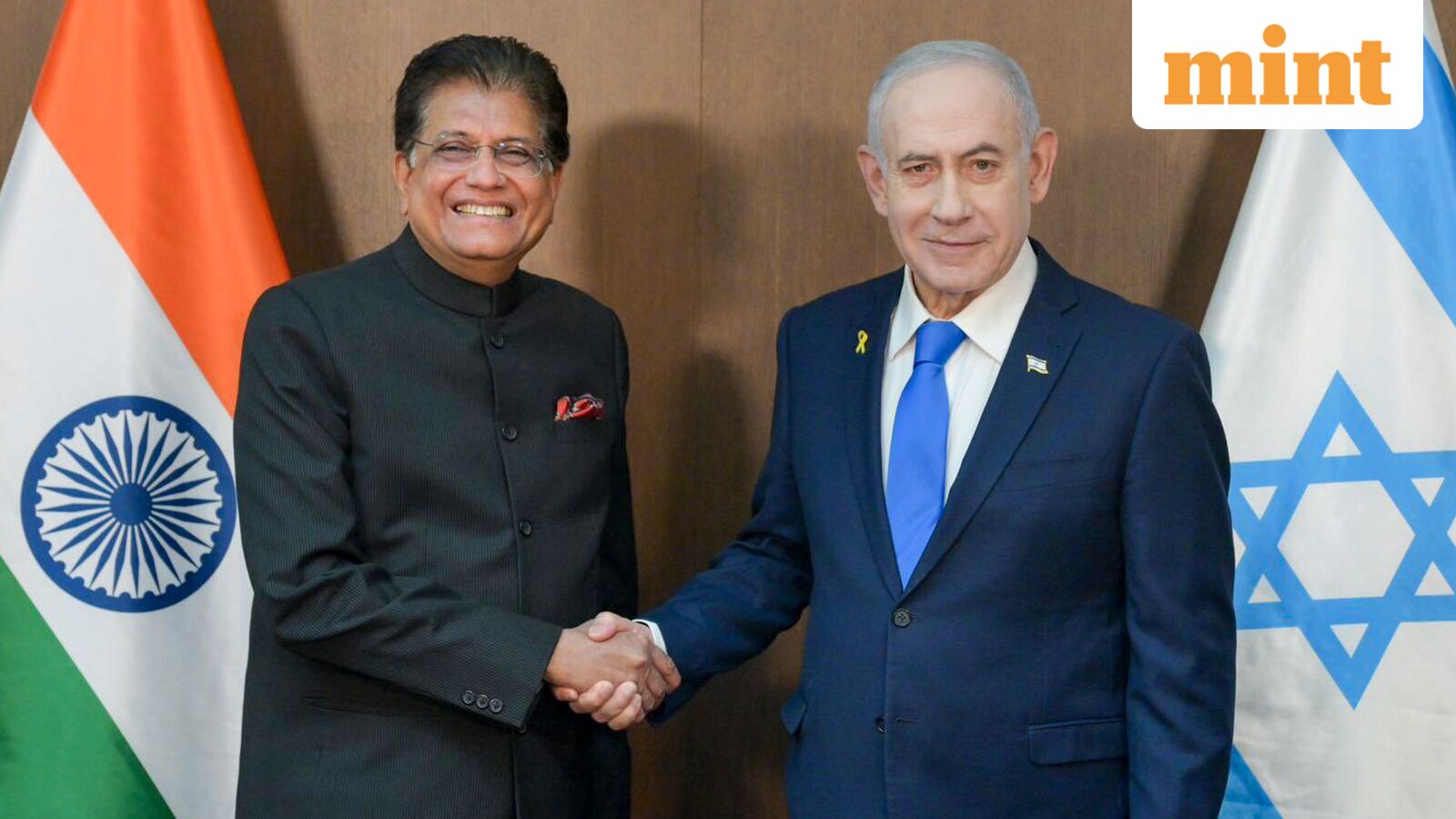
New Delhi: India and Israel signalled a renewed push in their economic partnership on Sunday after commerce and industry minister Piyush Goyal met Israel Prime Minister Benjamin Netanyahu and President Isaac Herzog in Jerusalem. After an over decade-long-lull, the two sides emphasized on deepening cooperation in trade, technology and investments.
The meetings come at a time when the two countries are preparing to take the first formal steps towards negotiations for a free trade agreement (FTA), a process that has been discussed intermittently since 2013, but is now drawing political attention on both sides.
After his meeting with Goyal, Netanyahu said the two countries were entering a phase of deeper cooperation across investment, technology and connectivity. “Israel and India are strengthening our strategic partnership, more investments, more innovation, and a strong economic corridor from India through Israel to Europe. Together we are building economic power,” he said in a post on X.
Also Read | Mint Explainer | Why does the proposed India-Israel FTA matter?
Separately, Goyal called on President Herzog. “Our discussions covered the full spectrum of our strategic partnership, including trade and investment, science & technology, innovation, and deeper economic engagement,” he wrote on the social media platform.
Both sides shared the positive outcomes of the business forum and the CEOs forum, and took the first big step towards FTA negotiations, while underlining India’s robust growth story and the wide-ranging business opportunities for Israeli partners, Goyal said.
On 20 November, the two sides signed the terms of reference for the FTA. During the signing of the terms, Goyal and Israel’s minister of economy and industry Nir Barka expressed confidence that the negotiations would move constructively towards a balanced and mutually-beneficial pact.
Goyal was accompanied by a 60-member team, facilitated by industry chambers.
Strategic timing
The renewed outreach follows a series of economic dialogues between the two countries and reflects a fresh political push to take forward the FTA process.
The timing is significant because bilateral trade has contracted sharply over the past year, and India is working on diversifying its export markets and reduce its dependency on the US. India’s exports to Israel fell from $4.52 billion in FY24 to $2.14 billion in FY25, while imports fell from $2 billion to $1.48 billion.
Experts believe that an India-Israel FTA could unlock opportunities in cybersecurity, agri-technology, clean energy, food processing, water solutions and digital services, areas where both countries already have strong complementarities.
Also Read | India plans big HR overhaul to unlock talent mobility gains in FTAs
“For India and Israel, agriculture has always been a natural area of collaboration, and the renewed push on the FTA could significantly scale this partnership. Israel’s strengths in precision farming, water-use efficiency and protected cultivation align well with India’s needs, especially as climate stress rises,” said Binod Anand, secretary general of the Confederation of NGOs of Rural India and a member of the government’s committee on minimum support price (MSP).
“A deeper trade framework can accelerate technology transfer, bring down costs of critical equipment and open new opportunities for joint innovation across horticulture, drip irrigation and post-harvest management,” said Anand.
India and Israel have been negotiating an FTA since May 2010, but the progress has been slow. The eighth round of talks were held in Israel in November 2013.
The talks had then stalled over issues such as pharmaceutical market access, tariff reduction on plastic and chemicals, rules of origin and services mobility. The renewed political engagement in Jerusalem is being seen as an attempt to bring the process back on track.
The current push reflects strategic alignment as well as economic priorities. For India, Israel is part of a broader effort to expand trade partnerships after sealing agreements with the UAE, Australia and EFTA countries. For Israel, closer ties with India offer access to a large and fast-growing market and help strengthen economic partnerships in Asia amid changing geopolitical conditions.
The latest exchanges in Jerusalem suggest both sides are preparing to reopen structured negotiations, but no timelines have yet been announced.
Also Read | The Kiwi barrier is broken: Why Indian grapes are crossing the ocean