
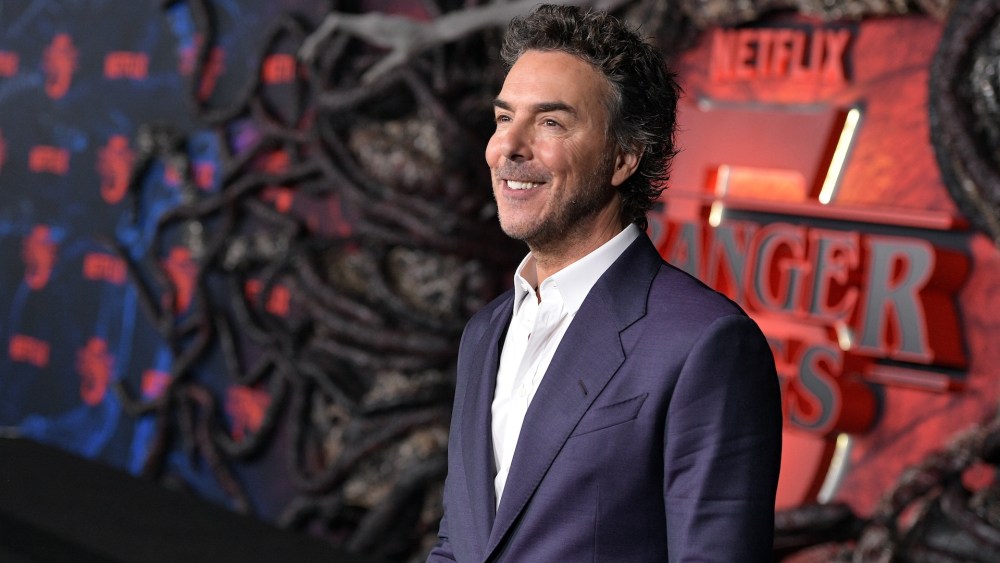
Shawn Levy‘s go-to shorthand for Matt and Ross Duffer, the creators of “Stranger Things” — which Levy brought to Netflix through his company, 21 Laps, in March 2015 — is simply “the brothers.” He calls them that frequently and affectionately, as he speaks with Variety over Zoom in mid-August, pacing around his London hotel room as he’s about to begin filming “Star Wars: Starfighter,” due in 2027. Though he’s extremely busy, as an executive producer and director on “Stranger Things” as well as its creative champion, Levy wanted to make sure he shared his version of the origins of “Stranger Things” for Variety’s Oct. 15 cover story about the show’s final season.
“There’s not that many of us who have been here from day one to day last,” Levy says. “I feel privileged to be among them.”
Back in 2015, as a director, Levy’d had a successful run of family comedies, such as “The Night at the Museum” movies and “Cheaper by the Dozen.” He was not a TV guy, nor was he a genre director. But Dan Cohen, his 21 Laps partner, walked into Levy’s office one day and changed all of that. “‘You need to stop what you’re doing and read this thing,’” Levy remembers Cohen said. “‘It’s one of the best scripts I’ve ever read.’ My memory is that I said, ‘We don’t do TV.’ And he was like, ‘Please, just trust me. Read it.’”
The script Cohen was raving about was called “Montauk,” which would later turn into “Stranger Things.” And the rest is pretty much history. Levy has directed two episodes in every season, including in the fifth and final one, and his involvement in “Stranger Things” changed his career too — he went from family comedies to blockbusters like “Free Guy” and “Deadpool & Wolverine.” Working on the show, he says, “revealed filmmaking muscles I didn’t know I had back then.”
And if Matt and Ross Duffers are “the brothers” to Levy, in their 10-year text chain, he says, he’s known as “Warlock.” He wouldn’t tell us why, but the Duffers did, calling Levy a “master” of his type of wizardry: “navigating studio politics.”

Ross Duffer, Shawn Levy and Matt Duffer seen on June 6, 2017, in Los Angeles.
Courtesy of Eric Charbonneau/Invision for Netflix/AP Images
“When things went wrong, and things inevitably would go wrong every once in a while, we would call in Shawn,” Matt says, “who we called Warlock. Just because he had some form of dark magic that he could wield when necessary. You don’t want to set the warlock loose too often, but when he needs to come in, he will come in and solve any situation no matter how dire.”
Even as the Duffers’ confidence grew, and they became experts in the things they’d once been ignorant of, they would occasionally need the Warlock. “Season by season, it gets more complicated — there are more fires,” Ross says. “We now know so much more than we did back then. But there’s still instances where the Warlock comes in and helps save the day.”
Here, Levy explains what made him want to champion the Duffer brothers, how “Stranger Things” changed his own career and why sticking the landing in the show’s series finale has always been their “North Star principle.”
What was your first meeting with Matt and Ross like? What were your first impressions of them?
This will definitely be the pull quote, especially if you’ve met them: My first impression was hair twirling and gum fidgeting. Like, literally, the Duffers have signature fidgety habits, and they often involve hair and gum — sometimes bottle caps? But I just remember, on the one hand, they were quite internal, young guys. They don’t give themselves away. Yet there is a kinetic, busy energy to their body language. And I remember seeing it on my couch and being really charmed by it.
I felt like, “Oh, they are not comfortable selling in a room. But they are all heart.” They so often work and converse in this bubble of twinship — this was back then — that I could feel that presenting and connecting outside of that twinship was a less comfortable zone for them. They’ve grown and evolved stunningly over the past near-decade.
Courtesy of Tina Rowden/Netflix
What did you talk about in that meeting? What did they say that gave you faith in their potential to create this show?
For one thing, sometimes you read something and the tone is so confident, so clear — and that script “Montauk” had it. It was not trying to be anything but itself. It was breaking so many rules with confidence. It was a period piece. It was a show about kids that wasn’t for kids. It was coming of age sweetness with horror genre darkness. So it broke all these supposed rules, but it transgressed with such assurance.
I’ll tell you the other thing I remember: The depth of movie nerdom, the extent to which these boys are crazy fans of movies, was self-evident from that very first meeting. Suddenly it didn’t matter that I wasn’t in the television business, because I was a movie director talking to these young, aspiring storytellers about movies. They told me the story of “Hidden,” the one movie they had made, and I watched that movie, and that sealed the deal. Because the confidence of that direction, even when they were so young and brand new — the same confidence that I saw on the page, I saw on the screen in the one movie they directed.
Which is why we trotted into Netflix not only determined to sell the show, but I backed their dream of directing all of it themselves. Between that script and “Hidden,” I just knew they were capable of it. They’ve since told me that my betting on them fed into why they bet on me and my company. There was just a connection there in spite of our personality differences — the overlap was enough for us to bet on each other.
It sounds like they initially were very uncomfortable doing anything separately, but since that time, that’s changed.
Matt and Ross, they were the AV Club. The reason that the show is special is that beyond all the mythology and all the genre scale, it’s an anthem to outcasts. Because the Duffer brothers were never the Steve Harringtons: They were always the Mike, the Will, the Dustin. And what they did have, in lieu of a broad, effortless social circle, was each other. So there’s just this deep, often non-verbal connection between Matt and Ross.
They still love writing, editing, color timing, directing — doing every step together. My recollection and my observation is in 2015, the Duffers were predominantly comfortable talking to each other, and they have grown just massively more comfortable leading broader groups on broader stages and connecting outwardly with a much more broad swath of people and collaborators.
When we interviewed them in Season 4, they talked about how Netflix was the only buyer for “Stranger Things” that would agree to allow them to direct. Obviously, Netflix is now the monster that ate the world. But can you talk about what the streaming landscape was like in 2015?
Because the brothers always envisioned this as an eight-hour movie, the streaming binge model always made the most sense. It was not necessarily the coolest place to be; it was not the obvious place to be. Netflix was one exhibition outlet among many, and it was not the de facto first choice among any.
But this streaming model, where people could experience a story contiguously and as the eight-hour movie that the Duffers envisioned, that always made tremendous sense. Back then, Netflix was a much smaller company. My memory is that the circle of decision-makers was much smaller. And to be clear, the freaking bet the Netflix put on us and this show was staggering — and the kind of huge swing that we don’t see that often at any network or streamer anymore.
This was an original show with kids, but not for kids; with two 30-year-old, unproven filmmakers; a movie director who had never done TV and whose movie career at that point was predominantly family comedy — on paper, this made not a lot of sense. But it was just that good. It was just that good.
I’ll add this in case it’s useful: It wasn’t just that the script was that good. It’s that the lookbook — which is now famous on the internet, and studied in film schools, by the way —that you can still find for “Montauk,” that the Duffers made before we ever made the show, it was proof that they had it all inside them already. If you go and look at that lookbook, as I encourage readers of this article to do, you’re going to see that they knew what they wanted this to be. It was that clear. And Netflix bet on us big. Did I answer your question?
Matt Duffer, Ted Sarandos, Ross Duffer, Shawn Levy, and Bela Bajaria at Netflix’s “Stranger Things” Season 5 World Premiere at TCL Chinese 6 Theatres on November 6, 2025 in Hollywood
Courtesy of Getty Images for Netflix
You did!
Why I wanted to talk to you, and why I knew it would take some time, is there’s not that many people who have walked the long road. The Netflix folks who greenlit the show, many of them have moved on to other jobs. We’ve had crew members come and go. It’s a long road, nine and a half years! But to be one of maybe a dozen, maybe less, who have walked every step alongside the brothers, and to do it as a fellow EP and fellow director, it’s really been one of the most gratifying parts of my career. And that’s the truth.
What was your experience of what happened when Season 1 came out?
I’m sure the brothers will tell you the same thing, and I’m literally a block from where it happened. I was here in London. It was the Saturday in July 10 hours after we premiered, and my recollection is it was social media that told me first. I remember where I was standing in front of the Connaught Hotel in Mayfair, London, talking to the brothers, and us being like, “Are you seeing this?! I think something’s happening.”
A short time thereafter, we started getting a sense of the numbers, and we realized, oh, wow, this thing is everywhere, and it’s loud.
We visited them in their editing room in July, and they were editing Episode 6, which you directed, and their mind-meld with Dean Zimmerman, the editor, was so complete that we couldn’t comprehend it.
One of the many, many famous expressions from “Stranger Things” lexicon is the hive mind? The hive mind is the Duffers. It sounds like you got to witness a bit of that.
With Winona Ryder
Courtesy of Tina Rowden/Netflix
How has the show’s popularity affected the process of actually making the show?
I spoke about the very risky bet that Netflix made back in 2015 — that bet is less risky, but it is also a bigger bet every season. So the resources that we’ve been given by Netflix have been remarkable, and it’s really empowered the Duffers’ storytelling on an increasingly grand scale. One of their biggest fears is complacency, and the secondary huge fear is repeating themselves. This internal imperative that the Duffers have to level up with every season has been, fortunately, very supported by Netflix.
How has your day-to-day involvement with the show evolved since Season 1?
When we made Season 1, the Duffers did not enjoy, and were not particularly comfortable with, any of the outward-facing aspects of running and creating a hit show. They’ve grown. They’re a decade older. They’re a decade more mature. One of them has become a dad of two young girls. As that’s happened, the Duffers’ comfort with all the outward-facing aspects of the job has grown immensely, and as that’s grown, I’ve been able to take the back seat where I belong.
Their happy place remains writing, directing, editing, scoring, color timing — the making is their bliss. That will always be their greatest joy. But as they’ve evolved into true leaders, my role has become more one of support. And what will never change is when they need something handled, I get it handled. Over the years, that’s been small things like, “Shawn, can you get permission for us to use ‘Thriller’ in our Season 2 trailer?” Or “‘Magnum, P.I.’ turned us down for Hopper’s cabin television — is there someone you can call?”
I told the brothers early on, back when we pitched Netflix, “I don’t know what you’re going to need me to be on this show, but whatever that is, that’s what I’m going to do. I just want to help get this thing in the world.” I’ve tried to honor that promise for a decade now.
Do you remember when they knew that it would be five seasons? And what conversations you had about where they wanted the show to go, and how long it would take to get there?
I wish that I did. I will say that even to this day, even as we talk about the future, there’s still a private place in the Duffer heart that only each other can access. And so while I had a glimmer of the end zone — and by the way, I feel like the Duffers would vomit at me using a sports metaphor in reference to them — they had a sense of where this was heading pretty early: I want to say late Season 2.
But can I also add to that that one of the superpowers that I’ve observed is they’re able to react to the unexpected. So, for instance, Steve Harrington was going to be in one episode. Then it was several episodes, and then it was “Wait, what if we paired Steve with Dustin?” They have always been really sensitive to discovery along the way. Even though they had a roadmap in their head, I know that it’s been redrawn based on which characters come alive in certain ways, which actors contribute things they might not have expected.
With Noah Schnapp
Courtesy of Tina Rowden/Netflix
When you did start talking in earnest about the logistics of the final episodes, what were the most important things you wanted to achieve with the final season?
The brothers have always talked about sticking the landing; they talk about it in relation to movies. They talk about it in relation to television series. The Duffers always pointed out when something stuck the landing — and how nothing matters more than sticking the landing, whether it’s a movie, an episode, a season or a series. That’s like a North Star principle for them: You’ve gotta stick the landing.
So when we started talking about Season 5, it was it was non-negotiable that we stick the landing. They have had their hearts broken by shows that they loved that failed fans in the end. They did not want, and do not want, and refuse to be one of those shows. So this has been obsessively important to them.
What do you think are the big questions of “Stranger Things” that were essential to be answered by the finale?
I would contend that the brothers don’t want to leave any questions unanswered. There might be literally less than one hand’s worth of things that are not clarified and resolved — because the Duffers ultimately want to satisfy the audience. They make the show for themselves, but they also make the show for our audience. That’s one thing I’ve always loved about them, and it’s one area where we’ve always connected.
We have very different personalities, very different tastes — but where we’ve always understood each other is that we’re making things for audiences. We’re telling stories for other people, not for our own sort of narcissistic enjoyment. We’re making these stories for people to connect with. So answering those questions was really important, and I think they did an exceptional job. It’s why it’s a big, sweeping final season.
I would say this, and then I’ll take a breath. Yes, we have once again elevated scale and cinematic spectacle, but they have never — and they do not in this final season — abandon the character storytelling that is our special sauce. So this toggling between the massive and the intimate — the epic and the intimate, that might be a better way of putting it — that’s classic “Stranger Things.” And it’s fundamental to Duffer storytelling.
How involved are you in the “Stranger Things” spinoff?
You mean, the one that nobody knows anything about yet?
That one.
I’m trying to think what’s been announced. Like “First Shadow” on Broadway, like the animated series, like every Halloween Horror Nights and piece of merchandise, the brothers and I are very much in it together. We always have been. We always will be. The same will apply to the spinoff.
While I am excited to extend the storytelling life of “Stranger Things” — I’m not going to call it a “universe,” because that would be obnoxious. The “STU”? Too soon? Shit, I know you’re going to use that! But like with the end of our series, they’ve been very protective of spinoff talk, and I understand that the Matt-Ross bubble is sacred. And so while I’m involved in those conversations about the future, they’re also protective of talking about it too much until they really figure it out, and they don’t like to take their eye off the priority ball. And right now it’s “Stranger Things 5.”
A show like “Stranger Things,” with two unproven creators that bucks so much conventional wisdom — do you think that could happen in today’s landscape?
I think about it all the time. My answer is, while it could happen, it happens so much more rarely. It’s rare enough that a vision and voice this clear comes along, but it’s equally rare in this moment, in this industry, for someone to place that big bet on something brand new. The decision-making tends to be more fearful. This is not specific to Netflix. This is the entertainment industry at large.
With Dacre Montgomery
Courtesy of Tina Rowden/Netflix
What impact do you think the show has had on the industry?
Everyone is looking to strike this same vein of gold. But the whole thing about it is, if there were a bunch of them, more people would do it. They’re very rare. They’re very special.
I do think that it’s a useful reminder that whatever the rules are at a given moment, they’re just waiting for someone to come along and break them. I love when I see a movie like “Sinners” or show like “Hacks” or a show like “The Bear” or “Beef,” or a movie like “Weapons.” I love that every time people get comfortable in the rules, some motherfucker is going to come along and break them.
You touched on this earlier, but when you first got to know them, you were known as a comedy director. How did “Stranger Things” affect your career?
I think about it a lot, because I had this incredible run of hit movies before 2015 that were predominantly comedies, and a lot of them were family comedies. And then I look at everything since, and it’s “Free Guy” and it’s “Adam Project” and “Deadpool & Wolverine,” and now “Star Wars.”
“Stranger Things,” for one thing, revealed filmmaking muscles I didn’t know I had back then. It really deepened my confidence in my own storytelling range, and it also seems to have disrupted a former perception of what I was all about.
With Noah Schnapp on June 6, 2017, in Los Angeles
Courtesy of Eric Charbonneau/Invision for Netflix/AP Images
What has it been like for you to say goodbye to the show?
As sad as you would imagine, as proud as you would imagine. And above all, with this very strong knowledge that the connection we have — the Duffers and me, this cast and us — it’s really unique. We’ll all go on to other jobs and, God-willing, other hits.
We just knew it could be great. That was all the reason I needed. I can’t think, other than “Arrival,” honestly, of something that I’ve gone into with no sense of whether people will show up, but a certainty that it could be great and special. And the bond between the Duffers and I, having walked this road together, it’s really meaningful to me. Literally, there’s a 10-year text chain between the brothers. I’ll let them explain the nicknames if they feel like it. But that connection is very dear to me, and it’s about way more than shared success. It’s shared experience — that’s a really intimate bond.
What’s their nickname for you? You have to tell us.
I’ll let them explain it: Warlock.
Warlock! Is there anything that we didn’t ask you that you’d like to tell us?
Maybe just one thing. The evolution of the Duffers has been — I mean, the shift has been seismic. Because the brothers are emotionally private, they don’t give themselves away. They are much more comfortable in the public forum than they were even four or five years ago. You’re getting the benefit of that, presumably.
But there’s a sweetness to these boys that is not worn on the outside, that is not immediately obvious. But I’ve seen it. I’ve seen it 100 times over a decade. It’s in their writing, and it’s in the connections they have, particularly with our young cast. And frankly, it’s been in their relationship with me. I saw two guys in 2016 — they told me straight up: “We don’t do great talking about feelings. Our feelings are in our writing.”
And now I’ve had countless moments where gratitude, emotion, connection is expressed in real life. The big hearts that sit inside these boys is really beautiful to me. I feel lucky because I’m one of a small group of people who’s gotten to see it.
This interview has been edited and condensed.