
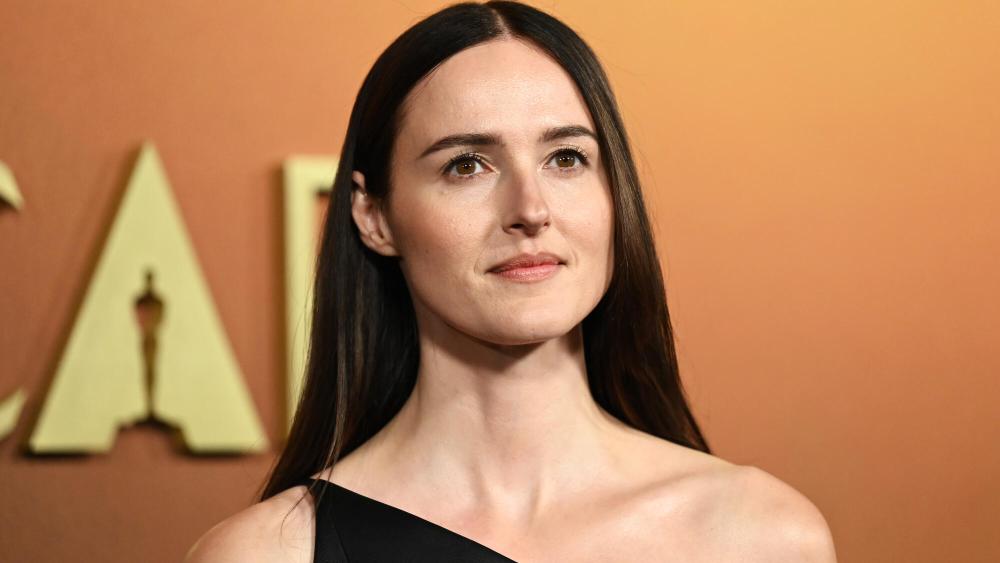
Renate Reinsve almost didn’t make it to Los Angeles for our interview.
Three years ago, while traveling for Oscar campaigning after her breakout role in “The Worst Person in the World,” she accidentally canceled her ESTA visa application on the plane. “I managed to cancel it somehow. I didn’t notice that I did it,” she recalls with characteristic self-deprecation. Five police officers interviewed her in a back room at customs, debating whether to send her home. It’s the kind of absurd, almost-tragic mishap that seems to follow Reinsve — a woman who describes herself as an “involuntary rebel” who has been kindly asked to leave nearly every job she’s ever had, that wasn’t acting. They’ve included the Girl Scouts and grocery store clerk.
But when it comes to acting, there’s nothing accidental about Reinsve’s work. In Joachim Trier’s “Sentimental Value,” she delivers what may be her most devastating performance yet, playing a woman grappling with her complicated feelings about her late filmmaker father. The role was written specifically for her, building on the deep creative partnership she’s developed with Trier since “Oslo, August 31st” and solidifying their status as one of modern cinema’s most compelling actor-director collaborations.
” I was very connected to the role,” Reinsve explains during the Variety Awards Circuit Podcast. “It’s not like specifically the story, or like detailed —it’s not my story, but it is kind of. We share that perspective of how complex things are, and how subtle you can say something very dramatic about everyday life and what small moments contain of drama.”
The film’s emotional centerpiece — a scene in which Reinsve’s character finally breaks down in bed with her sister, played by Inga Ibsdotter Lilleaas — required a delicate balance between preparation and spontaneity. “You can’t really get to somewhere in rehearsal, because then you won’t have the event occur when you’re on set,” she says.
What made it onto screen includes profound moments not in the script, born from instinct and trust. When her co-star climbed into bed and whispered “I love you” authentically from the character, Reinsve’s character could only respond as honestly, with difficulty saying it back.
Growing up in Norway, surrounded by forests, Reinsve started Girl Scouts and was promptly asked to leave after two weeks. “I was just trying to do everything a little bit differently, or I just didn’t get why we had to do it that specific way. Why can’t a birdhouse have five windows?”
The Scout leaders suggested she try theater instead, inadvertently launching a career. That connection to nature remains central to who she is. During the overwhelming whirlwind of her first Oscar campaign, she found solace by taking her tent into the forest. “If I just take my tent, go into the forest, I’ll just wind down,” she says. “When you’re on the [Oscar predictions] lists, there are these forces pulling you towards — should I really work for it? What do I do now? Do I have to change now? You just have to go back to the forest and be like, wait, this is enough.”
That authenticity — that refusal to perform as anything other than herself — is precisely what makes Reinsve so compelling on screen and off. She admits she’s “not very good at networking,” preferring to build relationships slowly with collaborators she trusts.
As awards season conversation builds around “Sentimental Value,” Reinsve remains grounded in gratitude rather than expectation. “Just being on those lists and someone thinking that your performance is something so important to them — it is enough for me, because it’s so insane,” she says. “Whatever happens from now, I am very, very happy.”
It’s a refreshing perspective in an industry often consumed by ambition and calculation. On this episode of the Variety Awards Circuit Podcast, Reinsve discusses the movies that influenced her, her ambitions as an actor and possible director, and her connection to Mother Earth.
Listen below!

Renate Reinsve, Jonas Jacobsen, “Sentimental Value.” (Neon / Courtesy Everett Collection)
Courtesy Everett Collection
Read excerpts from her interview below, which has been edited and condensed for clarity.
How did you end up with the acting bug?
I just remembered from another interview today that I grew up — it was a house, a road with some houses. Very few people lived there, and it was surrounded by the forest. So we were in the forest. Since I went to school in the forest, I naturally joined the Girl Scouts. And then I was asked to leave two weeks after. I was just trying to do everything a little bit differently, or I just didn’t get why we had to do it that specific way. Why can’t a birdhouse have five windows?
They came to me one day and said, “You should do something else.” They kindly asked me to leave, but they suggested that I start in the theater. And then I got a really good teacher when I was young because he lived in a town next to where I lived, and he just put so much joy into that for me. That joy has just been driving me, and I’ve tried to have other jobs, but I have been asked to leave all of them. All of them. It’s very sad.
What was the last job you got fired from?
Well, I think I moved to Oslo to try to get into theater school, and then I worked in a grocery store, and they asked me to leave there, too. I was organizing the stuff on the shelves, and also working as a cashier. They were like, “Don’t do it like that. They have to be in that order.” And then I don’t have a lot of talent for structure.
So you’re a rebel?
Involuntary rebel. I’ve always tried to be a good girl, but then that stuff just keeps happening.
What were some of the early movies that deeply touched you?
I think the first one that really got to me was David Lynch’s “Mulholland Drive.” It was just so mysterious, and it hit me in places I didn’t know that I had. I think I watched it also too early, but I read about it onlin,e and I saw some people had gone crazy trying to understand it, and then I was even more intrigued — like the power that is in a movie. And then I went down that path of seeing dark, strange movies, and I was so into that kind of perspective for a long time.
In “Sentimental Value,” you deliver such a deeply emotional performance. The film explores feelings about a complicated father. Did you find any personal connection to the character?
Actually, after “The Worst Person in the World,” Joachim and I started talking about different themes and other character traits we wanted to explore. He’d gotten to know me a lot better, both as an actor and as a person. So he wrote that role for me, and I was very connected to it. “The Worst Person” was also written for me because we got to know each other a little through “Oslo, August 31st,” but very little. We saw each other here and there, and then he wrote that based on what he saw and the little he knew about me. But then this was an even deeper dive into something we had already discussed.
The sister relationship in “Sentimental Value” is so great because they’re not having an ongoing fight or a big conflict. They see their own lacks through each other. I really love the subtlety of Joachim’s movies and the way we really explore those details together with the actors when we get on set, but also from the stage, where you read the script all the way through.
That final scene in bed with your sister is devastating. How much did you rehearse that, and how many takes did it take to nail it?
That was the question—rehearsing it. Because you can’t really get to somewhere in rehearsal, because then you won’t have the event occur when you’re on set. So we did talk about it, and we actually did it in the audition with Inga, who plays Agnes, but we never got to a place where we kind of landed it.
When we were on set, everyone was nervous because we knew it was a pivotal scene in the movie and that we needed it to convey a lot of complexity and nuance. It is very sentimental and emotional, and you really need to feel the balance of how far you can go and how much you hold back in those situations. You need to leave space for the audience, too, so they can feel what they’re feeling and have their story in there with the movie.
Everything that happened that day is in the script, but it also includes some very profound moments that aren’t. Joachim is a director — he sits by the camera. He’s never behind the monitor, especially not in those big emotional scenes. Inga had this instinct, but she was so scared of ruining the scene that she wanted to climb into bed, but she didn’t. Joachim could feel that she had that instinct, and he said, “Do it,” whispering. Then she climbed up, and she said — and Joachim could never write this — “I love you.” She says it from her authenticity in the scene and from the character. Then, in the moment, my character answers like she can, which is very hard to say back. That became the moment. We probably did it more times, but I think we all knew that was the moment it came together.
You and Joachim Trier have developed this incredible partnership. Do you feel that same kinship when he calls you and says, “I have a role for you?”
Well, I didn’t know how, because it’s hard to explain that collaboration, because it’s very intimate in a way when you find someone that you can express something through both of you together. You have the same taste. You understand something about the other person and what they want to express, and you know how to do it because you’re kind of the same.
Do you have a directing bug? Do you feel like you’ll be directing one day?
I have a lot of curiosity about it. But also editing and the camera. I like all of it. I do. I did direct some things in the theater when I was a teenager, and then I kept getting really good roles. So I haven’t gotten to it. And now I haven’t had any time since I did it back then, and it was a very teenager-like way of doing it.
You might get an Academy Award nomination. What could something like that mean to you?
It’s so far away from the forest in Norway. It’s so shocking to me to be on those lists, and then I’m trying to stay calm and keep my cool because it’s so insane. I’m so grateful now — being on those lists and someone thinking that your performance is something being so important to them — it is enough for me because it’s so insane. So whatever happens from now on, I am very happy.
Are you getting mainstream offers these days? Has Marvel called?
I, of course, respect it a lot, and I really enjoy it for what it is. But I just don’t think I could do it really well. I admire it. I would be fired. I think I’m so interested in these kinds of stories and personal movies — personal stories in movies and directors that have a vision that everyone follows. You can either work with it or against it — not against it, but there’s a dynamic where you can have your autonomy in that structure.
I really love that way of working, and to go into a character in the way that I’ve been able to the last few years has been. I want to keep doing that. I just worked with Sebastian [Stan] again in Christian Mungiu’s next movie. Working with the same people, to have that trust and to go even deeper into collaborating and really building relationships — I’m not very good at networking and stuff, so building relationships slowly.
What’s next for you?
The next thing I’m doing is Alexander Payne. He’s a really good person. So maybe he has the answers to what we can do to fix everything.
Variety’s “Awards Circuit” podcast, hosted by Clayton Davis, Jazz Tangcay, Emily Longeretta, Jenelle Riley and Michael Schneider, who also produces, is your one-stop source for lively conversations about the best in film and television. Each episode, “Awards Circuit” features interviews with top film and TV talent and creatives, discussions and debates about awards races and industry headlines, and much more. Subscribe via Apple Podcasts, Stitcher, Spotify or anywhere you download podcasts.