

UK at risk of ‘sudden confidence crisis’ if markets lose faith in budget
UK government borrowing costs have inched down today, as the bond markets continue to welcome the budget.
The yield (or interest rate) on 10-year gilts has dipped by 1.5 basis points to 4.44%, while 30-year gilt yields are down 3.5bps.
Those are small moves, but they add to a recovery on Wednesday when traders cheered the news that the government had doubled its fiscal headroom (to have a balanced current budget in 2029-30) to nearly £22bn.
However, fears are growing that this plan may not be credible, as it relies on tax rises and spending cuts in the run-up to the next election, and afterwards.
City consultancy Oxford Economics fear that markets will gradually lose faith in the budget. They’re warning that the risk of a sudden confidence crisis remains live, for several reasons.
In a new research note, they say:
The long-awaited UK Budget featured a small near-term loosening of fiscal policy and a larger longer-term tightening. The initial market reaction was positive, but we think markets will gradually lose faith, and the risk of a sudden confidence crisis remains live.
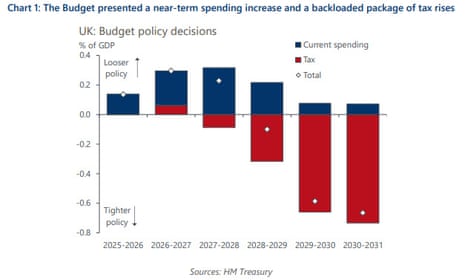 A chart showing the UK budget consolidation plans Photograph: Oxford Economics
The first reason is that the tightening is “backloaded”.
Oxford Economic’s chief UK economist Andrew Goodwin explains:
This isn’t just a problem in terms of risking consolidation fatigue. The new plans imply a £17bn (0.5% of GDP) tightening in fiscal year 2029-2030, a year when the next general election is due to take place (Chart 2). By then the target year for the fiscal rules will be moving out again, and we think it very unlikely this tightening will be fully implemented.
Second, Goodwin says the Chancellor made no attempt to restrain spending, apart from the inclusion of some unspecified “efficiency savings” in the last two years of the forecast.
History suggests that revenue-based consolidations have a higher risk of failure. The Chancellor’s decision also risks adding to the perception that the government lacks the internal discipline to cut spending.
Third, apart from the extension of the threshold freeze, the tax measures encompassed a wide variety of large increases to smaller revenue streams.
“Such changes often trigger behavioural change, so revenue projections are more speculative. And as the experience of the October 2024 Budget demonstrates, they tend to result in specific groups being hit particularly hard, which can sometimes make the measures politically unsustainable. “
Finally, Goodwin adds there were no major measures to boost growth.
The OBR revised down its growth forecasts, which were previously more optimistic than any independent forecaster, but they still look too high in our view. Its new projection is in line with the strongest forecast of the consensus. But with this week’s new population data reporting much lower net inward migration than is assumed in the OBR’s forecast, there’s already questions over whether its projections will prove achievable.
Updated at 07.10 EST
Key events
Show key events only
Please turn on JavaScript to use this feature
Time to wrap up…
Fears are growing in the City that the tax-raising plans at the heart of this week’s budget may not be credible.
City consultancy Oxford Economics has warned that the markets could gradually lose faith in the budget. They’re warning that the risk of a sudden confidence crisis remains live.
Oxford Economics are concerned that the fiscal tightening is backloaded (so may not happen), that there is no attempt to restrain spending, or boost growth, and that the effectiveness of various tax measures is unclear.
The Office for Budget Responsibility (OBR) has cast doubt on claims Rachel Reeves dropped plans to raise income tax in this week’s budget because of rosier forecasts, pointing out she knew about these well before the change of heart.
In a move likely to exacerbate tensions with the Treasury, the OBR chair, Richard Hughes, has taken what he acknowledged was the “unusual step” of writing to the Treasury select committee to explain how its forecast evolved, “given the circumstances in this case”.
Black Friday appears to be going better for online retailers than the high street, in the UK.
Asda has criticised the government for “killing confidence” among consumers but blamed “self-inflicted” problems that left gaps on shelves for a big reverse in sales.
Updated at 12.09 EST
Deutsche Bank economists have also voiced some scepticism about this week’s budget plans.
In a new note today, they point out that the raft of smaller tax-raising measures creates uncertainty.
Here’s why:
Out of the many tax raising measures, the OBR has identified 13 policy measures that come with either “high uncertainty” or “very high uncertainty”. Indeed, the behavioral impact of CGT relief on employee ownership trusts, mileage-based charge on electrical vehicles, and many others all come with wide confidence bands.
How much tax revenue is uncertain? Of the total (gross) consolidation (~ £30bn), the OBR estimates that roughly £4.2bn of estimates tax revenues come with higher amounts of uncertainty. Tax slippage on these estimates therefore pose a material risk to the Chancellor’s headroom calculations.
Deutsche Bank also say:
Bottom line, while the Budget was indeed a historic tax-rasing event, the growth impulse from policy decisions alongside some front-loading of government points to some positive momentum over the next couple of years – despite the projected increase in fiscal tightening over the next couple of years. On our growth projections, the drag in GDP only emerges from 2029 onwards.
Share Sarah Butler
Back in the UK, Black Friday appears to be good news for online retailers but less so for high streets and shopping malls according to data just out.
The number of shoppers out and about in the UK was 1.5% lower overall than Black Friday last year with high streets (-3%) and shopping centres (-3.5%) leading this decline whereas retail parks noticed a 3.7% increase in visits according to MRI Software.
It said numbers were up in central London but down in market towns.
However, the number of transactions made by Nationwide customers paint a more positive figure on sales performance.
The building society said that, as of 1pm today, Nationwide customers have made over 4.88m transactions on Black Friday, which represents a 10.36% increase compared to Black Friday 2024.
Mark Nalder, service, operations & performance director at Nationwide, said:
“Despite some scepticism around the value for money consumers are getting with Black Friday deals, undoubtedly shoppers are continuing to spend as we predicted on the peak day of the Black Friday period.
“Undoubtedly, Black Friday remains a key shopping date for most consumers, whether they intend to treat themselves to higher ticket items or household brands, indulge in their hobbies and interests, or stock up on Christmas presents.”
ShareWall Street opens higher after Thanksgiving
Wall Street has opened a little higher, as traders return to their desks after the Thanksgiving holiday.
The Dow Jones Industrial Average is up 80 points, or 0.17%, at 47,507 points, with the broader S&P 500 index up 0.3%.
It’s been a jolly week for New York traders. As well as yesterday’s holiday, they enjoyed a visit from Macy’s Santa Claus on Tuesday:
Macy’s Santa Claus is greeted by traders on the floor at the NYSE on November 26, 2025 Photograph: Brendan McDermid/ReutersShare
Updated at 09.41 EST
This morning’s revelation that chancellor Rachel Reeves was told well before the budget that the downgrade to UK productivity growth didn’t mean she’d break her fiscal rules has caused a row in Westminster.
Downing Street has brushed off claims that Rachel Reeves misled voters ahead of the budget about the state of the public finances, telling reporters that “The chancellor set out the challenges facing the country”.
But Conservative leader Kemi Badenoch says Reeves should be sacked, accusing her of having “lied to the public”.
Andrew Sparrow’s Politics Live blog has all the details:
ShareMRI: High street footfall up week on week, but lower than last Black Friday
The prospect of Black Friday bargains appears to have lured more shoppers onto the high street.
Black Friday data from retail tech experts MRI Software shows a 13% increase in footfall by 1 pm today compared with last week, with shopping centres and high streets leading the uptick.
But footfall is slightly below last year, highlighting shifting consumer patterns as the festive season begins.
MRI’s latest Consumer Pulse research also suggests high streets are set to be the big festive winners, with nearly a quarter of shoppers planning visits as Christmas events and food-and-drink outings ramp up.
Updated at 09.23 EST
 Mark Sweney
Shares in the Premier Inn owner, Whitbread, have slumped by almost 10% today after analysts at Bernstein calculated it would be hit hard by the changes to business rates in the budget.
Bernstein announced a double downgrade in their rating for Whitbread, to underperform; analyst Richard Clarke said the impact of business rate changes in the budget was a “hammer blow” to Whitbread.
Bernstein examined a sample of 67 Premier Inn hotels and found the median increase in the rateable value of its properties to be about 174%, with most of its estate above the £500,000 level meaning no relief.
As an example, Bernstein cited the Manchester Piccadilly Premier Inn, where there will be a 385% increase in its rateable value.
Bernstein estimates the overall impact on pre-tax profits to be up to £30m in the first year, £90m in the second year and £140m in year three.
Analysts at Citi also downgraded Whitbread, estimating that about 110 of its hotels would be affected by the upward revaluation of the rateable value per hotel. Its estimate put the cost to the company at about £43m a year.
“We expect Whitbread to look to offset some of this increase through cost-cutting measures,” the Citi analyst Leo Carrington said, adding:
“Equally, given that all big-box hotels will be facing similar property-level cost increases, we might expect that industry pricing can increase to offset the higher rates. That said, we expect investors to view this as an unmitigable cost.”
ShareCanada returns to growth in Q3
Just in: Canada has avoided falling into recession.
Canadian GDP grew by 0.6% in the July-September quarter, new official data shows, following a 0.5% contraction in Q2.
Statistics Canada reports:
The rise in the third quarter was driven by a strengthening trade balance, as imports dropped and exports edged up. Increased capital investment was driven by government capital spending, as business investment was flat. Overall growth was dampened by declines in household and government final consumption expenditures as well as a slower accumulation of business inventory.
Kate Nicholls, the head of UK Hospitality, says it is “frankly surreal” that the government didn’t provide more support for businesses in the budget, given they actually knew the public finances were in better shape than widely thoughts.
There are always tough choices in politics – but this is frankly surreal when you realise that the decisions on spending that included NOT giving maximum business rates support to hard pressed hospitality businesses struggling the most with last years budget and revaluations https://t.co/4s9jNAcGaF
— Kate Nicholls OBE (@UKHospKate) November 28, 2025
Posting on X, she warns that the pre-budget fears of a huge black hole in the finances hurt the economy.
That sense of crisis crashed consumer confidence and spending, damaged investment and has undoubtedly cost jobs
Budget uncertainty has been blamed for a fall in house price in the South of England in the last few weeks.
Property portal Zoopla has repored there was a 12% decline in buyer demand and fewer sales agreed in the four weeks up to 23rd November, compared with last year.
Rumours of more taxes on homes over £500,000 in the run up to the Budget contributed to a drop in house prices in London and the South, for the first time in 18 months, they say.
A chart showing Zoopla’s latest house price data Photograph: Zoopla
The fact the UK’s new ‘mansion tax’ starts with houses worth £2m could spur a pick-up in the market.
Richard Donnell, executive director at Zoopla, said:
“The Budget bark was worse than the Budget bite for the housing market. Home buyers and sellers will welcome the end of the uncertainty that has stalled housing market activity since the late summer. Our data shows the underlying demand to move home remains strong. With greater certainty we expect a rebound in housing market activity that builds into the new year with households who paused home moving decisions over recent months return with greater confidence.
“The removal of the threat of a new annual property tax from 210,000 homes is particularly positive for the market and will help revive activity in higher-value areas across southern England where house prices are under pressure.”
The pound is on track for its best weekly performance in over three months against the US dollar.
Reuters says it’s a sign of relief among investors following the budget.
So far this week, the pound has risen from $1.3094 to $1.3211, a gain of 0.89% – the best weekly rise since the week to 4 August.
Most of this week’s gains came on Tuesday and Wednesday. They also reflect a weakening dollar, as traders have grown more confident that the Federal Reserve will lower US interest rates next month.
ShareUK at risk of ‘sudden confidence crisis’ if markets lose faith in budget
UK government borrowing costs have inched down today, as the bond markets continue to welcome the budget.
The yield (or interest rate) on 10-year gilts has dipped by 1.5 basis points to 4.44%, while 30-year gilt yields are down 3.5bps.
Those are small moves, but they add to a recovery on Wednesday when traders cheered the news that the government had doubled its fiscal headroom (to have a balanced current budget in 2029-30) to nearly £22bn.
However, fears are growing that this plan may not be credible, as it relies on tax rises and spending cuts in the run-up to the next election, and afterwards.
City consultancy Oxford Economics fear that markets will gradually lose faith in the budget. They’re warning that the risk of a sudden confidence crisis remains live, for several reasons.
In a new research note, they say:
The long-awaited UK Budget featured a small near-term loosening of fiscal policy and a larger longer-term tightening. The initial market reaction was positive, but we think markets will gradually lose faith, and the risk of a sudden confidence crisis remains live.
A chart showing the UK budget consolidation plans Photograph: Oxford Economics
The first reason is that the tightening is “backloaded”.
Oxford Economic’s chief UK economist Andrew Goodwin explains:
This isn’t just a problem in terms of risking consolidation fatigue. The new plans imply a £17bn (0.5% of GDP) tightening in fiscal year 2029-2030, a year when the next general election is due to take place (Chart 2). By then the target year for the fiscal rules will be moving out again, and we think it very unlikely this tightening will be fully implemented.
Second, Goodwin says the Chancellor made no attempt to restrain spending, apart from the inclusion of some unspecified “efficiency savings” in the last two years of the forecast.
History suggests that revenue-based consolidations have a higher risk of failure. The Chancellor’s decision also risks adding to the perception that the government lacks the internal discipline to cut spending.
Third, apart from the extension of the threshold freeze, the tax measures encompassed a wide variety of large increases to smaller revenue streams.
“Such changes often trigger behavioural change, so revenue projections are more speculative. And as the experience of the October 2024 Budget demonstrates, they tend to result in specific groups being hit particularly hard, which can sometimes make the measures politically unsustainable. “
Finally, Goodwin adds there were no major measures to boost growth.
The OBR revised down its growth forecasts, which were previously more optimistic than any independent forecaster, but they still look too high in our view. Its new projection is in line with the strongest forecast of the consensus. But with this week’s new population data reporting much lower net inward migration than is assumed in the OBR’s forecast, there’s already questions over whether its projections will prove achievable.
Updated at 07.10 EST
The UK Treasury were told in mid-September that the deficit to meet the fiscal rules was smaller than feared.
Richard Hughes’s letter to the Treasury Committee (see previous post) shows that the OBR told the Treasury on 17 September that it had raised its forecast for wage growth and inflation, which lead to higher tax receipts.
He writes;
Our Round 1 forecast was also a full forecast and therefore also included increases in real wages and inflation which offset the impact of the productivity downgrade on receipts. But other changes in the outlook for spending meant that pre-measures borrowing and the current deficit were higher than in our March forecast.
As Steven Swinford of The Times puts it:
It makes the Budget build up – and the narrative that big tax rises were coming because of a deterioration in the public finances – look frankly surreal in hindsight.
BREAKING
The OBR says it informed Rachel Reeves as far back as ***September 17*** that the downgrade in productivity forecasts was offset by ‘increases in real wages and inflation’. The deficit was in fact just £2.5billion
By October 31 that deficit had turned into net positive… pic.twitter.com/LmTvwVXISI
— Steven Swinford (@Steven_Swinford) November 28, 2025Share
Updated at 07.06 EST
Treasury Committee publishes OBR letter confirming headroom forecast timings
Just in: Parliament’s Treasury Committee has now published the letter from Office for Budget Responsibility chair Richard Hughes, confirming that the fiscal watchdog told the government at the end of October that their budget headroom had not been totally eroded.
The letter, from Hughes, outlines the process of forecast rounds which took place between OBR and the Treasury in the run-up to the budget, as it updated its forecasts and analysed various fiscal proposals.
Significantly, the letter confirms that the government was initially missing its fiscal rule (to have a balanced current budget in 2029-3o), but was back on track in the Round 3 fiscal forecast, the final pre-measures forecast, which was submitted to the Chancellor on Friday 31 October.
Hughes explains:
The only changes to the post-measures forecast reflected the impact of the policies submitted by the Treasury in the two subsequent forecast rounds:
Round 4, which reflected the impact of the Government’s initial policy package, and Round 5, which reflected the impact of the final policy package.
After the 5th round, the headroom was up to almost £22bn.
A chart showing the OBR’s fiscal forecast rounds Illustration: OBR
The 31 October data is significant, as this is several days before Rachel Reeves gave an early morning press conference which appeared to hint at a rise in income tax…
… and two weeks before news broke that this plan was being dropped! (a u-turn which sources attributed to improved forecasts).
Hughes also tells the Treasury committee that the OBR took its data for assessing interest rates in the financial markets was the 10 working days to 21 October, and it did not revise them afterwards.
That indicates that the drop in bond yields in early November, when the markets anticipated a rise in income tax, did not flatter the OBR’s forecasts….