
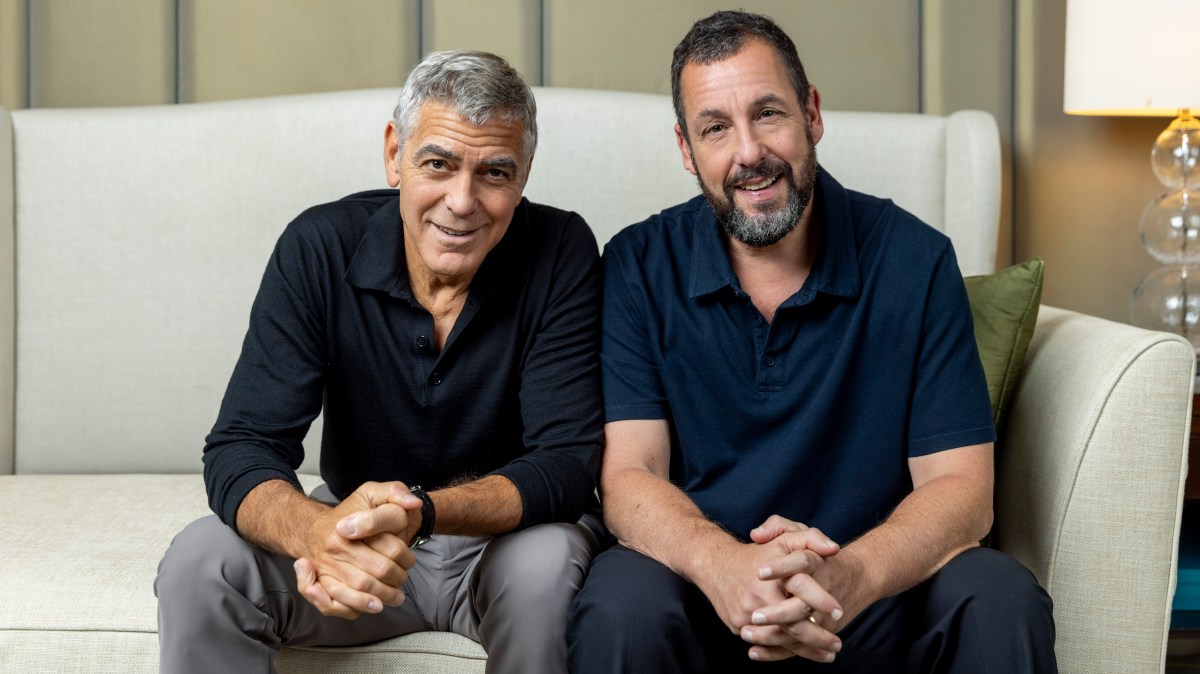
George Clooney and Adam Sandler are Hollywood titans who leapt on to the A-list in the 1990s and never left. But they both started out on television. Clooney was Doug Ross on ER, the doctor everybody wanted to be examined by. Sandler, meanwhile, was the funnyman who broke through on Saturday Night Live before making his mark in very silly, very successful comedies such as Billy Madison.
Put them in a room together and they are a riot, bouncing off each other. We meet for coffee in London to discuss Jay Kelly, a new film they star in together. Clooney plays the titular superstar actor (not a stretch) who is in the midst of a crisis (a stretch). Sandler is his loyal manager, Ron.
It is a movie about the movies and it is hard of think of two actors who know that world better. Still, when they were starting out, both found it hard to leave the small screen. Sandler tried and failed to break through by getting a part in Eddie Murphy’s film Coming to America in 1988. Clooney, meanwhile? Well, over to him . . .
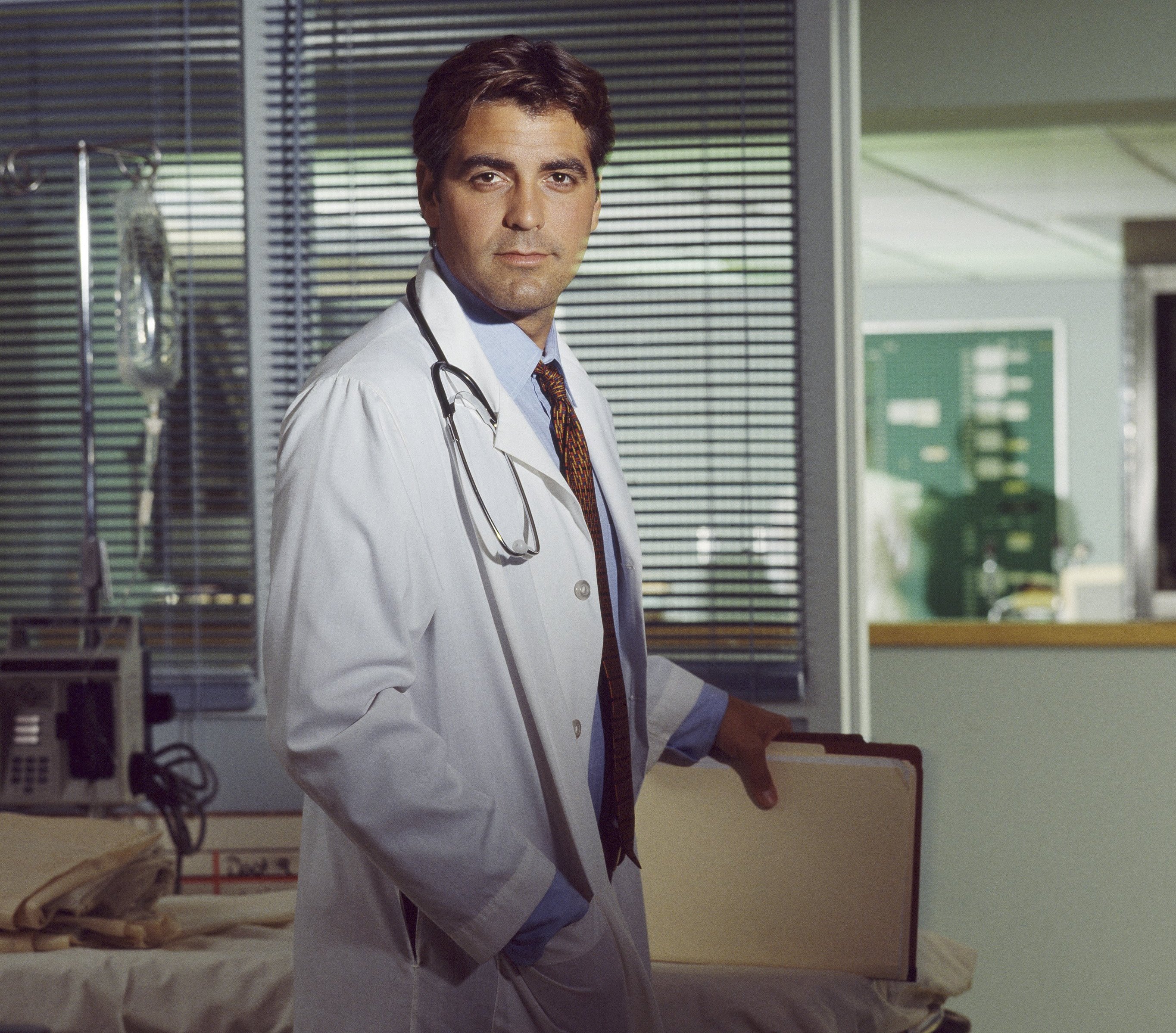
George Clooney as Doug Ross in ER
GETTY IMAGES
“So, I was in TV,” he begins, in that low growl of a voice that commands the room. “I was making a good living, but back then actors would say, ‘Well, I’m a film actor — I just happen to be doing TV.’” Clooney was similarly snooty — he was desperate to be in the movies. “And I got to the final test for a role in Thelma & Louise,” he continues, of Ridley Scott’s 1991 classic. “And, mother****er, Brad got it.” Brad is, of course, Brad Pitt, a close friend of Clooney’s; the pair will reunite in Ocean’s 14 next year.
“I didn’t watch Thelma & Louise for years,” Clooney continues, “because I was annoyed. The part launched his career in film. He was doing sitcoms and crap before, so when it was the thing that could’ve launched me? F***!” I assume Pitt knows about this? “Oh yeah, he gives me shit. But, of course, when I saw it, I was, like, well it had to be that guy.”
Pitt’s big scene involves him being topless and ripped in a hotel room. Sandler laughs. “I saw that at the cinema and when Brad took his shirt off people went nuts.” He shakes his head. “But it should have been you, Clooney.”
Sandler is warm and rather sweet, and it is just nice to meet the man, given he has not done a print interview since, it seems, the 1990s. This, though, is my third time round with Clooney. An absolute tycoon of charm, he greets me by recalling exactly where we last met. He should really be a politician, more on which later. They are on raucous form; two legends wired on caffeine and off the leash.
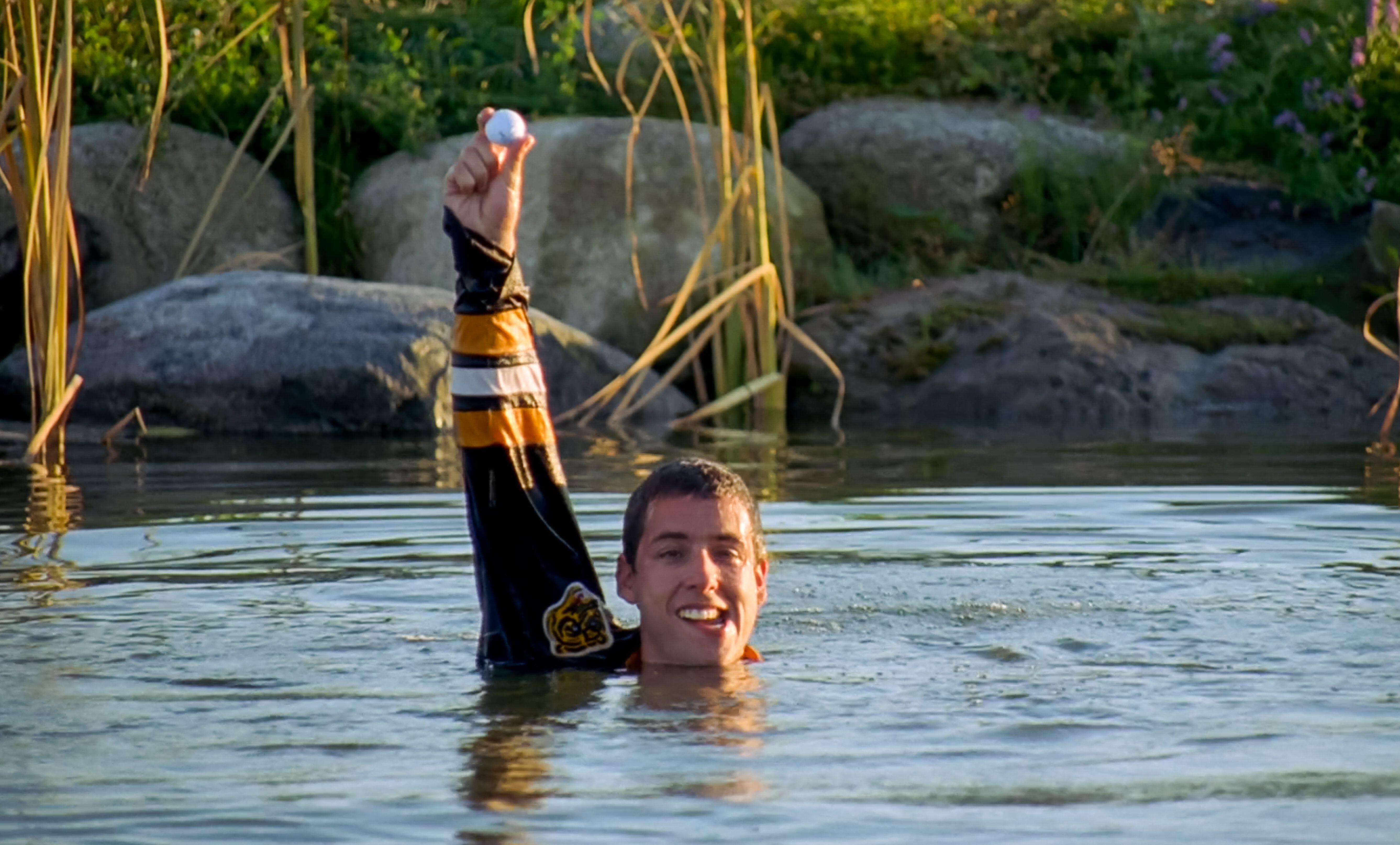
Adam Sandler in Happy Gilmore (1996)
ALAMY
“It was f***ing horrendous!” Sandler moans about London traffic as he apologises for being late. “I also made a little mistake: I saw an ad for a milkshake with the slogan ‘Good for your gut’. And my wife is always telling me I have a leaky gut. So I took a picture, but these tough-looking fellas thought I was taking their picture so they point, and then one said, ‘It’s that bloke!’ So they wanted a little picture time . . . ”
Conversation wanders before Clooney, charmingly childish for an actor involved in the highest levels of international diplomacy, blurts: “Leaky butt syndrome!” And how does one stop that? “Use a cork.”
We move on to the reason we are here: Jay Kelly, a film by the Oscar-nominated director Noah Baumbach, the man behind The Squid and the Whale and Marriage Story. Clooney and Sandler’s characters travel through Europe to a festival in Kelly’s honour. It’s a poignant comedy about ego and fame that ends with a showreel of Kelly’s fictional career that takes footage from Clooney’s real films: highlights include Out of Sight, Up in the Air and Michael Clayton. (A similar reel for Sandler might include the comedies Happy Gilmore and The Wedding Singer, plus the blistering Uncut Gems.)
“I didn’t know they were using my films,” Clooney says. “They used a couple of the popular ones but most were flops or films I did when I was really young.”
“It rocked me,” Sandler adds of the showcase of Clooney through the decades, “watching youth grow more into the . . .” Clooney smiles, interjecting: “Old man — you can say it.” Clooney is 64, married to the British human rights lawyer Amal Clooney, with primary school-aged twins. Sandler is 59, married to Jackie Sandler, an actress, with two teenage daughters. They laugh about the era they grew up in, when there would barely be any photos of them taken as kids, since pictures were finite on film — “We’ve only got four left!” — as opposed to today. “Now?” Clooney says, grinning. “I’ve got billions of pictures of my kids.”
Sandler, a stand-up comedian by trade who has just been on a US tour, begins a riff. “Have you noticed,” he starts, “that back in the day you’d have UFO sightings and someone would get a photo? But now everyone’s got a camera there are no more UFO sightings. Perhaps aliens are, like, ‘Don’t go down there, man — they’ve all got cameras.’”
Clooney was born in Kentucky, Sandler in New York, and both men went to acting school. Clooney remembers “tons of actors” who simply did not make it. “The best actors in class were not the ones who were most successful,” he says. “There’s no correlation between talent and success.”

Clooney and his wife, Amal, in Venice last year
ROCCO SPAZIANI/ARCHIVIO SPAZIANI/MONDADORI PORTFOLIO/GETTY IMAGES
So, on fame versus talent . . . “Are you pointing to me?” Sandler interrupts. I protest, but do ask whether he and Clooney simply wanted to act or whether they wanted to be famous. “As a kid? I 100 per cent wanted to be famous,” Sandler says. “When I was 17 and got into stand-up I wanted what Eddie Murphy had — walking down a street, people going, ‘My God!’ That would let friends at school and your parents know you had made it, and that was my first goal. So yes, I wanted fame, but a couple of years in you also want to be good. And that becomes the goal.”
“It’s also about finances,” Clooney adds. “Remember, we’re doing a job we could just do for free, in little plays or open-mic nights. Then suddenly you get to that age when you are either going to succeed or do a job behind a desk — so you want a steady income. You’re chasing security.”
And work that makes you famous also tends to be the best seen and paid? “Yes,” Clooney says, nodding. “But then there is a moment where you go, ‘Oh, this is a little different.’ There are a lot of things that get taken away from you.” Like what? “Independence. And listen, you will never hear us complain. I hated, back when I was working, cutting tobacco in Kentucky, hearing famous people complain about their shit. But it doesn’t mean there aren’t challenges along the way.”
“Trying to play a light mood when you are feeling darkness is not easy,” Sandler adds. “But you do it.” Clooney laughs — he used to play in a basketball league in Los Angeles with a group of comedians. “There is no group that is angrier than a bunch of comedians on a basketball court,” he says. “It was hate all day. I was, like, ‘Dude, I thought you guys were all funny!’”
Clooney shrugs, back to playing through the pain. He recalls shooting ER, doing 17-hour days. “You cannot be sick. I never missed a day.” He mentions his co-star Julianna Margulies, who played Carol. One day she took a phone call, “someone she really loved” had died. “And she was crying,” Clooney says. “But we had to do this long, funny scene — someone had an arrow stuck in their head. And she put the phone down, wiped away the tears, nailed the scene and then came back and cried. You can never let them see you sweat.”
“Look, no part of me, zero, wakes up and says, ‘Man, I wish that this hadn’t happened,’” Sandler says of his career. “But you have a real life. You have ups and downs just like everybody. People overlook that. You can be in the room but your head is spinning in another direction because of work. But that’s the same with every job.”
• The best films of 2025 so far
“Most people are sacrificing time with their family to make a living,” Clooney adds. His father, Nick Clooney, was a journalist and news anchor and George “would complain if my dad didn’t make it to a ballgame I was in, but he was working. When you get older you cut everyone a little more slack. We’re just trying to put food on the table.” He smiles. “But look, it’s easier for me,” he says. “I had kids very late and so I could spend more time with them. But when you’re young? That’s hard.”
Because earlier in his career he had less control over the work that he did? “You have no control,” Clooney says. “I remember when I got Batman & Robin [the 1997 film] — I called my friends and we screamed because back then I had only done one studio picture, and so to me that was a huge break.”
He pauses. “Of course, we did not understand then that it was going to be a terrible movie,” he adds. “Also, you get further in your career and realise that you’re going to be held responsible for the movies you make. Actors are funny beasts. We begin to save ourselves, because it’s our face on the screen. Nobody brings out a director and goes, ‘Let’s kill that guy!’ So Batman & Robin made me realise I had to pay attention to scripts and to directors. The next three films I did? Out of Sight with Steven Soderbergh, Three Kings with David O Russell, O Brother, Where Art Thou? with the Coen brothers.”
Sandler, meanwhile, took control with Billy Madison in 1995 — the prototype for his many box-office comedies that followed. He enjoyed further success this year with the golfing sequel Happy Gilmore 2 on Netflix, but, I say, a broad comedy like that felt out of place these days.
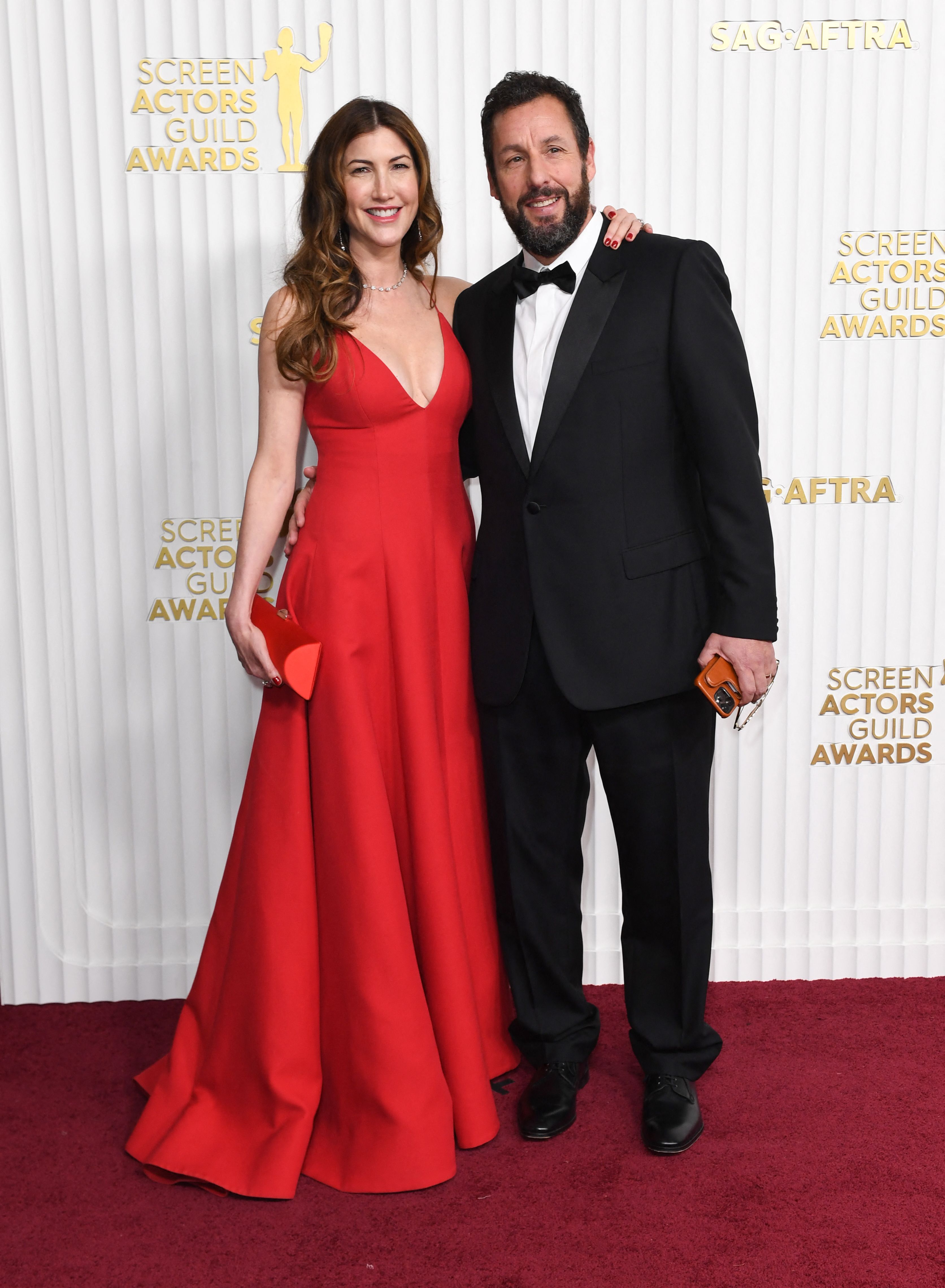
Sandler and his wife, Jackie, in 2023
VALERIE MACON/AFP/GETTY IMAGES
“Is it hard to get a comedy made now?” an intrigued Clooney asks. “The enthusiasm isn’t as high as 15 years ago,” Sandler admits. “It is a numbers game and comedies just weren’t hitting as hard as they used to. Still, there are a lot in production now — they’re cheap to make. But it’s not the same as it used to be.”
We finish on politics. Clooney is a paid-up Democrat — he led the call for Joe Biden to stand down in the 2024 US election, to be replaced by Kamala Harris (which he now calls a “mistake”, and says it was too hard for Harris to take over when she did: “She was given a very tough task.”) We first met during Donald Trump’s initial presidency, when Clooney told me the Democrats were too “passive” but also that they did not “necessarily” need a celebrity like Trump (like Clooney) to run.
• Read more film reviews, guides about what to watch and interviews
Does he still think that? “Honestly, the next election is three years away and if you look at the election cycles, two years from when Bill Clinton won we thought Paul Tsongas was going to be the nominee. We thought it would be Hillary when Barack Obama won, so we’re far away from having to home in on who could run for the Democratic Party — we’ll see, we’ll wait.”
Which feels odd for Brits, who invariably know the leader of the opposition years before an election. “Yes, but sometimes people are only in charge of a party for the length of a lettuce,” Clooney replies, with a sly grin. “Look, it’s an interesting time in my country, but most people, right and left, want the same. They want a job with dignity, health for themselves and their family. And so whoever runs has to be able to articulate the common ground, because division is getting us nowhere.”
And that person will not be Clooney? When Jay Kelly is asked in the movie if he will run for office, somebody adds he did too much “hillbilly shit in Kentucky” to make it in politics. Which felt like a line written for Clooney. “Exactly,” he says, laughing. “Honestly, I’m having a very good life right now. I’m enjoying working with my man Adam . . . ”
Sandler smiles affectionately. “You’re doing all right, kid.”
Jay Kelly is in cinemas and on Netflix from Dec 5
Two-for-one cinema tickets at Everyman
Times+ members can enjoy two-for-one cinema tickets at Everyman each Wednesday. Visit thetimes.com/timesplus to find out more.
Which films have you enjoyed at the cinema recently? Let us know in the comments