
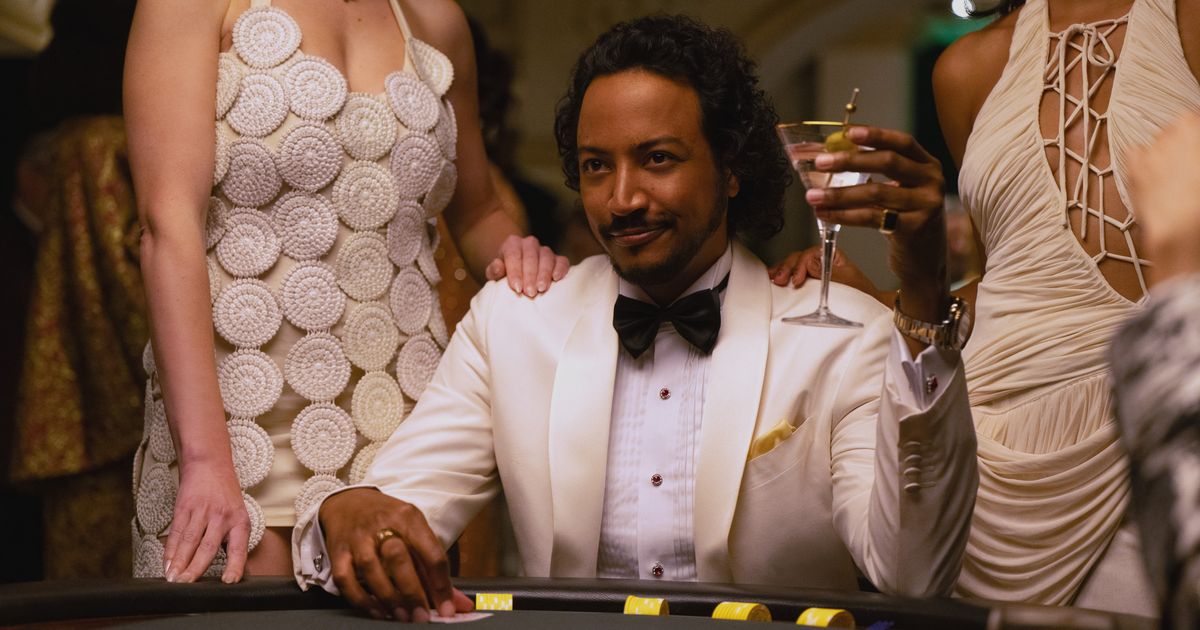
“We talked a ton about getting the right tone,” says Samba Schutte of his early discussions with Vince Gilligan about making Koumba “a child in a candy store instead of a pimp living his biggest life.”
Photo: Apple TV
Spoilers ahead for “HDP,” episode six of Pluribus.
At least someone’s having a good time. Pluribus, Vince Gilligan’s big science-fiction swing of the soul, is as much a philosophical Rorschach test as it is a character study of one miserable writer, and one of the clearest ways it interrogates its ideas is through the handful of humans who weren’t transformed during the Joining and how each copes with the new world. Our protagonist, Carol (Rhea Seehorn), is of course hard at work trying to break global peace and revert everyone to normal. Laxmi (Menik Gooneratne), who’s hostile to Carol, seems to cope by ignoring the stakes altogether because she still has the shell of her son.
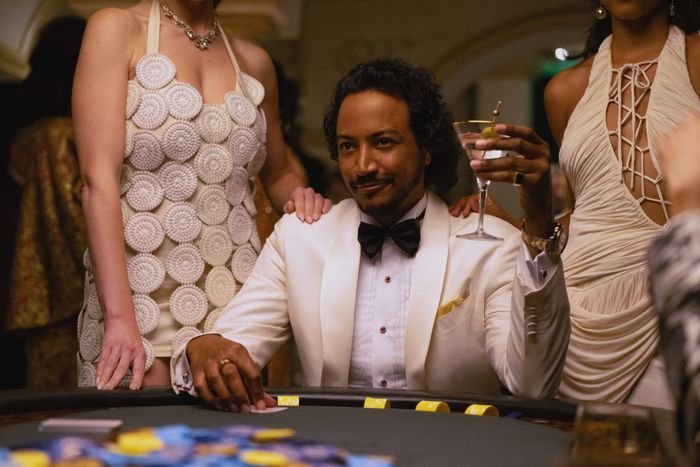
And then there’s Koumba Diabaté, an affable, elaborately dapper Mauritanian who greets the end of the world by living it up. We first meet him in the second episode, “Pirate Lady,” in which he has refashioned Air Force One into the pleasure craft where Carol tries, but fails, to win the remaining humans to her cause. He resurfaces in this week’s episode, “HDP,” now settled in Las Vegas, where he continues to indulge his fantasies complete with a little Casino Royale cosplay and sleeping with a variety of bodies absorbed by the Joining.
Koumba is a tricky character to realize, chiefly because postapocalyptic hedonism can easily slide into unsavoriness. His de facto harem has sparked a lot of conversation (certainly in my circles) about how consent works in Pluribus’s world. But in the hands of Samba Schutte, the warm, vibrant Dutch-Mauritanian actor last seen in Our Flag Means Death, Koumba reads more as a sweet, gentle being who just lucked out. That complication in reading the character is, of course, by design. “We talked a ton about getting the right tone,” Schutte tells Vulture. “What’s really key is that there’s a wonder to him. If we maintain that, the sweetness will come through.”
What was your experience getting cast on this show?
So, when my son was born on January 10 last year, I got the news that Our Flag Means Death had been canceled. That was the show I’d been on, and I was bummed. Then, exactly a month later, I get an audition for an “Untitled Vince Gilligan Project,” and I’m like, Oh my God, it’s Vince Gilligan. I’m a huge fan. But I had no idea what it actually was. Everything was super-secretive. They gave me this dummy scene where I’m a music producer trying to steal a client, and I’m thinking, What is this show? Then I hear nothing for five months and I felt, Oh man, I really thought I’d nailed it. But then I get a callback and then the job. Vince even called to tell me I got it. He said, “It took so long to get back to you because it was hard to find someone who could play this character not sleazy or creepy but actually sweet. We owe that to your nerdy, awkward side.” And I was like, Why thank you!
It was so great that Vince called to welcome me to the show but also that he wanted to make sure this character was from where I’m from, Mauritania. The funny thing is, in the dummy scene, his name was Mr. Koumba, which in my culture is a woman’s name — a man only gets that name if his mother died in childbirth. So I thought, Wow, what a genius character detail. I told Vince this and he was like, “I had no idea, that’s amazing. Let’s keep it.” Koumba was not originally written to be Mauritanian; Vince just found a name he liked. That dummy scene where I was a music producer turned out to be the scene where Mr. Koumba talks to Carol about taking Zosia with him.
Anyway, when Vince called to tell me I got the job, he explained the whole show and said, “Okay, so a week from now, we’re going to Vegas to film your Vegas scene first.” And I was like, “Wait, what?”
Playing Koumba as neither sleazy nor creepy is such a fine line given how he has essentially responded to the apocalypse by indulging his fantasies. Tell me more about those early conversations with Vince about who this character is.
We talked a ton about getting the right tone because it’s hard to justify someone who’s flying on Air Force One and surrounding himself with supermodels, basically having the time of his life. Discussions around consent came up a lot — how does that work with the Others? Vince explained to me that Koumba did not come from a life of opulence; he did not have a good life before this. We also established he didn’t have a family. You’ll notice only he and Carol are the original humans left who don’t have anyone else, which means he has something in common with Carol. He’s someone who’s lived with discrimination and racism. So now the world has changed, and suddenly he’s surrounded by people who want to give him everything he wants, who love him and want to make him feel special. Of course he’s going to embrace that and live out his fantasies. In that sense, he’s a child in a candy store instead of a pimp living his biggest life.
He talks about the Harrison Ford movie Air Force One while on the plane.
Right! He’s geeking out. Saying, “This is exactly how Harrison Ford was on the plane!” or pretending he’s James Bond in Casino Royale or having his portraits everywhere. There’s this childlike wonder of living out fantasies he’s been deprived of his whole life. And unlike Carol, he has embraced this new world. He’s even taken on the role of humanity’s representative, if you will, because he’s a very diplomatic guy. What I love is that beneath the ridiculous outfits and obsession with opulence, he’s actually very rational. If you listen to his counterarguments, he makes solid points that drive Carol nuts. He sees both sides: He doesn’t fully agree with the Others, but he gets why they’d eat humans because otherwise billions starve. He gets Carol, too, even if he doesn’t love her methods. He’s trying to find a middle ground and navigate this new reality. The show’s partly about how people deal with change: Laxmi’s in denial, Kusimayu wants to join the Others, Carol wants a scientific reversal, Manousos wants to kill them all. And Mr. Koumba wants to keep the world alive and figure out how to live in the one we’ve got.
You mentioned there was a lot of discussion around consent. Tell me more about that.
We talked about it all the time. Like, “So if I kiss you, am I kissing everybody?” There’s a moment in episode three where Zosia’s drinking whiskey with Carol, and Carol goes, “If you get drunk, does an 8-year-old in Pakistan get drunk?” And Zosia’s like, “No, it doesn’t work that way.” It’s a great detail because even though they’re collectively joined in terms of memories and thoughts, there is still some kind of individuality to them. Koumba sees them as individuals. He learns their names. He addresses Zosia as Zosia and John Cena as John Cena.
Which drives Carol nuts, of course. She even accuses him of being a sexual predator in episode two, and he’s genuinely hurt. That’s why he checks in with Zosia about whether he’s crossed any lines, and she reassures him, “No no, listen, we’re all about love.” That is a huge relief to him because he does not want to be a sleazebag. There’s a real humanitarian streak in him. I love those conversations, and I love that Vince says the writers’ room is still constantly debating whose side we’re on. Are we with the hive or Carol?
When Carol meets him in Vegas, it’s been only two weeks since the Joining, and he still hasn’t tired of paradise. It made me wonder how long any of us could enjoy getting everything we want before boredom sets in. How long do you think you’d last?
I don’t know. At that point, he’s had everything, right? He’s living his best life. But how long can you be fulfilled by that? You hit a limit at some point. I think I wouldn’t last more than a month. How will you not become bored? Koumba is also a very curious character. He is eager to experience new things — even eating an avocado sandwich the way Carol makes it. I have no idea where this character is going, but I really do think there will be a point where he’s like, Ah, boy. I’m curious to see what happens then.
How does Koumba perceive Carol? He’s quite gentle and polite with her despite her harsh disposition. How much of it is pity?
I think part of him feels, I need to talk to her because, at the end of the day, we’re allies. We’re two of the last original humans left. He has clocked how completely alone she is. So in some ways he genuinely wants to support her, to be an ally to her and take care of her and not make her feel alone and really get to know and understand her. He also recognizes himself in her and wants to understand her perspective while also reassuring her: Look, they can’t turn on us without our permission. Relax. Don’t try to kill them. This is the world we’ve got, and we’re just trying to make it work.
How’s working with Rhea?
She’s fantastic. As soon as I got the job, she called me — I’ve never had a No. 1 on the call sheet reach out — just to welcome me to the show. She told me, “Hey, this is how Vince works. He shoots a lot, he directs a lot, but the reason he does it is not because he thinks you’re a bad actor but because he’s trying to find the tone and he knows you can handle it.” So I felt very at ease.
And she wanted to rehearse with me! I was like, “Why are you like this?” She said, “Because it’s a collaboration. This is what we do. It’s going to help me because the better you are, the better I am. The better I am, the better you are.” She was very collaborative on set. When we were doing scenes together and it was on my coverage, she’d ask me what I need from her to get a certain reaction. Then when it was on her, I would ask her what she would need from me. She’s not just a generous, talented actor; she’s a genuinely caring, beautiful human being.
What have you learned working on the show? Working on a Vince Gilligan production seems like a pretty specific experience.
I’ve learned what it’s like to be on the most beautiful set ever, surrounded by wonderfully collaborative people who have no sense of hierarchy, who all want to bring their A game in service of the story. It’s just such a dream come true to work on something like this. It’s so rare. Plus, having a second season already commissioned gives you this incredible sense of calm that you have time to tell this story and develop these characters.
What was also interesting to me is how the show feels very current even though Vince did not have AI or COVID in mind when he wrote it. He was just hitting on themes that are so universal about isolation and human free will, human ingenuity, individuality or conformity, who we are as humans. If we were truly given a utopia, would everyone want to join it, or would people be like, “It’s not my utopia”? It’s really brought up all these discussions I’m still having with our group chat.
You’re all in a group chat together?
Oh yeah. Except Rhea, she’s not invited.
Related