

The early December weather this year in no way resembles a real winter, but when it comes to seasonal illnesses, the season has already arrived in full force. Over the past few weeks, the incidence of flu and other winter viral respiratory illnesses has risen steeply.
This year’s increase in influenza is much greater than usual for this time of the year compared to multi-year averages. The rise in morbidity from the flu is being felt across all age groups, while serious complications in children have been reported over the past two weeks, leading to three deaths, with many infants and children now hospitalized in serious and even critical condition.
In Israel and other countries, the flu season has started early, and the rate of illness is clearly rising sharply. “Based on monitoring of global data, a season with serious infection is to be expected,” the Health Ministry announced Sunday.
As a result, the ministry plans to convene its emergency pandemic response team on Monday to discuss the data and make recommendations. This is an unusual step, as in recent years, the response team has not met over the flu.
Haaretz Weekly’Neutrality is not a sexy choice to make’: Israel Red Cross chief regrets ‘unsuccessful’ attempts to assist hostages
play
Haaretz Weekly
‘Neutrality is not a sexy choice to make’: Israel Red Cross chief regrets ‘unsuccessful’ attempts to assist hostages
Volume: 0.5
1X
total– : –time0:00
fast forward15
play
rewind15
As of the last week in November, 1,165 have been hospitalized with the illness, with 26 having died within 30 days of receiving lab confirmation of having the flu virus, the Health Ministry’s Israel Center for Disease Control reported. Twenty-three of those who have died from the flu thus far were aged 65 and older, and 12 were 85 and older. These figures do not include the three deaths of children – two six-year-olds and a 10-year-old girl – last week.
 Close
Close
A patient is getting a flu vaccination in Tel Aviv, in 2019. Credit: Moti Milrod
A patient is getting a flu vaccination in Tel Aviv, in 2019. Credit: Moti Milrod
“This year, the flu came a few weeks early while the pace of vaccination among the population has not changed, which means there are more unvaccinated people at a time when the spread of the disease has started to rise,” said Prof. Lital Keinan-Boker, the director of the Center for Disease Control. She says that the increase in morbidity is quite steep this year, “but it’s not something we haven’t seen in the past.”
The three cases of previously healthy children have drawn great attention both among the public and the health system, but it is important to note that the flu is a dangerous illness that causes hundreds of deaths a year, even in years considered to be “standard” in terms of morbidity.
For example, last year, the Health Ministry reported at least 422 deaths of patients hospitalized with the flu. This is a partial number, which is based only on reports from government hospitals, and does not include the hospitals owned by the Clalit Health Services HMO. So in practice, the number of deaths from flu complications was much higher – possibly even twice as high as the number reported by the ministry.
Related Articles
“Mortality from the flu definitely exists,” Keinan-Boker said. “The risk of death is higher among the unvaccinated. The flu vaccine, even if it is not 100 percent effective in preventing infection and illness, has a great weight in preventing complications from the disease. But unfortunate cases of complications and death, despite the vaccination, may still occur. These cases are rarer, so it is recommended and very important to be vaccinated,” she added. One of the children who died last week had been vaccinated.
“It is difficult to say how the present flu season will look. There are unknown variables such as the level of vaccination, behavior of the sick population, or weather conditions, and we’re not even talking about the extent of change in the strain of the common virus and its adaptation to the vaccine,” Keinan-Boker said.
 Close
Close
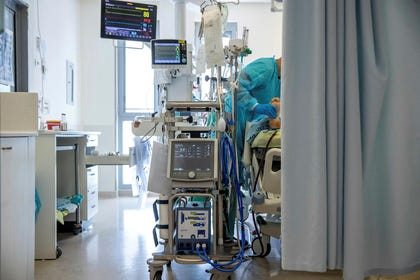
An ECMO machine at the Shaare Zedek Medical Center in Jerusalem. Credit: Ohad Zwigenberg
An ECMO machine at the Shaare Zedek Medical Center in Jerusalem. Credit: Ohad Zwigenberg
The increase in illness is being felt in the hospitals and in HMOs. General hospitals reported 394 new cases of people hospitalized who tested positive for the A strain of the flu virus in the last week of November. In addition, there were 106 new cases of people with the RSV virus, which causes infections of the respiratory tract and is more common in children and infants, and 18 cases of people testing positive for the coronavirus.
Two infants – one 8 months old and the other 13 months – are now being treated in the intensive care department of the Rambam Health Care Campus in Haifa for complications from the flu, and they are on ECMO life-support machines. A third baby was attached to an ECMO machine last week because of complications from measles and is still in serious condition. A fourth infant is also attached to an ECMO machine at Rambam due to a medical problem not caused by a virus. The department said they have not seen such numbers since the COVID pandemic.
The pediatric wards at the Hadassah University Hospitals in Ein Karem and Mount Scopus in Jerusalem now have children of all ages with complications from the flu. They are in stable condition, and some need respiratory support. A child one and a half years old is in critical condition in Hadassah Ein Karem due to complications from the flu and is on a ventilator and under sedation. A two-year-old is also in critical condition in the same ward, and a five-year-old girl with an active case of measles is hospitalized there in serious but stable condition.
The spread of the flu is also being felt outside the hospitals: The Center for Disease Control has reported a steep and earlier than average rise in clinic visits for flu-like illnesses, along with an increase in upper respiratory infection and pneumonia cases. The number of HMO visits for pneumonia has also already passed the multi-year average.
“We are seeing the A strain of the flu virus coming significantly early this year,” said Dr. Shirley Shapira Ben David, the head of infectious diseases for the Maccabi Health Services HMO. “If last year we saw the peak of the flu infections at the end of December and in January, this year we are witnessing exceptional and high morbidity that began back at the beginning of November. At this stage of the beginning of the winter, the morbidity is exceptionally high, and we feel it in the clinics, too,” she added.