
TNM has followed this case from the start. For verified and timely updates and legal explanations, join our WhatsApp Channel.
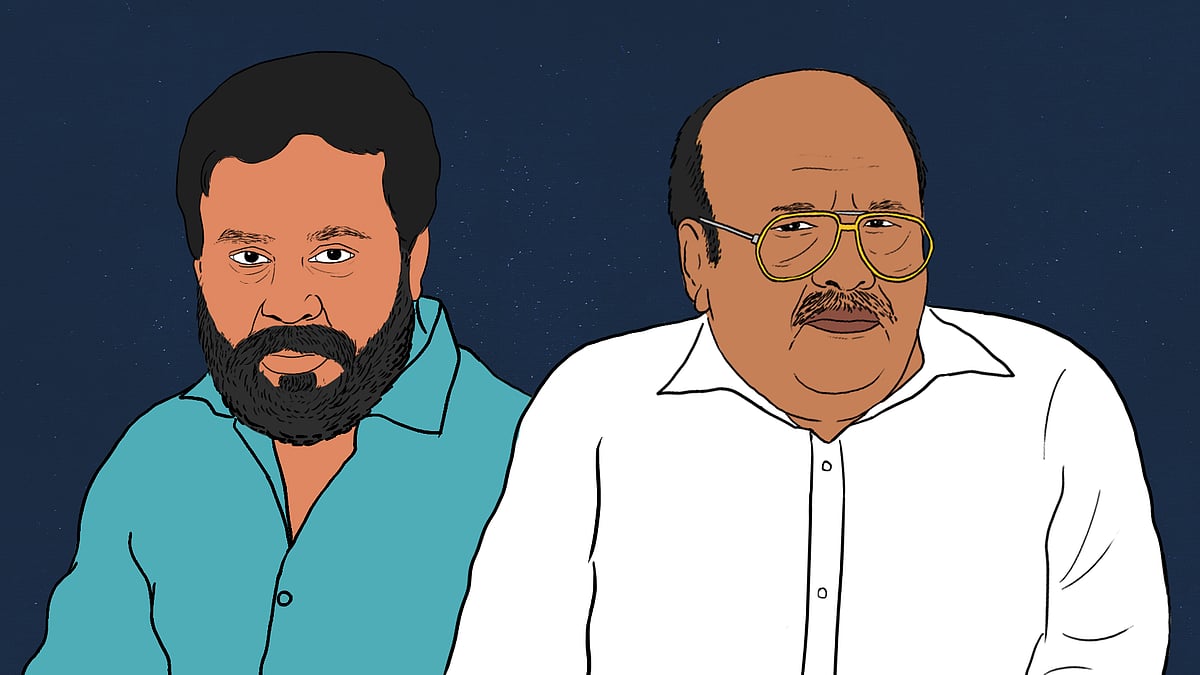
After his acquittal in the actor assault case, Malayalam actor Dileep went straight to meet the man he said he “owes his life” to: senior advocate B Raman Pillai. Arriving at his home, the actor walked to where the lawyer sat smiling, kissed him on his cheek, hugged him, and touched his feet.
It was on December 8 that the Additional Special Sessions Court in Ernakulam pronounced the verdict in the case. Dileep had been accused of commissioning the abduction and sexual assault of a female colleague, but Judge Honey Varghese cleared him of all charges. The Special Investigation Team (SIT) had spent years building its case, two prosecutors had resigned citing what they described as the court’s bias towards the accused, and in the final days of the trial a whistleblower appeared in court claiming that Dileep was the mastermind behind the crime.
As Dileep’s acquittal triggers fresh debates on the strength of the evidence, the court’s reasoning, and the prosecution’s failures, this lawyer deserves close attention. Senior advocate B Raman Pillai, a lawyer in his seventies, led Dileep’s defence and, despite persistent allegations of witness intimidation, survivor shaming, and other aggressive tactics, ensured that his client walked away unscathed.
When TNM first met Raman Pillai at his office in Ernakulam’s Kacheripady, he was just returning from court. A junior carefully assisted him from his car, and he walked slowly into the building, evidently troubled by his health and age, a pack of cigarettes clutched in his right hand. He smiled and politely told us that he didn’t think there was much to profile in his life. He still agreed to an interview and gave us an appointment for a week later. Only, the next week he asked for it to be pushed to the next week, and then the next and the next, for almost a month.
At the next meeting, he told us that he is averse to publicity. “I am dogged by such requests all the time. There are many journalists after me, but I don’t encourage anyone,” he said. But never did he utter a definitive “no”. It was always, “I am busy at the moment, come later.”
When we finally sat down for an interview, Pillai said, “Let me get to know you first.” He opened a fresh page in his diary to jot down our name and number, and even cracked a light-hearted joke.
Looks can be deceptive, especially in a court of law. This seemingly jovial man may not fit everyone’s mental image of the undefeated criminal lawyer, but he has quite successfully cultivated that aura about himself.
Those who have witnessed him in court offer diverse accounts. One day, he might exude the calm of a monk, whereas another day he would tear into those he was cross-examining. Witnesses have often raised the point of being intimidated by him in court. Yet the consensus is straightforward: Pillai does what he needs to as a criminal lawyer to win a case.
Despite having the tag of a ‘lawyer for the criminals’, he is admired and looked up to for his professional skills, especially his sharp memory, in the legal fraternity.
The media often portrays him as a legal giant whose involvement in a case guarantees the victory of his clients.
But is that true? Is success really a guarantee? How much is mere urban lore? Who is B Raman Pillai really?
This is a look at the lawyer’s long, controversial career. A man who has defended the accused in some of Kerala’s most sensational and divisive cases: the Sister Abhaya murder, the TP Chandrasekharan murder, the Nisham Hummer killing, and the Bishop Franco rape case.
Politics no bar
Raman Pillai has always stayed on the defence’s side for the entirety of his career, with just one exception—the Puthoor Sheela murder case of 2010, in which he appeared as the special public prosecutor. The deceased Sheela was the sister of a top bureaucrat in the state. The case had also earned notoriety after the first accused, 26-year-old Sampath, was brutally tortured and murdered in police custody.