
Your support helps us to tell the story
From reproductive rights to climate change to Big Tech, The Independent is on the ground when the story is developing. Whether it’s investigating the financials of Elon Musk’s pro-Trump PAC or producing our latest documentary, ‘The A Word’, which shines a light on the American women fighting for reproductive rights, we know how important it is to parse out the facts from the messaging.
At such a critical moment in US history, we need reporters on the ground. Your donation allows us to keep sending journalists to speak to both sides of the story.
The Independent is trusted by Americans across the entire political spectrum. And unlike many other quality news outlets, we choose not to lock Americans out of our reporting and analysis with paywalls. We believe quality journalism should be available to everyone, paid for by those who can afford it.
Your support makes all the difference.Read more
Searching for evidence of life on Mars should be the main scientific objective for the first human missions to the Red Planet, according to a major new report.
The report from the National Academies of Sciences, Engineering, and Medicine (NASEM) provides the strongest case yet for sending people to the surface of Mars, rather than just rovers and robots.
Crewed missions could engage in activities and make scientific discoveries that would be otherwise impossible with robotic exploration tools alone, the report’s authors noted.
“The first human landing on Mars will be the most significant moment for human space exploration since we first set foot on the Moon over 50 years ago,” said Linda T. Elkins-Tanton, a principal investigator on Nasa’s Psyche mission, who co-chaired the committee that wrote the report.
“Our report puts science at the centre of what will be a remarkable achievement, and outlines the incredible knowledge we’ll have the opportunity to glean about our place in the universe, the potential habitability of Mars, and so much more.”
open image in gallery
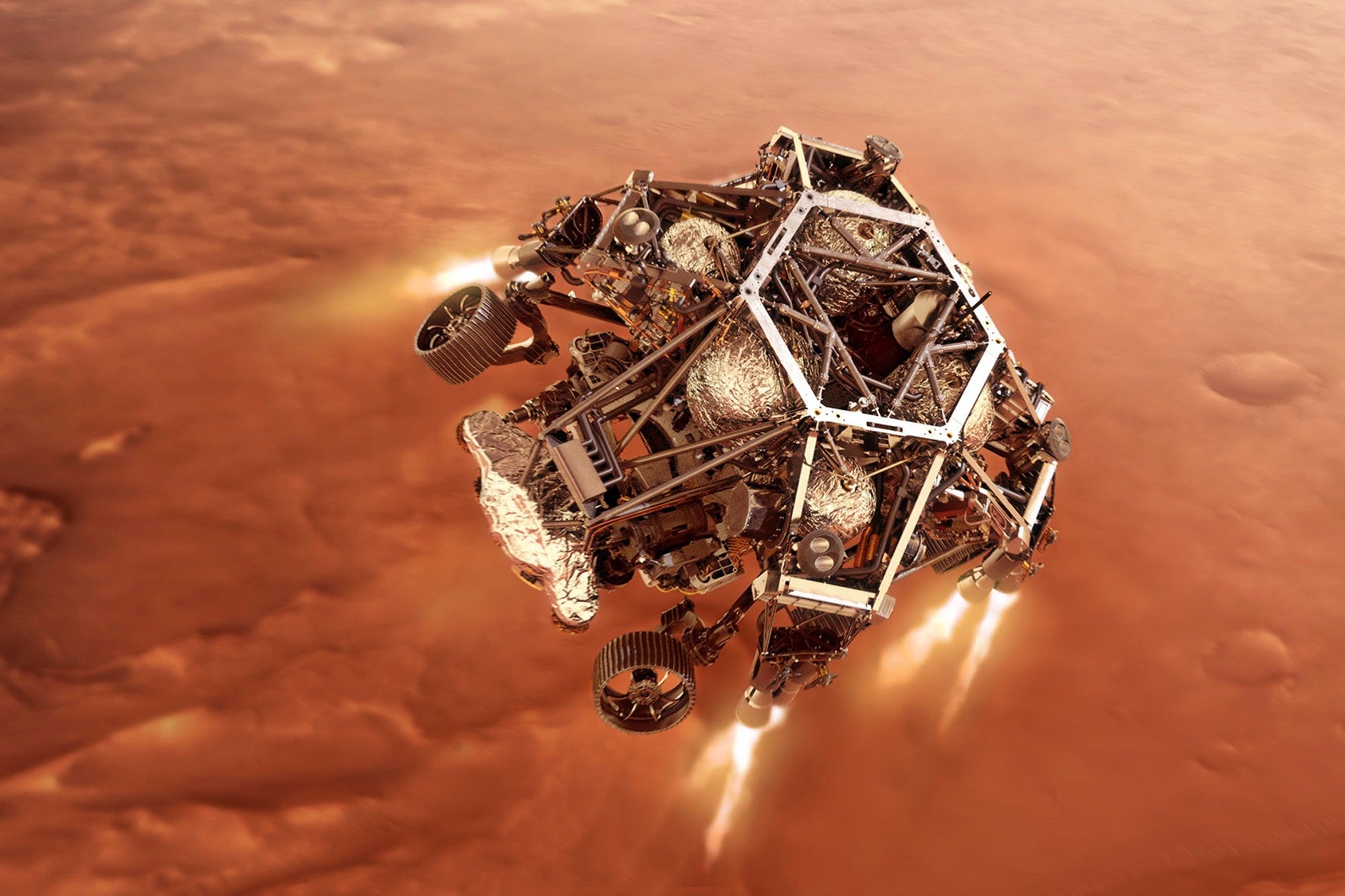
A concept illustration of Nasa’s Perseverance rover on its descent to the Martian surface (Nasa via Getty Images)
The 240-page report, titled ‘A science strategy for the human exploration of Mars’, offers recommendations to Nasa as the US space agency prepares its roadmap for sending astronauts to the Martian surface in the 2030s.
The report’s authors outline 11 science priorities for future crewed missions to Mars, ranging from searching for resources like water, to radiation sampling and assessing habitability.
These objectives could be achieved across four possible three-mission campaigns, made up of both crewed surface missions and uncrewed cargo delivery flights to different sites on Mars.
All mission proposals include the setting up of a science lab on the surface of the Red Planet, as well as returning samples back to Earth for further analysis.
“By imagining different ways that priority science could be pursued during actual human missions, our report shows there are many different options for humans to explore Mars and achieve great scientific breakthroughs,” said committee co-chair Dava Newman, a professor in the Department of Aeronautics and Astronautics at Massachusetts Institute of Technology (MIT).
“Importantly, it also offers a synergistic review of science priorities enhanced by human exploration.”