
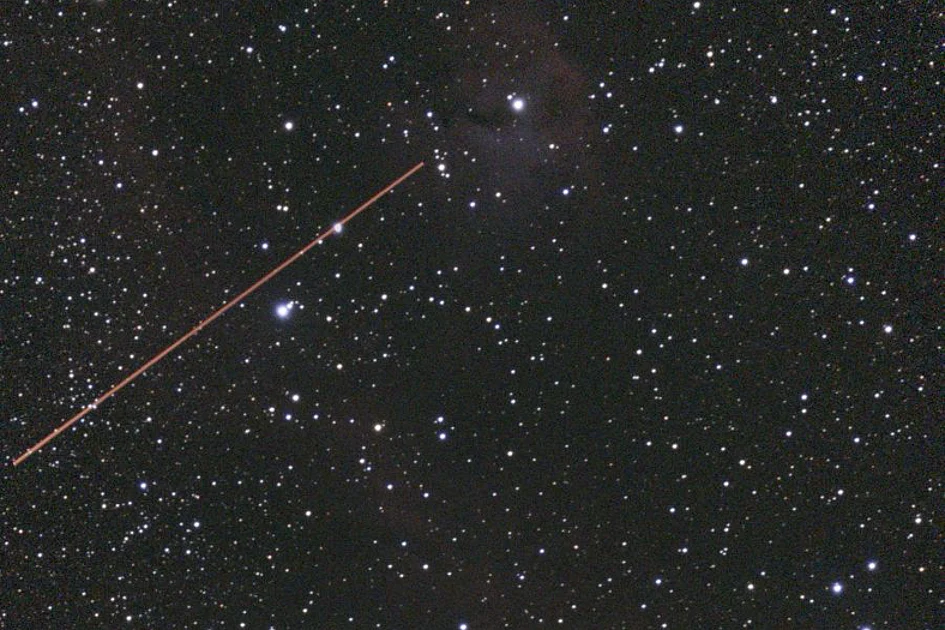
Hundreds of UAE residents made their way to the desert on Saturday evening to watch the Geminids meteor shower, as thousands of shooting stars lit up the night sky in a truly remarkable end-of-year spectacle. Driving in from different emirates, and armed with blankets and food with the sky as their roof, residents they lay down amid the vast Al Qudra dunes to marvel at the wonders of the universe, up until around 2am.
More than 300 residents showed up to the event organised by the Dubai Astronomy Group, where ‘blink and you’ll miss it’ was truly the motto of the meteors. As flashes of light streaked across the cosmos, the crowd erupted in unison with exclamations of delight — and sighs of disappointment for those who happened to look away for a second.
Russian expat Natalia’s family were, in a manner of speaking, in those very skies just hours ago. Her husband and kids made their way to the desert straight from Dubai airport, having flown in from London a few hours prior.
Stay up to date with the latest news. Follow KT on WhatsApp Channels.
“My granddad was an astronomer, so the stars were always an important part of growing up,” said Natalia, who moved to the UAE in 2022. “I wanted to pass on that same heritage and love for the unknown to my children.”
While there have been plenty of meteor showers in the UAE, they often took place when her husband and kids, who live in the UK, were away. This time, the stars did align in a “lucky coincidence” for the family.
Several families turned out in similar fashion, with parents eager to pass on a passion for space to their kids. Indian-French siblings Riya and Rithi were among those who had their gaze fixed on the sky, and their ears tuned to the mythological stories behind the shower.
Two years ago, the family had made their way to Al Qudra to watch a meteor show on their own. When they heard of the event organised by Dubai Astronomy Group, they decided to make the trip in a quest to not just sight the lights, but also gain more knowledge.
“One of the reasons why I want the kids to gain some interest in astronomy is so they realise that the problems we have are so small, as compared to the vastness of the universe,” their mother, Supriya Aggarwal, said. For their father, Raja Aggarwal, it was also about “making memories as a family”.
Riya and Rithi were thrilled to hold an actual meteorite “from literally out of the world”, handed out by DAG. According to the group, the meteorite (see below) is millions of years old and worth thousands of dirhams.

Chinese expat Ivan is just three months into living in the UAE. After having worked in China as an amateur astronomer for over 10 years and who organised space events of his own there, one of the things on his ‘moving to-do list’ was to find a similar experience in Dubai, he said.
Ivan came to Al Qudra for the Geminids on both days of the event, and was one of the first to arrive at the spot. “I have never done something like this so far from the city,” Ivan said. In China, events like this were often held in mountains or just in the city outskirts, he said.
The 30-year-old Chinese expat was in awe of the large scale of the event in Dubai, and the palpable excitement in the air. He echoed the sentiment of being constantly being amazed by the universe, and reminded of “how small we are”.
The meteors are “timeless”, Ivan added, describing them as travellers who came a very long distance to meet humans.
The Geminids shower is not just about the viewers; it’s also about the volunteers who put in considerable efforts behind the scenes to enlighten audiences with interesting scientific facts and age-old legends, help them set up camp, and take memorable photos.
Twelve-year-old Safiya has been volunteering with Dubai Astronomy Group for “the past 4 or 5 years”. The young enthusiast can be found at the check-in desk, assisting those who registered with their wrist bands, and event information; she may also be found helping set up snacks at the cafe.
With her parents working at DAG, volunteering at space events is the perfect outing for the 12-year-old who is fascinated by Greek mythology, and the stories behind the skies.
For David, a 16-year-old volunteer who now studies astrophysics, working with the telescopes and watching people search the skies for the first time is always rewarding.
“When I see them looking at the sky for the first time, it reminds me of the first time I viewed the skies through a telescope,” he explained. David also experiments with astrophotography, both with shots of the moon, and deep-sky objects.
With academics taking up his week, he volunteers on weekends. It is not without hurdles; long queues and cloudy weather can prove challenging to astrophotography, David said. The planet Jupiter is particularly difficult to capture, he added.
While photographic telescopes capture deep-sky objects with multiple images stacked together, to get more light and detailing, astrophotography enthusiasts can also take pictures on their phone through observational telescopes, David said. (See this reporter’s shot below of a nebula, for example!)
To do so, night mode must be turned on, and the shot must last for around 30 seconds. The phone must be kept steady.


Poojaraj Maniyeri is a Digital Journalist who loves turning everyday conversations into news stories. She is also a typical bookworm, and brings a novel with her everywhere she goes.