
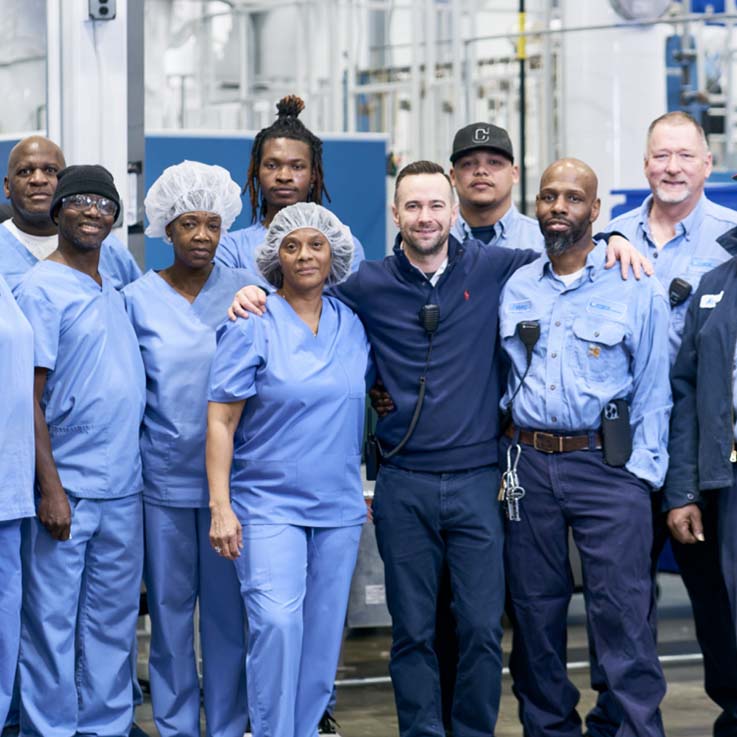
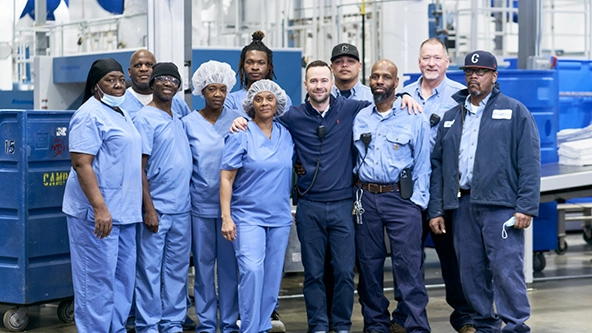
Worker owners at Evergreen Cooperative Laundry in Cleveland, Ohio, a commercial laundry owned by its 200 workers. (Photo by Collin Arnold, courtesy of Evergreen)
It’s a sign of the times when the board of Tesla grants billionaire Elon Musk an eye-popping trillion-dollar pay package, even as New York’s new mayor, Zohran Mamdami, wins an election with rhetoric that includes a call to tax the rich.
With wealth inequality reaching alarming new heights comes the question of what to do, and it’s another sign of the times when someone like billionaire Mark Cuban publicly calls for sharing wealth with workers. Responding to Oxfam’s news that billionaires’ wealth has increased by $33 trillion in a decade, Cuban went onto X to say it’s time that workers get a piece of that bounty, asking, “Why are we not giving incentives to companies to require them to give shares in their companies to all employees?”
As if on cue, Samsung, the global tech giant, recently announced it would award stock and bonuses to all workers—the first time it’s awarded stock to all staff, not just executives. Estimates by Fortune show this could amount to $20,000 for each of its 260,000 employees globally. The company’s move was a response to pressure from workers after its smaller rival, SK Hynix Inc. (provider to Nvidia) began giving 10 percent of annual profits to employees in bonuses in 2021.
Worker ownership as a form of broadly based capital ownership isn’t a new idea; worker cooperatives have been around for 250 years, and Ronald Reagan advanced employee stock ownership plans (ESOPs) more than 40 years ago. But the tides have changed. Today, artificial intelligence threatens to further eviscerate labor, the political consequences of billionaire power are ever more apparent, and the greatest transfer of wealth in history is underway. And when even big capitalists like Cuban and globe-spanning firms like Samsung recognize capitalism isn’t working for workers, it’s clear a new cultural moment is opening—a moment when worker ownership might take on a new sheen of possibility and promise.
Are you enjoying this article? Read more like this, plus SSIR’s full archive of content, when you subscribe.
A Proven Idea in Waiting
The Democracy Collaborative has been working to advance worker ownership for two decades, starting with helping launch a network of worker-owned cooperatives called the Evergreen Cooperatives
in Cleveland, Ohio—the second poorest city in the United States. Evergreen pays living wages and provides extensive training in financial literacy and management skills, with the aim of empowering workers to develop into leaders, and it often promotes supervisors from within. In 2018, workers at Evergreen Laundry delivered such high-quality service that they won a contract to do virtually all the laundry for Cleveland Clinic, a massive regional nonprofit medical center—and they’ve taken home annual bonuses of $8,000 to $11,000.
ESOPs like Evergreen Laundry are under-recognized, wealth-sharing machines that benefit both workers and companies. Research shows that employee-owned companies enjoy higher sales growth, improved return on assets, and lower employee turnover. These firms are also less likely to lay off workers in times of crisis, and benefit communities by hiring and reinvesting locally and recirculating wealth.
ESOP trusts currently hold $1.8 trillion in assets, according to the National Center for Employee Ownership (NCEO). In the United States, major companies offering stock to virtually all workers include Verizon, Starbucks, Genentech, and Bank of America. Companies where workers own the majority of company stock include W.L. Gore, King Arthur Flour, Dansko, and Bob’s Red Mill.
Yet, despite some growth in assets and participants among these and other ESOPs, the total number of ESOPs has been stagnant for decades. And while worker cooperatives are growing in number—tripling in the last decade, according to the Democracy at Work Institute—in aggregate, they’re a blip on the landscape, with just 1,300 worker co-ops employing 15,000 people.
Still, there are signs of a ripening moment for worker ownership. Today, for example, there are 24 state-level centers for employee ownership—compared to 8 centers 6 years ago—thanks to the nonprofit Employee Ownership Expansion Network, whose mission is to create a network of state centers. At the federal level, a half dozen congressional bills are proposing ways to advance employee ownership, and these efforts enjoy bipartisan support. The new secretary of labor, Lori Chavez-DeRemer, is also a long-time supporter of employee ownership.
In addition, as conditions in the economy and society become more dire, people are looking for solutions. In response to widespread concern over wealth and power inequities, many policy makers, like Mamdami, are turning their gaze to taxes. At the federal level, lawmakers have introduced the Billionaires Income Tax Act, which would ensure that the super-wealthy are taxed every year on realized gains, no longer permitting them to endlessly defer. And a number of states— including Massachusetts, Minnesota, New York, Rhode Island, and Washington state—have raised taxes or created new taxes on high-income earners. Seattle residents in 2025 voted to levy a new tax on companies paying executives excessive pay and to use the proceeds for affordable housing.
Yet as necessary as taxing is, it’s an end-of-pipe solution; it fails to address the underlying issue of where wealth comes from in the first place. In large part, it comes from ownership—of homes, businesses, and other assets. With ownership of homes priced beyond reach for many Americans, and when 60 percent of Americans don’t have the currency to handle a $1,000 emergency, an important remaining path to wealth accumulation is ownership of the place where you work.
Why Business Conversion Is Key
A few years back, Jessica Rose, CFO of Global Impact Investing Network, and I convened and conducted 50 interviews with consultants, nonprofit leaders, company presidents, and fund managers specializing in the field to better understand what it would take to jumpstart growth of employee ownership. Our research and subsequent experience led to several observations and conclusions that we believe inform the path ahead—a path that has become more obvious, more necessary, and more possible in recent years.
First, employee-owned startups are a hard road, prone to failure, and slow to grow. The surer route to success is converting existing, privately owned companies into employee-owned companies. But who has the agency to convert them? Workers often don’t understand ownership and lack capital to buy firms, and the traditional ESOP approach has been to educate exiting owners, relying on them to do the hard work of hiring consultants, finding the capital, overseeing the sale, and supplying part of the debt that funds the sale. That, too, is a hard road, requiring huge effort from folks who are already running a business and ready to retire and relax.
The missing agent is active capital—not passive bank debt but funds out there looking to acquire and convert firms. As my colleagues and I wrote in a 2021 report, “Opportunity Knocking,” exiting owners need a knock on the door from someone who’s ready to buy their business and take care of the rest themselves. Then—just like private equity firms or corporate competitor sales—all exiting owners need to do is say yes.
The Democracy Collaborative’s work has proved this out. In 2009, it helped develop the Evergreen Cooperatives in Cleveland via three startups, but only one has grown and thrived. A decade later, our organization helped Evergreen design and launch the Fund for Employee Ownership. The fund has since purchased five firms, converted them to worker cooperatives, and pulled them into Evergreen’s supportive network.
The good news is that active capital is gaining traction as the route to growth. In 2021, 13 investment funds focused on employee ownership. Today, a Harvard Business School report shows that 53 funds in North America provide employee ownership funding. At the same time, impact investors—via “ownership lens investing”—are beginning to incorporate broad-based ownership into their choices. The new Ownership Capital Lab has a vision of growing capital for employee ownership to $1 billion in five years.
One particular—and massive—opportunity to convert existing businesses to worker ownership comes with a generational shift: More than half of all US businesses have owners over age 55 who face retirement in 10 years. According to Project Equity, businesses owned by people over 55 total 2.9 million, with 32 million workers. Most owners find their children don’t want the business, and only 20 percent of those who try to sell will find a buyer. Up to 80 percent could close. If just 10 percent of these “silver tsunami” businesses move to employee ownership, 8.2 million workers might enjoy the wealth they help create—or, as Alison Lingane of Ownership Capital Lab says, “build the ownership economy.”
Strategies for Scaling Worker Ownership
Active capital is fundamental to scaling worker ownership, but the right approach to making a shift depends on company size. Large corporations, for example, need no outside capital but instead need incentives to share equity with workers. One project pursuing strategies here is Expanding ESOPs, a coalition examining legislative remedies.
To increase conversions among lower middle market companies, targeted financing funds are an effective avenue. Examples include Mosaic Capital Partners, the largest and oldest with total assets under management at $370 million, and Apis & Heritage, a newer fund aiming to convert firms that employ large numbers of Black and Brown workers. A wide range of investors, including family offices and inheritors in the $124 trillion Great Wealth Transfer, can invest in funds like these, which are now open only to qualified investors. Foundations can also help launch funds that support worker ownership; Kendeda Fund (now spent down), for example, gave $24 million to help start four.
Smaller firms, where ESOP administration (including valuation, worker accounting, and trustee services) is too expensive and worker cooperatives are more appropriate, have so far been largely left out of the financing equation. This is why Democracy Collaborative is exploring work with the Fund for Employee Ownership to show how converting smaller companies can close the wealth gap for Black workers and communities.
In addition, nonprofits, churches, and universities can incorporate employee ownership programming and advocacy into their work on issues like community stability, wealth inequality, and the racial wealth gap. Aspen Institute, for example, created an annual Employee Ownership Ideas Forum, and Harvard recently launched The Ownership Project at the Institute for Business in Global Society. Morehouse College and University of California Riverside are both active in the Black Employee Ownership Initiative launched by Project Equity, as are cities such as Atlanta, Los Angeles, and St. Paul.
As a society, we face an opportunity to decide which direction we want to go. If we sit on the sidelines and stick to business as usual, it’s a pretty sure bet we’ll see a future of greater and greater wealth concentration. If we make the most of today’s opportunities to grow employee ownership, we can instead move toward an ownership society of broadly shared wealth and prosperity.
Support SSIR’s coverage of cross-sector solutions to global challenges.
Help us further the reach of innovative ideas. Donate today.
Read more stories by Marjorie Kelly.