
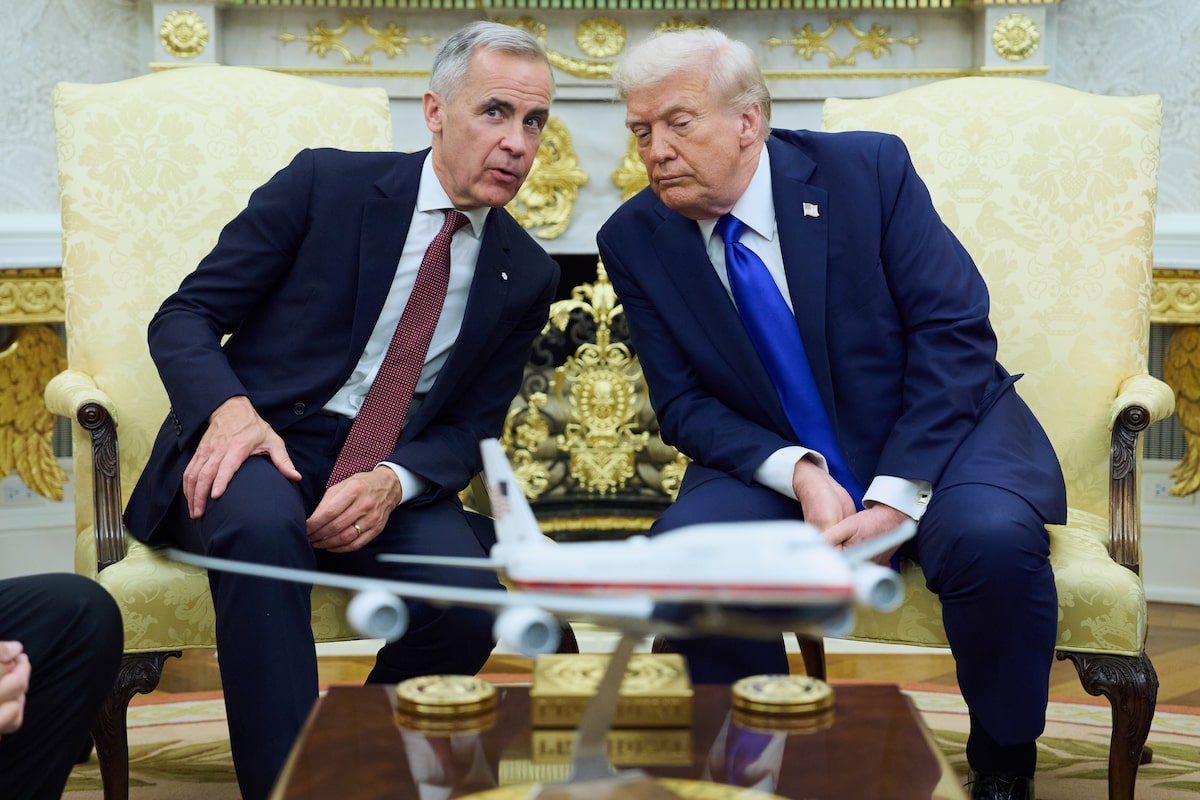
Prime Minister Mark Carney and U.S. President Donald Trump in the White House on Oct. 7.Evan Vucci/The Associated Press
Tariffs imposed by the United States have priced Canadian exporters out of their most important market, stalled hiring, bankrupted small businesses and lifted costs for households already stretched by inflation. This has been, by many measures, one of the most challenging periods in recent history.
Before long, Canadians may look back on it with a degree of fondness. On July 1, 2026, a mandatory review of the Canada–U.S.–Mexico Agreement will determine whether the next decade unfolds under predictable rules or a prolonged period of recurring uncertainty.
Unlike the torrent of deadlines and threats of deadlines that have persisted since Donald Trump was returned to the Oval Office, the 2026 review carries formal weight – and will bring attention to a ticking time-bomb provision offered as a major concession to the U.S. trade team in the 2017 renegotiation of NAFTA.
In a last-minute bid to keep the U.S. from walking, Ottawa and Mexico City agreed to a measure that allows the deal to be reopened or fundamentally altered – shifting trade policy away from permanence and toward frequent tests of political approval. If no agreement emerges from the review, the deal could be revisited each year until USMCA expires in 2036.
The measure in question – Article 34.7 – is without precedent in modern free-trade agreements, and a powerful option to the benefit of precisely one country. Robert Lighthizer, then the U.S. trade representative, described it as a “paradigm-changing” mechanism designed to prevent trade arrangements from becoming permanent by default.
Carney rejects idea Trump wants to exit USMCA
Article 34.7 arms the Trump administration with an actual trump card. And as Ottawa and Mexico City pursue a trilateral deal in the run-up to the July review, U.S. negotiators can play it as often as they want.
The current negotiation is being shaped by a fundamentally new relationship with a country that no longer views trade as a question of mutual gain. That was made clear in March, when the U.S. imposed tariffs on many Canadian goods under the cover of national security threats. But the clock started ticking in 2017, when Canada and Mexico agreed to the sunset clause.
Ben Rowswell, a former Canadian diplomat and now a consultant with Catalyze4, a strategic advisory and leadership development firm, said the U.S. is ruling out any “kind of arrangement of equality” and is instead seeking to negotiate a deal that will help establish its dominance in the Americas.
The disputes Canada faces could spill out of the economic realm, involving political or security demands that would have been unthinkable under previous frameworks. Those are the unsettling stakes facing Canadian politicians, who have spent the year navigating volleys of executive orders; last-minute reprieves; tariffs both threatened and imposed.
But for all those efforts have achieved – microscopes at the ready – Team Canada’s messaging has held the familiar line: tariffs raise costs for U.S. consumers, American firms need steady access to Canadian goods, and mythical “adults in the room” will ensure decades of integration and shared economic interests will continue to guide U.S. policy.
Those reassurances sit uneasily with reality. The collapse of steel talks in October showed that Washington expects permanent tariffs, and that Canada cannot count on securing even that level of certainty. Countries that depend far less on the U.S. market have already accepted permanent tariffs. The stability Canadian consumers feel today is built on temporary exemptions that exist only on Washington’s sufferance.
Canada has sought leverage in its foundational sectors, highlighting the many key natural resources the U.S. depends on – oil and gas, critical minerals, electricity. That case is meant to demonstrate mutual reliance. Canada is saying: We have what you need. The U.S. is saying: Oh, we know.
Canadian companies cannot buy more time, but they can determine how resilient they are when the clock runs out. The next year presents an opportunity to diversify supply chains, broaden market reach, and assess where intellectual property, financing and operations are most vulnerable. The alternative is to follow a dangerous assumption that history, tradition and widely held economic logic will prevail.
None of these measures can be achieved overnight. But political and business leaders should see this period for what it is: the final stretch of what might be the most favourable trade deal that Canada will ever have with the United States.