

Published
19/12/2025 às 17:25
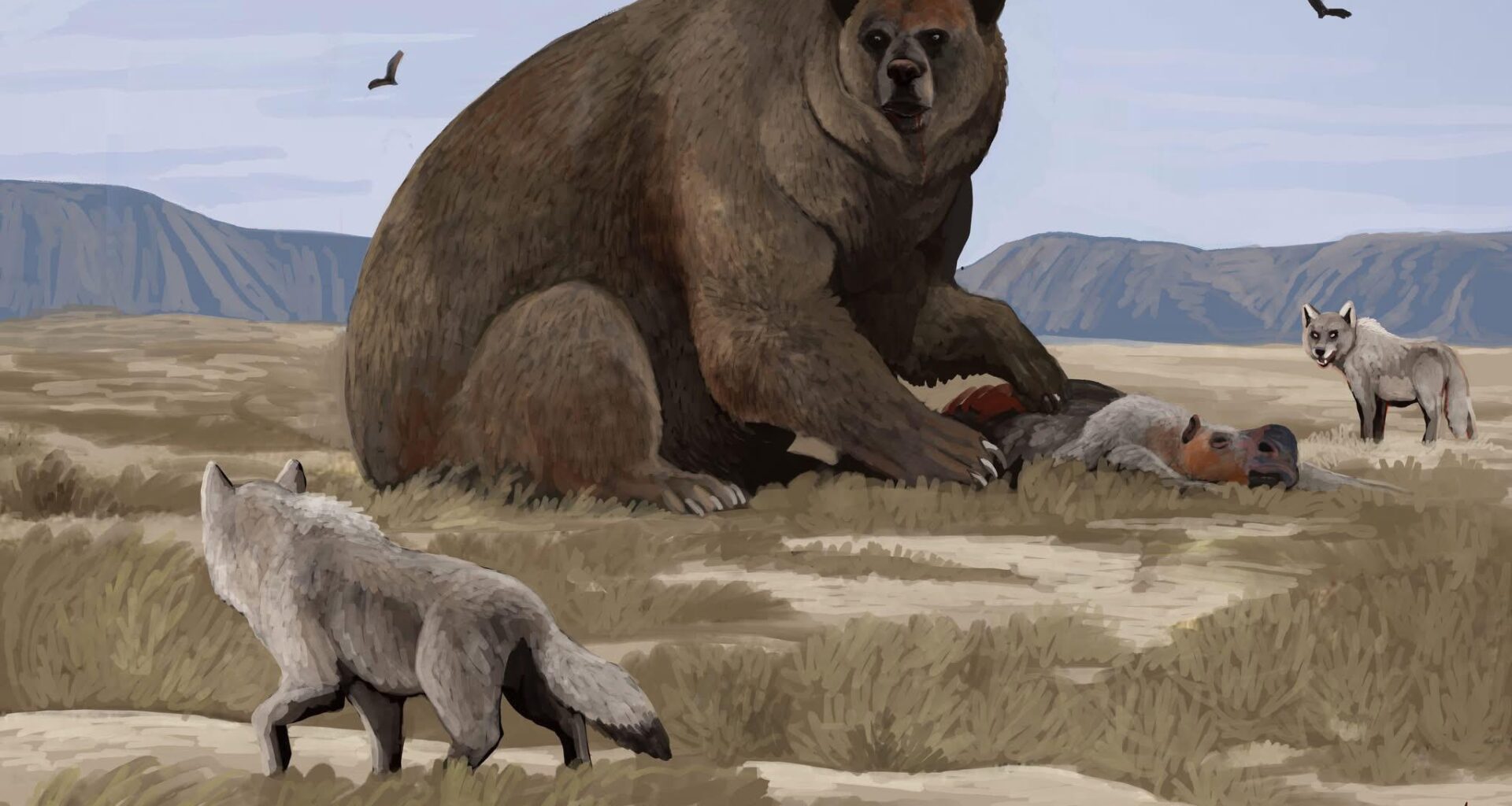
Long before polar and brown bears dominated forests and icy regions, a terrestrial colossus roamed South America and completely redefined the size limits among terrestrial carnivores. Arctotherium angustidensThe prehistoric short-faced bear is now recognized by science as the biggest bear that ever existed — surpassing any living or extinct species in body mass.
The largest fossils attributed to Arctotherium angustidens indicate an animal capable of reaching between 3,4 and 3,5 meters tall when standing on its hind legs.. Its weight is estimated to be between 1.300 and 1.600 kilospossibly having exceeded 1,5 ton in the most extreme individuals.
For comparison, an adult male polar bear rarely grows larger than 700 kgThis means that Arctotherium could be more than twice the weight of the largest bear currently alive.
— ARTICLE CONTINUES BELOW —
See also other features
Reaching up to 15 meters in length, weighing an estimated over 40 tons, and possessing a jaw capable of crushing bones, was the Megalodon truly the largest shark that ever existed in the oceans? Find out!
With a full scholarship estimated at R$2 million, a student from the Brazilian public school system is accepted to Harvard and breaks down barriers to accessing the world’s academic elite.

Henry, the world’s oldest crocodile, is 124 years old, five meters long, and weighs a ton. He has fathered over ten thousand offspring and still rules the tank like a prehistoric monster who seems simply immortal.
Since 2015, brightly colored cars have been banned by law, and only white vehicles are allowed to circulate in Ashgabat, the capital of Turkmenistan.

Where did he live and when did he dominate the continent?
Arctotherium angustidens lived during the Lower Pleistocene, there are about 2 million to 1 million years, a period marked by large, giant mammals, such as giant sloths and mastodons.
Their fossils were found mainly in Argentina, Uruguay and parts of Brazil, indicating that it occupied vast areas of South America in an environment rich in large prey.
The anatomy of a superpredator
Despite its colossal size, Arctotherium was neither slow nor clumsy. Its anatomy combined:
wide and short skull, typical of short-faced bears;
extremely robust jaw, capable of crushing bones;
long and muscular limbs, ideal for quick movement across open terrain;
large claws, useful both for hunting and for competing for carcasses.
This combination placed it at the absolute top of the terrestrial food chain at the time.
Dominant hunter or scavenger?
Studies indicate that Arctotherium angustidens was opportunistic omnivore, but with a strong tendency towards hypercarnivoryHe probably:
It hunted large, weakened herbivores;
It easily drove other predators away from carcasses;
It competed with saber-toothed cats and large prehistoric canids — almost always having the advantage due to its size.
The mere presence of an adult individual would be sufficient for to keep any other carnivores away from the territory..
Why did it reach such an extreme size?
The gigantism of Arctotherium is explained by a rare combination of factors:
abundance of herbivorous megafauna;
absence of competitors of similar size;
Favorable climate and vast open plains;
Evolutionary advantage of size for territorial dominance.
This combination allowed the species to surpass all known limits for bears.
The extinction of the largest bear in history.
Arctotherium angustidens disappeared long before the end of the Pleistocene. Climate change, a reduction in megafauna, and rapid environmental alterations made the survival of such a large carnivore, dependent on bulky prey, unfeasible.
With its extinction, No other bear has ever reached similar proportions again.Not even the largest modern bears.
Arctotherium angustidens represents the absolute pinnacle of gigantism among bearsHe was not only the greatest of his group, but one of the largest terrestrial carnivores that ever walked the Earth.
Its existence proves that, at certain points in natural history, evolution took size to extremes—creating creatures that today seem almost impossible.